The “Solar Graveyard” Warning: Upcoming EPA Regulations on Battery Disposal
January 30, 2026
2026 Market Outlook: Why Tier-1 Solar Panel Prices are Changing
February 2, 2026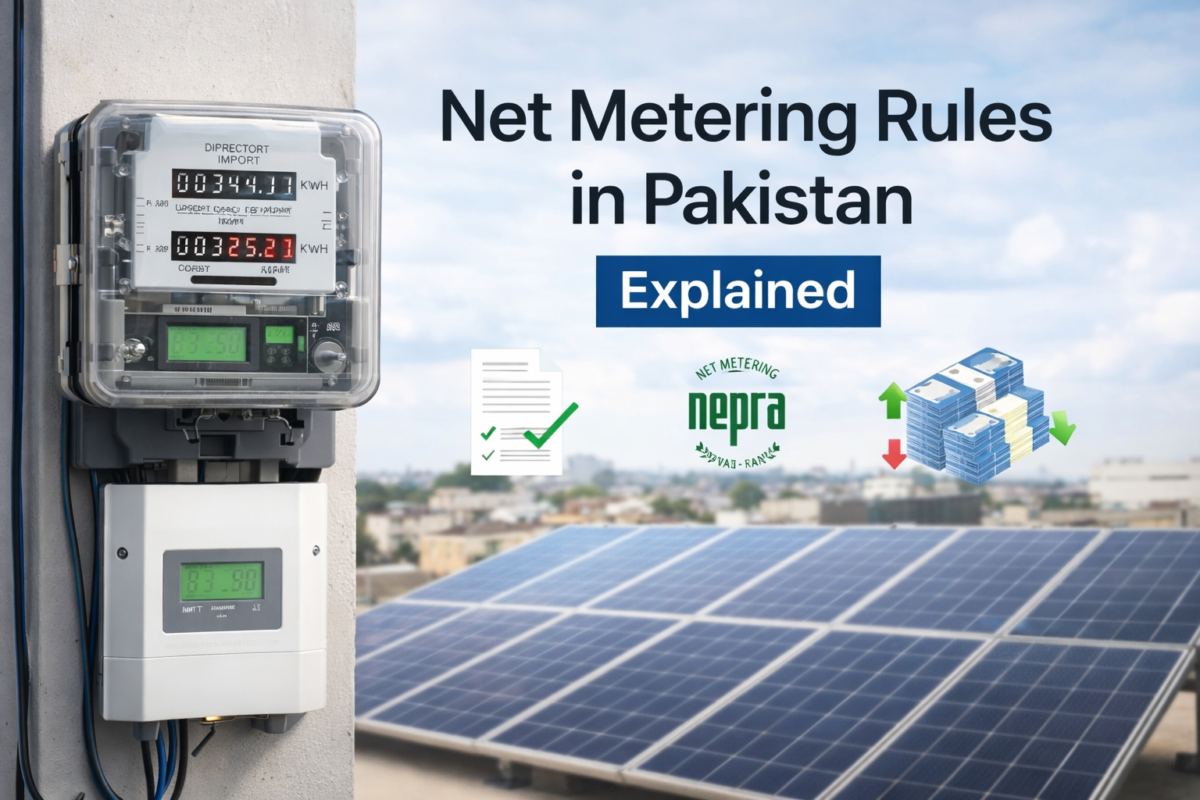
A brief explanation of net metering in Pakistan is possible. Solar energy is produced by the installation of solar panels. Excess units are sold to the electricity distribution company. A rebate is received on the electricity bill. Though the above statement is not harmful, it lacks the most important point. An identified regulatory framework applies to net metering.
Most solar users understand the concept but not the legal principle involved. This is the root cause for late submission, failure to pass inspection, and the disparity between expectations and reality, which, in many cases, could be prevented.
This resource helps you understand how net metering is regulated in Pakistan. All of this information is provided in a manner that you can easily understand. Finally, by completing this resource, you will know everything about net metering and what you must be aware of before applying for it.
What does Net Metering Mean Under Pakistan’s Electricity Framework?
Net metering allows electricity consumers to connect solar panels to the grid and exchange electricity with the national grid. When your solar system produces more electricity than you consume, the surplus flows into the grid. When your consumption exceeds solar production, electricity is drawn from the grid as usual.
The most important point is that net metering is a billing mechanism. It is not a backup power solution, and it is not a way to earn money. Instead, it helps reduce long-term electricity costs and plays a direct role in improving the solar payback period in Pakistan by offsetting units over time rather than generating cash income.
Pakistan introduced net metering to encourage renewable energy while maintaining grid stability. This balance explains why clear rules exist around system size, equipment standards, and approvals.
Who Regulates Net Metering in Pakistan?
The net metering system is governed by NEPRA in the context of a country like Pakistan. This defines the legal structure and compliance requirements under Pakistan’s solar policy framework, setting clear rules for eligibility, system sizing, and grid interaction.
Distribution companies, or DISCOs, are charged with implementation. They are responsible for processing applications, inspecting systems, installing bidirectional meters, and granting approvals.
Since each DISCO operates on a different grid with its own load characteristics, enforcement timelines and procedures may vary. This often leads to confusion for applicants. While the policy remains standard nationwide, its practical enforcement can differ by region.
Understanding this distinction helps explain why approval timelines and success rates may vary across different areas of the country.
Eligibility Criteria Under Current NEPRA Regulations
Not every electricity consumer automatically qualifies for net metering. Eligibility depends on the consumer profile and system design.
Residential, commercial, and industrial consumers can apply if they hold an active electricity connection billed directly by the utility. Shared or disputed connections are typically not eligible.
System capacity must fall within limits tied to sanctioned load. Oversizing beyond approved thresholds is one of the most common reasons applications are rejected. Reviewing solar system sizing rules before installation helps avoid this issue.
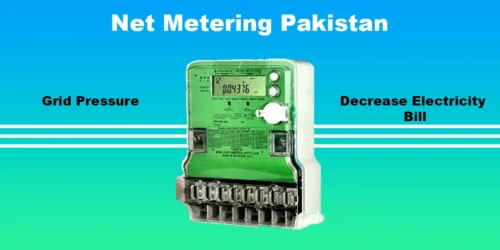
A utility-approved bidirectional meter is mandatory. Standard electricity meters cannot record import and export units separately and will not be accepted.
Technical Requirements Solar Systems Must Meet
Net metering systems must comply with strict technical standards to protect grid safety.
Inverters must support grid synchronization, anti-islanding protection, voltage regulation, and frequency control. Equipment must meet approved standards and be installed according to utility guidelines.
Applications often fail inspection due to unapproved inverters, improper earthing, missing protection devices, or incorrect wiring. Many of these issues occur when systems are installed before confirming approved inverter standards.
Installing first and applying later is a common mistake. If the installed system does not meet requirements, approval may be delayed or denied entirely.
Net Metering Application and Approval Process
There is a sequence of approval. The consumer submits his/her application form along with technical documents, load details, and specifications. The utility organization screens the application form. There is a site inspection.
During the course of inspection, capabilities are verified for system capacity, safety standards, equipment compliance, and installation. After being approved, a bidirectional meter is installed.
Delays usually occur due to incomplete documentation or non-compliant installations. Understanding the net metering application process in advance helps manage expectations and avoid repeat visits.
How Net Metering Billing and Unit Adjustment Works?
Billing is done on the basis of net consumption on a monthly basis. Import units refer to the power intake, and export units refer to the power fed into the net.
If export units are greater than import units within a billing cycle, then such units are rollover credits. The credits are used to settle electricity bills. The credits are not paid in cash.
At the end of the billing year, remaining credits are adjusted according to utility rules. This is why net metering reduces electricity bills but does not generate income. Learning how net metering billing works helps users plan realistically.
Export Rate and Credit Rules Explained Clearly
Exported units are priced at a rate decided under regulations framed by NEPRA. Such a rate is lower compared to the retail tariff applicable to imported units.
The difference is present as net metering is not meant to generate profits. Export credits work to lower the bills, as they generate in the future, not today.
Some installers promote net metering as an income source. This leads to disappointment when credits do not convert into cash. Understanding export unit credit rules protects consumers from unrealistic expectations.
Capacity Limits and System Sizing Rules
System capacity must align with the approved load. Installing a larger system than permitted does not improve approval chances and often causes delays.
Utilities review historical consumption and sanctioned load before approving capacity. Any system expansion after approval requires a fresh application and inspection.
Ignoring these limits can lead to penalties or disconnection. Reviewing net metering capacity limits before installation ensures compliance and long-term stability.
Recent Updates and Enforcement Trends in Net Metering
Many people believe that the rules of net metering have changed significantly. In reality, the basic structure remains stable; it is simply enforced more rigorously.
Utilities now scrutinize applications more carefully to safeguard system stability as solar adoption has increased. This stricter review process is largely a response to emerging grid challenges with rooftop solar in Pakistan, rather than the introduction of new regulations.
Following the latest NEPRA net metering updates helps separate confirmed regulatory changes from market rumors.
Common Net Metering Rule Violations to Avoid
Several mistakes regularly delay or block approvals. These include installing systems before approval, using unapproved equipment, oversizing beyond sanctioned load, and modifying systems without reinspection.
Most of these issues are preventable. Learning from solar system pricing saves time, money, and frustration.
What Net Metering Rules Do Not Cover
Net metering systems do not provide backup power during grid outages. Grid-tied solar systems are designed with an automatic shut-down feature in the event of an outage to ensure the safety of utility workers and grid infrastructure.
Battery storage or hybrid technologies are evaluated separately, as net metering itself does not address power availability during blackouts. In this context, battery storage for solar systems becomes a practical consideration for users who require continuity of power beyond grid availability.
It is also important to understand that net metering policies do not guarantee long-term tariff consistency. Awareness of these constraints allows consumers to design more resilient and future-ready solar systems.
Practical Checklist Before Applying for Net Metering
Before applying, confirm that your sanctioned load supports the proposed system size, equipment meets approved standards, documentation is complete, and installation follows utility guidelines.
Clarifying these points early reduces delays and rework.
Conclusion: Clear Rules Lead to Better Solar Decisions
Net metering is more effective when the expectation is the same as the regulatory framework. This is not a magic solution to get free electricity or ensure income.
Knowledge about net metering policies in Pakistan will enable you to take informed actions, avoid many errors, and confidently go for solar. This will make net metering predictable, stable, and less stressful, since net metering policies will be less ambiguous.
Independent Power: Connect with Enon Traders Today!
Start your off-grid journey with Pakistan’s most reliable solar partner.
| Connect With Us | Action Link |
| Chat Instantly on WhatsApp | Get an off-grid system quote: Click to Chat Now! |
| Visit Our Website | View our off-grid inverters: Official Website |
| Call Our Experts | Design your custom micro-grid: Contact Page |