Net Metering Price Per Unit Pakistan (2026): Current Buy Back Rate Explained Clearly
March 18, 2026
Solar Panel Warranty in Pakistan (2026): Coverage and Performance Explained
March 20, 2026
If you searched for solar equipment tax in Pakistan, you are not browsing casually.
You want a clear answer:
Will GST increase your solar system cost in 2026, and should you install now or wait?
Budget headlines in Pakistan move quickly. Market rumors move even faster.
One dealer says solar is fully tax-free. Another says 17% GST has been imposed on everything. A third gives you a bundled “complete system” price with no breakdown. This confusion costs buyers money.
This guide separates policy facts from market noise so you can make decisions based on numbers, not fear.
Is GST applied to solar equipment in Pakistan in 2026?
GST treatment depends on the specific component and how it is classified under Pakistan’s tax framework. Solar panels, inverters, batteries, and electrical accessories are not treated identically. Some items may receive favorable renewable energy positioning, while others fall under standard GST categories depending on classification, documentation, and invoice structure.
That is the direct answer.
Now, let us break it down properly.
Why Solar Equipment Tax Matters in 2026
Tax discussions influence three things immediately:
- Installation timing
- Market pricing behavior
- Trust in installers
Whenever GST headlines appear, the market reacts before policy clarity arrives.
You usually see:
- Sudden price increases
- Bundled quotes without line-item breakdown
- Buyers delaying installation
One do not need to become a tax expert. You only need a structured way to verify what is real and what is margin expansion.
How GST Works on Solar Equipment in Pakistan
Many people think “solar” is one product.
It is not.
A typical residential system includes:
- Solar panels
- Inverter
- Battery (optional)
- Cables, breakers, ACDB/DCDB
- Installation services
Each category may fall under different GST treatment depending on:
- HS code classification
- Import-stage documentation
- Whether goods are zero-rated, exempt, or standard-rated
- How the invoice is structured
That is why headlines alone are not enough. Documentation determines everything.
GST Summary Table (2026 Market Positioning)
|
Component |
Typical GST Treatment |
Why It Varies |
|
Solar Panels |
Often favorable classification |
Renewable energy positioning |
|
Inverters |
Frequently standard-rated (up to 17%) |
Electrical equipment category |
|
Lithium Batteries |
Classification-dependent |
Import and documentation stage |
|
Cables & Protection |
Commonly standard GST |
Electrical accessory category |
|
Installation Services |
Service-based billing |
Structure of invoice |
This table simplifies what many dealers complicate.
GST on Solar Panels in Pakistan (2026 Budget Context)
Solar panels typically form the largest portion of the system cost.
Historically, renewable energy components have received supportive positioning under federal policy discussions. However, classification and documentation are critical.
Instead of assuming panels are fully tax-free or fully taxable, verify:
- Is the panel listed separately in the invoice?
- Is the GST percentage clearly mentioned?
- What HS code classification is being used?
- Is the seller registered with FBR?
If the seller cannot answer these clearly, that is a risk signal. Transparency protects your investment.
GST on Solar Inverters in Pakistan
Inverters often fall into electrical equipment categories that may attract standard GST treatment unless specifically exempted.
In Pakistan, standard GST on goods is commonly 17 percent unless otherwise specified.
Let us look at a realistic example.
If an inverter costs:
300,000 PKR
And 17 percent GST applies:
300,000 × 0.17 = 51,000 PKR
Total becomes:
351,000 PKR
Now imagine a 10 kW system where the inverter and accessories total 450,000 PKR.
450,000 × 0.17 = 76,500 PKR
That is not a minor difference. Without line-item clarity, you cannot distinguish between genuine tax and hidden margin expansion.
Are Solar Batteries Taxed in Pakistan?
Battery treatment depends on the type and classification.
Pakistan’s market includes:
- Lithium batteries
- Tubular lead-acid batteries
Pricing behavior varies due to:
- Import timing
- Exchange rate fluctuations
- Customs channel treatment
- Distribution margins
Even when solar GST headlines dominate discussions, battery pricing is not always purely tax-driven.
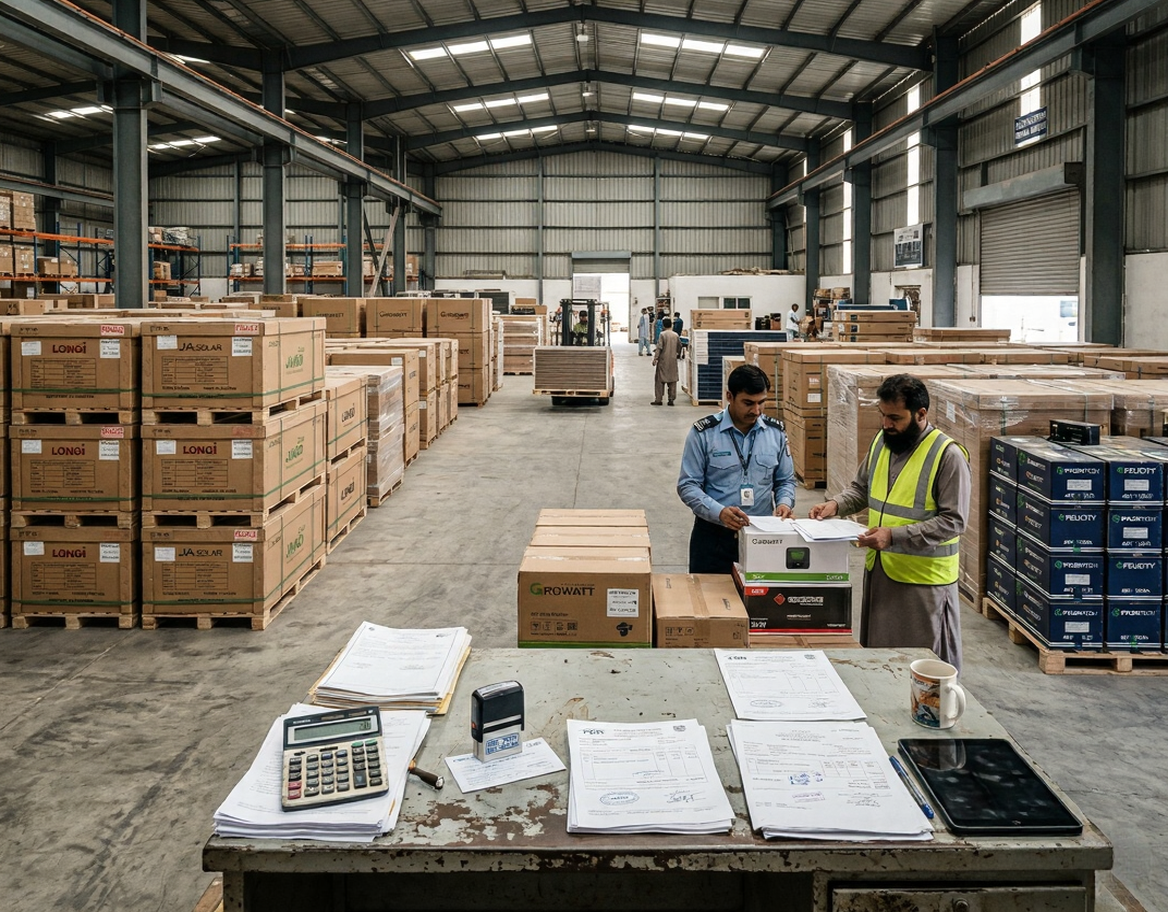
For broader cost trend understanding, you can review imported solar module batteries through this guide.
Accessories and Balance of System Items
Cables, MC4 connectors, ACDB/DCDB panels, breakers, and protection devices are often treated as standard electrical goods.
These frequently carry normal GST treatment.
Many homeowners ignore these components during the quotation stage. Later, government charges appear unexpectedly in final invoices.
The solution is simple:
Demand full itemization before installation begins.
Real Cost Example: With GST vs Without GST
Let us calculate a practical 7 kW rooftop scenario.
Panels: 950,000 PKR
Inverter: 320,000 PKR
Accessories: 180,000 PKR
If 17 percent GST applies only to the inverter and accessories:
(320,000 + 180,000) × 0.17 = 85,000 PKR
Total increase: 85,000 PKR
That is significant, but it does not suddenly make solar unaffordable.
The real risk is uncontrolled margin expansion disguised as tax. To compare full rooftop system structures logically, review the rooftop solar system cost in Lahore.
Do Not Confuse Equipment Tax With Net Metering
Equipment tax affects the upfront purchase. Net metering affects long-term export billing. They are separate systems. If you are planning export approval, read how to apply for net metering in Pakistan. Below are the common myths that cost buyers money.
Myth 1: Solar Is Completely Tax-Free
Solar is a bundle of components. Supporting items often follow standard GST treatment.
Myth 2: 17% GST Was Added to Everything Overnight
Policy shifts follow documentation and classification. Panic pricing often appears before official clarification.
Myth 3: Imported Equipment Avoids Tax
Imported does not mean exempt. GST may still apply at the distribution stage.
To avoid documentation and quality risks, read how to choose quality solar equipment in Pakistan.
Should You Wait Before Installing Solar?
Most searches for solar equipment in Pakistan are timing decisions.
Ask yourself:
- Is your current electricity bill already high?
- Is your installer transparent?
- Is net metering part of your plan?
- Are you verifying invoices properly?
If you are unsure about payback impact, calculate using a structured method. This guide is on the payback period for home solar systems.
Considering Battery Storage?
Battery decisions depend more on usage patterns than tax percentage alone.
Before adding storage, evaluate long-term economics using this guide on battery storage for home solar in 2026.
How to Verify Solar GST Properly
Use this checklist:
- Demand an itemized quotation
- Confirm the GST percentage shown explicitly
- Separate goods from services
- Ask for an invoice sample before installation
- Never rely on verbal claims
If the invoice is clear, tax becomes manageable.
If the invoice is vague, the risk increases.
Final Conclusion
If you searched for solar equipment tax in Pakistan, remember this framework:
- Solar is not one product.
- Each component may be treated differently.
- Separate GST from import economics.
- Demand line-item clarity.
- Use real calculations.
- Verify through paperwork.
When you approach solar this way, tax stops being confusing. It becomes a measurable line item. And your investment decision remains logical, confident, and financially sound.
Independent Power: Connect with Enon Traders Today!
Start your off-grid journey with Pakistan’s most reliable solar partner.
| Connect With Us | Action Link |
| Chat Instantly on WhatsApp | Get an off-grid system quote: Click to Chat Now! |
| Visit Our Website | View our off-grid inverters: Official Website |
| Call Our Experts | Design your custom micro-grid: Contact Page |