Net Metering Cost in Pakistan 2026 – Green Meter and Approval Fees
March 13, 2026
Solar Battery Maintenance Guide: Practical Battery Care Tips to Extend Lifespan
March 17, 2026
When someone searches for ground mount solar structures in Pakistan, they are not browsing casually. They usually own land. They want stability, durability, and engineering clarity before investing.
Many homeowners and factory owners compare panels and inverters first. Very few evaluate the structure carefully. That is where long-term problems begin.
A weak structure bends under stress. Poor anchoring shifts during monsoon winds. Incorrect row spacing reduces winter output. Thin steel vibrates over time. On the other hand, a properly engineered land mounting system protects your investment for 20 to 25 years with minimal structural risk.
This guide explains the ground mount solar structure in Pakistan with practical engineering clarity. You will understand structure types, real cost ranges, wind load calculations, soil requirements, land calculations, and installation checkpoints so you can approve a system with confidence.
What Is a Ground Mount Solar Structure in Pakistan?
A ground mount solar structure is a steel framework installed directly on open land instead of a roof slab. It holds solar panels at a fixed or adjustable tilt and transfers wind forces safely into the ground through anchors or concrete foundations.
Unlike rooftop systems, land mounting gives you full control over:
- Row spacing
- Tilt accuracy
- Cleaning access
- Airflow beneath panels
- Future expansion
If you want a broader understanding of system layout differences, review ground-mounted solar panels.
Ground mounting makes sense when:
- Your roof slab has structural doubts
- Tanks or neighboring buildings create shade
- You own agricultural or industrial land
- You plan a 10kW or larger system
- You want easier cleaning and maintenance
In many Pakistani projects, the rooftop is chosen by default. That is not always the better engineering decision.
Types of Ground Mount Solar Structures Used in Pakistan
1. Fixed Tilt Ground Mount Structure
This is the most common system used across Punjab, Sindh, and KPK. Tilt is set according to latitude. In central Pakistan, optimal fixed tilt typically ranges from 28° to 32° for annual performance.
Advantages:
- Low maintenance
- Stable output
- No moving parts
- Strong structural integrity
For residential and factory systems, fixed tilt is usually the safest and most durable option.
2. Adjustable Tilt Land Mounting
This allows manual seasonal tilt changes. In theory, winter adjustment can improve output by 5 to 8 percent. In reality, most owners adjust once and never change again. Unless you actively manage it, adjustable systems add mechanical complexity without meaningful long-term benefit. Choose this only if you are committed to seasonal optimization.
3. Elevated Ground Mount Systems
Panels are raised higher above ground level. These are common in:
- Flood-prone areas
- Agricultural farms
- Solar irrigation sites
Farmers using irrigation systems should review solar-powered tube wells. Elevation improves airflow and protects panels from temporary water accumulation during heavy monsoon seasons.
Pile Driven vs Concrete Foundation in Pakistan
Two anchoring methods are common:
Pile Driven Steel Posts
- Steel posts embedded 3 to 5 feet deep
- Faster installation
- Suitable for firm soil
Concrete Footings
- Excavation followed by a reinforced concrete pour
- Requires a curing time of 5 to 7 days
- Suitable for loose, sandy, or unstable soil
Execution quality matters more than method. Poor compaction or rushed curing weakens long-term stability.
Ground Mount vs Rooftop Solar Structure in Pakistan
The choice depends entirely on the site’s reality.
|
Feature |
Ground Mount |
Rooftop |
|
Wind Resistance |
High when anchored deeply |
Limited by slab thickness |
|
Cleaning Access |
Easy and safe |
Requires ladder access |
|
Expansion |
Flexible |
Limited by roof space |
|
Structural Risk |
Soil dependent |
Slab dependent |
|
Airflow |
Excellent |
Limited |
Wind Safety Reality
In Pakistan, monsoon gusts in some regions can reach 100 to 120 km/h. A 550W panel at 30° tilt can experience uplift forces exceeding 800 to 1,000 Newtons.
A properly engineered ground mount system with deep anchoring and diagonal bracing handles these loads effectively. Rooftop systems depend on slab embedment depth and anchor quality.
Maintenance Advantage
Pakistan’s dusty environment reduces performance quickly. Ground-mounted systems are easier to clean and inspect. For climate-based care, see maintenance tips for solar systems.
Roof Load Concerns
Old slabs, hairline cracks, and uncertain reinforcement increase structural risk. Review structural basics at the rooftop load-bearing. Ground mounting avoids roof load concerns but introduces soil evaluation instead.
Engineering Factors That Decide Long-Term Stability
1. Wind Load and Anchor Depth
Anchors should typically penetrate 3 to 5 feet, depending on soil type.
Ask clearly:
- What is the anchor depth?
- What steel thickness is used?
- Is diagonal bracing included?
- How is uplift calculated?
Avoid vague responses.
2. Steel Thickness and Galvanization
Common structural thickness ranges between 2mm and 4mm.
2mm reduces cost but increases vibration risk in larger arrays.
4mm sections provide stronger rigidity for industrial systems.
Hot-dip galvanization provides greater corrosion resistance than a simple paint coating, especially in Karachi and humid coastal areas.
3. Soil Condition and Drainage
Before installation, evaluate:
- Soil firmness
- Water flow patterns
- Flood history
- Low-lying accumulation areas
Improper drainage causes settlement over time.
Real Case Example (20kW Industrial System)
A 20kW system installed in Multan required:
- 1,600 square feet of land
- 4mm structural steel
- 4.5 feet anchor depth
- Wind design tolerance of 120 km/h
- 10 percent additional spacing for winter shadow
The structure costs slightly more upfront but reduces long-term maintenance risk significantly.
Land Requirement for Ground Mount Systems
Approximate space requirements:
- 5kW system: 350 to 450 sq ft
- 10kW system: 700 to 900 sq ft
- 20kW system: 1,400 to 1,800 sq ft
Row spacing must consider winter shadow between November and January. Compressing rows reduces seasonal output.
Ground Mount Solar Structure Cost in Pakistan (2026)
Typical structure cost:
- PKR 12,000 to 20,000 per kW for residential systems
- Higher for elevated or heavy industrial structures
Cost depends on:
- Steel thickness
- Galvanization quality
- Anchor depth
- Bracing density
- Elevation height
- Soil complexity
Lower quotes often mean thinner steel and reduced bracing.
For full financial planning, review the payback period.
Step-by-Step Installation Process
1. Site Survey
Assess slope, shading, soil stability, drainage, and south alignment.
2. Marking and Foundation
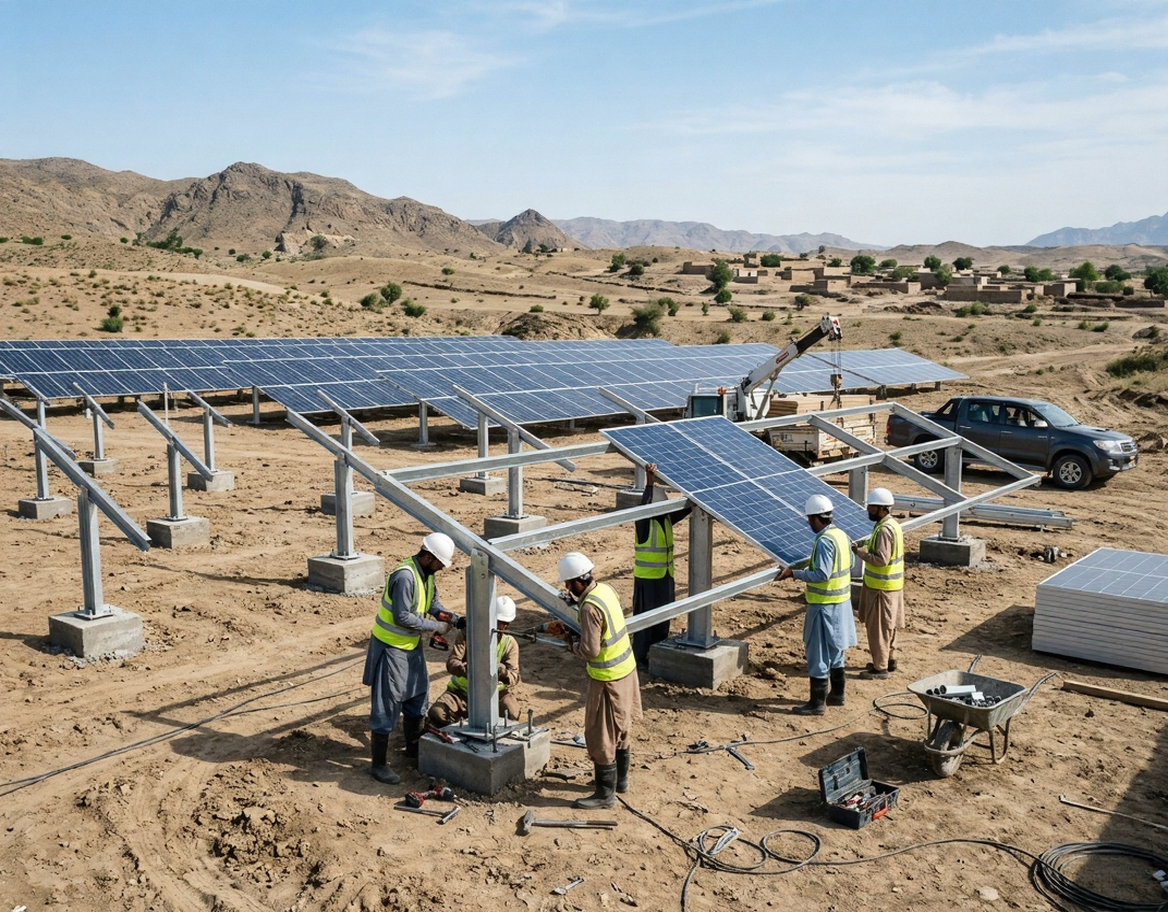
Rows aligned straight. Excavation begins. Concrete or piles installed. Concrete must cure properly before loading.
3. Frame Assembly
Rails aligned accurately. Diagonal bracing tightened correctly.
4. Cable Routing and Electrical Protection
Proper UV-resistant cable management required. Reference solar DC cables. Earthing and surge protection must be verified.
Common Mistakes in Ground Mount Solar Structure in Pakistan
- Choosing thin steel to reduce cost
- Ignoring galvanization quality
- Installing in poor drainage zones
- Keeping rows too close
- Skipping diagonal bracing
- Not verifying soil firmness
Industrial owners exploring savings should review factories in Pakistan that are saving.
Who Should Choose a Ground Mount Solar Structure in Pakistan?
Choose ground mount if:
- You own open land
- You plan an expansion
- You want easy cleaning
- You operate agricultural or industrial loads
- You prefer structural independence from the roof
Rooftop suits you if:
- Land is limited
- The roof slab is verified
- System size is small
Each site requires a professional assessment.
Final Engineering Checklist
Before approval, confirm:
- Steel thickness in writing
- Galvanization method
- Anchor depth
- Wind design calculation
- Row spacing plan
- Drainage management
Clear answers indicate professional design.
Conclusion: Build for 20 Years, Not 2 Seasons
A ground-mount solar structure in Pakistan can be durable, scalable, and maintenance-friendly when engineered correctly.
It offers:
- Better airflow
- Easier cleaning
- Expansion flexibility
- Reduced rooftop risk
Durability depends on steel quality, anchor depth, drainage planning, and spacing design. Do not choose based on price alone. Choose based on engineering clarity. When land mounting is executed properly, it becomes a long-term asset rather than a short-term experiment.
Independent Power: Connect with Enon Traders Today!
Start your off-grid journey with Pakistan’s most reliable solar partner.
| Connect With Us | Action Link |
| Chat Instantly on WhatsApp | Get an off-grid system quote: Click to Chat Now! |
| Visit Our Website | View our off-grid inverters: Official Website |
| Call Our Experts | Design your custom micro-grid: Contact Page |