Solar Panel Lifespan in Pakistan: How Long Panels Really Last
January 13, 2026
PV Module Specifications in Pakistan Explained
January 15, 2026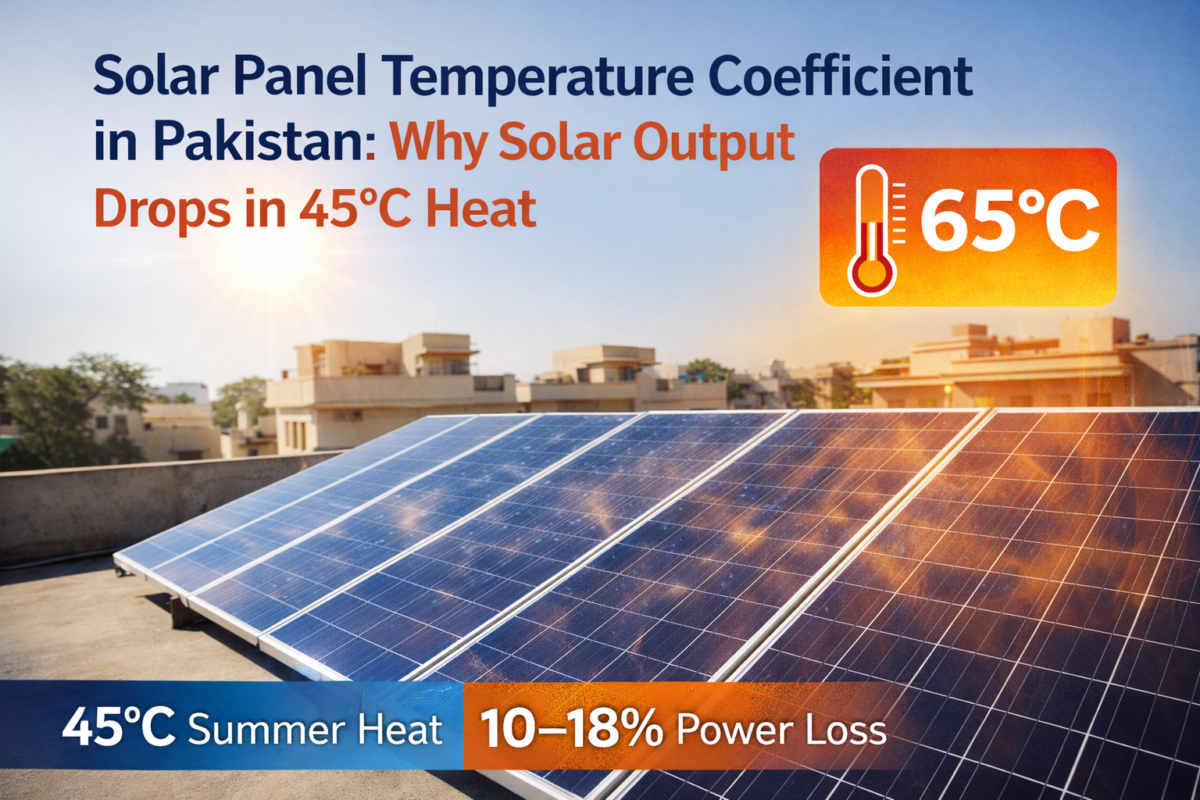
-
Have you noticed your solar system producing fewer units in May and June, even when the sunlight feels stronger than ever? Many system owners in Pakistan assume something is wrong with their panels or inverter. In reality, the issue is often heat. While air temperature may be 40–45°C, rooftop solar panels can reach surface temperatures of 60–70°C under direct sunlight. At those temperatures, panels can temporarily lose 10–18% of their rated output.
When consumers compare solar panel brands, they usually focus on wattage, efficiency percentage, or brand reputation. However, one specification on the datasheet plays a critical role in hot climates like Pakistan. This specification is called the solar panel temperature coefficient. It determines how much power a panel loses as its temperature rises above the standard testing reference of 25°C.
Although many system owners see this number on a datasheet, few fully understand what it means or how it affects real-world performance. Some ignore it completely. Others overestimate its impact. The truth lies between those extremes. In this guide, you will clearly understand what the solar panel temperature coefficient is, how to read it, and how to use it wisely when comparing panels for Pakistan’s climate.
What Is the Solar Panel Temperature Coefficient?
The solar panel’s temperature coefficient is the measure of power variation with respect to temperatures above the reference value.
This reference temperature is 25°C, which is used in laboratory testing in Standard Test Conditions. This temperature makes it possible for manufacturers to compare different panels, but not in actual conditions. Outdoor panels work in 25°C temperatures for long periods of time.
In practical applications, the temperature difference may be more pronounced. The temperature coefficient indicates how it will affect performance.
A simple definition
If a solar panel has a temperature coefficient of −0.35 percent per degree Celsius, it means the panel loses about 0.35 percent of its rated power for every degree above 25°C.
The value is always negative because higher temperatures reduce output rather than increase it.
Why are panels rated at 25°C?
The manufacturers prefer the usage of 25°C to create an equal platform for testing the panels. Although practical for comparisons, the testing conditions in the lab have no relation to the working conditions of the panels on the roofs of buildings, where the temperatures often range between 45°C and 70°C.
The difference here is what makes understanding the importance of the temperature coefficient critical.
Why does Heat reduce solar Panel Output?
A common misconception is that hotter weather improves solar panel performance. Strong sunlight does increase production, but heat itself has the opposite effect.
Heat affects voltage, not sunlight
The increase in temperature will not affect the level of sunlight coming to the solar panels. This only deals with the manner in which the electricity moves inside the solar panels.
As the temperature rises, the voltage corresponding to it decreases. The current value remains relatively constant, and because of this, the power decreases.
The basic science behind heat loss
As the solar cells get heated up, the electrons start moving freely in the solar cell. As a result, there will be less electrical potential needed to drive the energy through the circuit.
This results in reduced voltage and power generation, even on very sunny days.
Understanding the Temperature Coefficient on a Datasheet
Solar panel datasheets often list several temperature-related values. The most important one for system owners is the power temperature coefficient.
What does a negative value actually mean?
A negative temperature coefficient is not a quality issue. As the temperature increases, every silicon-based solar cell loses its energy.
It is the magnitude of the loss that matters. Panels with lower negative values lose heat better compared with those that have high negative values.
How to read the percentage correctly?
The percentage applies only to output above 25°C. It does not represent permanent damage or long-term degradation.
In cooler weather, panels can briefly exceed their rated output, which balances some of the summer losses over the year.
How Much Power Do Solar Panels Lose in Hot Weather?
Percentages become meaningful only when translated into real situations.
A realistic heat loss example
To understand the real impact, let us use a practical rooftop scenario.
Consider a 550W solar panel with a temperature coefficient of −0.35% per degree Celsius.
In Pakistan’s summer, rooftop panel temperatures commonly reach 60–70°C. Let us assume the panel temperature reaches 65°C.
Now calculate the difference from Standard Test Conditions (25°C):
65°C − 25°C = 40°C above reference
Next, apply the temperature coefficient:
40 × 0.35% = 14% power loss
Now, calculate the actual output:
550W × 14% = 77W loss
550W − 77W = 473W actual outputThis means that at 65°C panel temperature, the 550W panel may temporarily produce around 470–475W instead of its rated value.
This reduction is not damage and not permanent degradation. It is a normal, temperature-related performance adjustment that occurs during peak heat hours
Why does summer production still look strong?
Many system owners are surprised that total energy production is often higher in summer despite heat-related efficiency losses.
This happens because longer daylight hours and stronger sunlight outweigh the reduction caused by heat. This balance becomes clearer when you understand the solar panel performance ratio, which explains how real-world conditions affect total system output.
What Is Considered a Good Temperature Coefficient?
There is no single perfect value, but realistic ranges help with comparison.
Below is a simple comparison of common panel technologies and how they typically perform in high-temperature conditions:
Temperature Coefficient Comparison by Panel Type
Panel Type Typical Temperature Coefficient Heat Handling in Pakistan Mono PERC −0.35% per °C Good TOPCon −0.30% per °C Excellent Polycrystalline −0.45% per °C Moderate Lower negative values indicate better resistance to heat-related efficiency loss, which becomes more important in regions where rooftop temperatures frequently exceed 60°C.
Typical industry ranges
Most modern solar panels fall between: