Solar Market Analysis in Pakistan: Demand, Supply and Market Direction
February 14, 2026
Solar DC Cables in Pakistan: A Clear, Practical Guide for Real Installations
February 16, 2026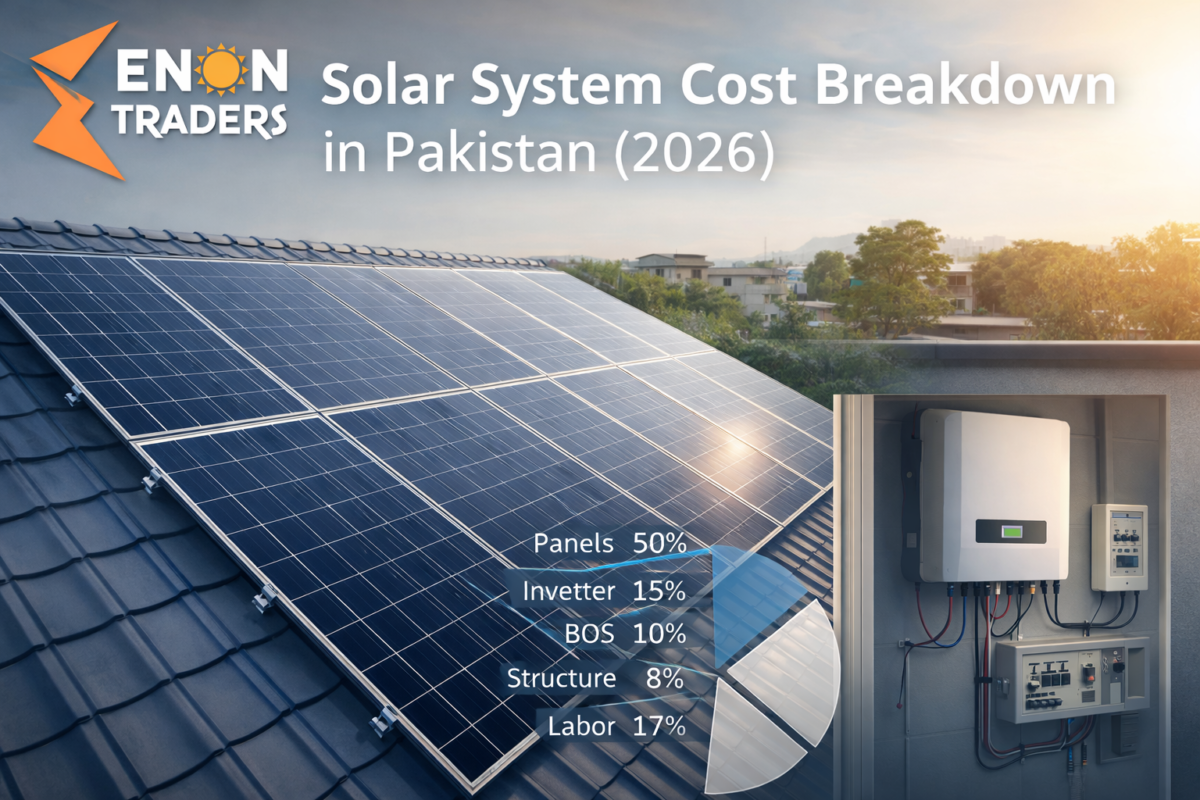
When homeowners receive a solar quotation, they usually focus on one number – the total system price.
But the total number never tells the full story. The real story sits inside the breakdown. In Pakistan’s 2026 market – where exchange rates, import cycles, and grid instability directly affect system design – two 10kW systems can differ significantly in cost for completely valid engineering reasons.
This guide explains:
Where your solar budget actually goes
• What truly drives panel and inverter cost
• Why two identical kW systems differ in price
• How to evaluate a solar installation cost breakdown like a professional
• What percentage each component consumes in Pakistan
If you understand cost allocation, you stop comparing totals – and start comparing engineering logic.
Why Solar Cost Distribution Matters in Pakistan
A solar system is not one product.
It is a completely engineered energy structure.
Each layer performs a different function:
Panels generate DC electricity
• Inverter converts and manages power
• Structure ensures mechanical stability
• BOS (Balance of System) ensures electrical safety
• Battery (optional) provides autonomy
When homeowners ignore the breakdown, they risk:
Overpaying for branding
• Underpaying for protection
• Choosing a weak inverter design
• Missing surge protection
• Facing upgrade costs later
Understanding allocation eliminates pricing confusion.
Instead of asking: Why is this system expensive?
You start asking: Where exactly is my money being allocated? That shift improves decision quality dramatically.
What Makes Up a Solar System in Pakistan (Component Overview)
1. Solar Panels – Energy Generation Layer
Panels convert sunlight into DC electricity.
They usually represent the largest visible portion of the budget, but they do not control system stability.
Panel pricing depends on:
- N-Type vs P-Type technology
• Tier-1 traceability
• Anti-PID protection
• Temperature coefficient
• Authentic import channel
If you want to avoid low-grade or recycled imports, read How to Choose Quality Solar Equipment in Pakistan.
2. Solar Inverter – The System Brain
The inverter does more than convert DC to AC.
It controls:
- Grid export
• Voltage response
• Load prioritization
• Surge handling
• Monitoring
In Pakistan’s unstable grid environment, inverter quality directly impacts performance reliability.
If you want to understand how efficiency ratings affect real savings in hot climates, review Inverter Efficiency Ratings Explained.
3. Mounting Structure – Mechanical Stability Layer
Structure includes:
- Aluminum rails
• Clamps
• Anchoring hardware
• Roof sealing
• Wind-load tolerance
Weak structure may not fail immediately, but corrosion, vibration, and sagging appear over time.
Roof strength assessment is critical. You can review Rooftop Load Bearing for Solar Systems.
4. BOS (Balance of System) – Wiring and Protection Layer
This is the most underestimated category.
It includes:
- DC cables
• AC cables
• Breakers
• Isolators
• Surge protection
• Earthing
• Distribution boards
Most long-term failures begin here – not with panels.
If the BOS cost appears unusually low in a quote, protection may be compromised.
5. Battery Storage – Energy Autonomy Layer
Batteries change the entire cost structure.
They:
- Increase independence
• Increase upfront cost
• Require lifecycle planning
• Demand hybrid inverter compatibility
Before deciding, review Battery Storage for Home Solar.
Solar Component Cost Breakdown (Pakistan 2026 Percentage Distribution)
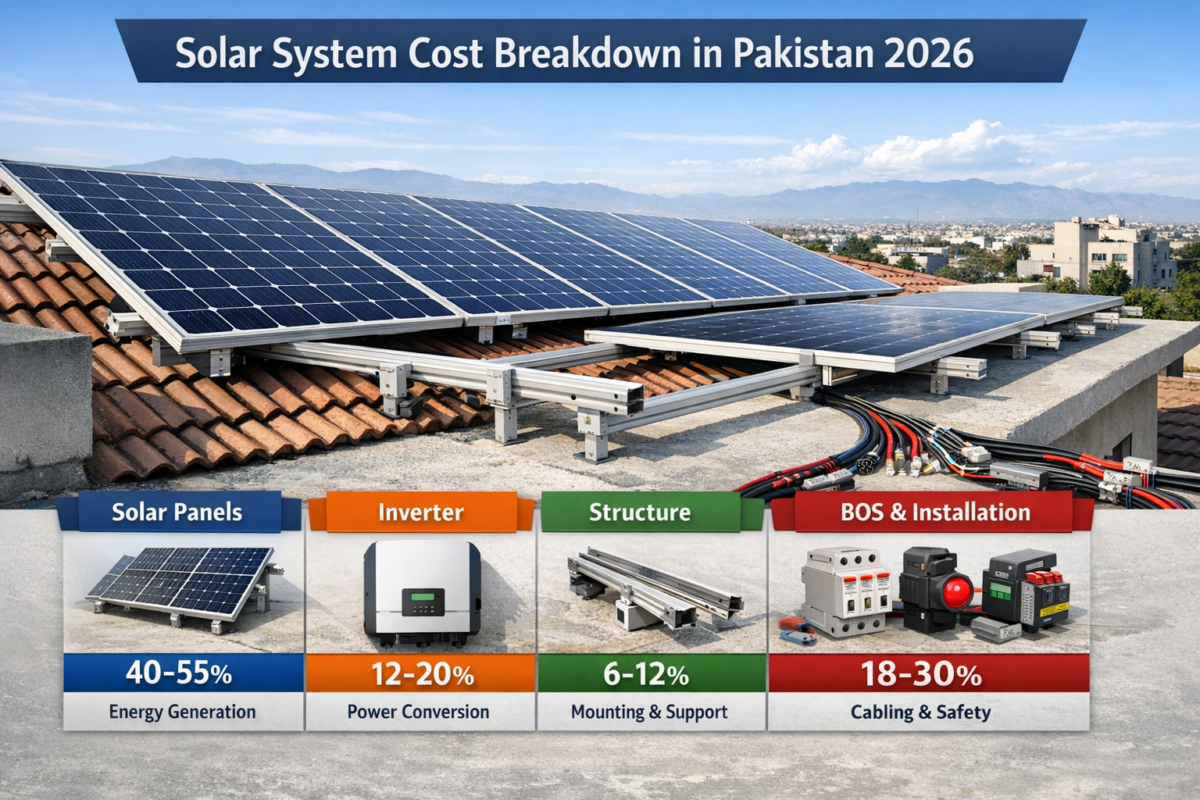
Residential On-Grid System (Without Battery)
|
Component |
Typical % Range |
|
Panels |
40–55% |
|
Inverter |
12–20% |
|
Structure |
6–12% |
|
BOS |
8–15% |
|
Installation & Labor |
10–18% |
If BOS falls below 7–8%, safety components may be missing.
Hybrid System (With Battery)
|
Component |
Typical % Range |
|
Batteries |
25–45% |
|
Panels |
30–45% |
|
Hybrid Inverter |
15–25% |
|
Structure + BOS + Labor |
15–25% |
Adding a battery is not a simple upgrade.
It restructures the energy logic of the entire system.
Real Price Example (PKR-Based Illustration)
Example: 10kW On-Grid System – Approximate Market Range
If total system cost = PKR 1,400,000
Typical allocation:
Panels (50%) ≈ PKR 700,000
Inverter (15%) ≈ PKR 210,000
Structure (8%) ≈ PKR 112,000
BOS (10%) ≈ PKR 140,000
Labor (17%) ≈ PKR 238,000
Two quotes may differ by 150,000–250,000 PKR depending on:
- Cable quality
• Breaker ratings
• Surge protection
• Mounting thickness
• Inverter warranty
This is why comparing totals alone is misleading.
Fixed Costs vs Variable Costs (Why Per kW Price Changes)
Fixed Costs
- Site survey
• Engineering planning
• Basic logistics
• Core installation team
Small systems appear expensive per kW because fixed costs are distributed over fewer.
Variable Costs
- Additional panels
• Larger inverter
• Thicker cables
• Higher-rated breakers
This is why 10kW systems often have better per-kW pricing than 5kW systems.
Why Two Identical 10kW Quotes Differ
Hidden differences may include:
- Thinner DC cables are causing a voltage drop
• No surge protection
• Weak earthing
• Lower grade breakers
• Shorter inverter warranty
• Lightweight mounting
These issues often appear months later – especially in peak summer heat.
To avoid common installation errors, review Top Mistakes to Avoid When Installing Rooftop Solar in Pakistan:
Hidden Costs Many Homeowners Miss
1. Roof Preparation
Some roofs require reinforcement.
See: Rooftop Load Bearing for Solar Systems
2. Distribution Board Upgrades
Older homes may require breaker panel upgrades.
3. Net Metering Compliance
Export approval involves documentation, inspection, and meter installation.
You can review the full process in How to Apply for Net Metering in Pakistan.
What a Healthy Solar Cost Breakdown Looks Like
A professional quote should:
- Separate panel and inverter cost
- Show cable sizing (mm²)
- List surge protection
- Specify the earthing method
- Define labor scope
- Clarify warranty terms
Avoid vague labels like: Complete Solar Package. Transparency signals engineering integrity.
Long-Term Maintenance Planning
Panels last 20-25 years.
Inverters last 8-12 years.
Batteries depend on cycle count.
Heat, dust, and loose connections gradually reduce performance. For climate-specific maintenance advice, read Maintenance Tips for Solar Systems in Pakistan’s Climate.
Final Conclusion
A solar investment is not about finding the lowest number. It is about understanding allocation.
When you understand:
Solar installation cost distribution
• Panel vs inverter cost behavior
• Fixed vs variable pricing
• Hidden BOS expenses
You stop comparing totals. You start comparing engineering logic. And that is how informed solar decisions are made in Pakistan’s 2026 market.
Independent Power: Connect with Enon Traders Today!
Start your off-grid journey with Pakistan’s most reliable solar partner.
| Connect With Us | Action Link |
| Chat Instantly on WhatsApp | Get an off-grid system quote: Click to Chat Now! |
| Visit Our Website | View our off-grid inverters: Official Website |
| Call Our Experts | Design your custom micro-grid: Contact Page |