Net Metering Documents Required in Pakistan (2026 Complete Checklist)
February 11, 2026
Solar System Cost Breakdown in Pakistan
February 14, 2026
Solar market analysis in Pakistan is no longer about whether the industry will grow. Growth is already visible across rooftops, factories, agricultural land, and commercial buildings. The real question now is how the market behaves: how demand reacts to grid instability, how supply responds to global manufacturing cycles, and how policy influences timing rather than long-term adoption.
Over the past five years, Pakistan’s solar sector has transitioned from niche installations to gigawatt-scale annual additions driven primarily by distributed rooftop systems. Rising electricity tariffs, repeated fuel cost adjustments, grid reliability concerns, and currency pressure have turned solar from an optional backup into a structural energy decision.
This analysis examines Pakistan’s solar market from a structural and operational perspective, separating long-term forces from short-term price noise to understand where the industry stands today and where it is heading next.
Pakistan Solar Market Growth (2020–2026)
Between 2020 and 2022, rooftop solar adoption accelerated gradually as electricity prices climbed. From 2022 onward, the pace shifted sharply. Import volumes of panels surged, installer networks expanded rapidly, and net metering applications increased significantly across major DISCO regions.
Key market characteristics since 2022:
Shift from megawatt-scale annual additions to gigawatt-scale rooftop deployments
• Decentralized adoption led by households and small commercial entities
• Increased demand for hybrid systems and lithium battery storage
• Rapid installer market expansion
• Growing scrutiny of system design quality
Unlike utility-scale solar projects, which remain policy-dependent, distributed rooftop solar growth in Pakistan is consumer-driven. This distinction is critical. It means adoption momentum is tied more to electricity tariffs and grid stress than to government incentives.
The solar industry in Pakistan is now in the early stabilization phase following rapid expansion.
What Defines the Solar Market Right Now
The current solar market in Pakistan is defined by four structural realities:
- Demand is necessity-driven and reactive to grid stress rather than incentives.
- Supply is import-dependent and shaped by global manufacturing cycles and currency movements.
- Policy influences installation timing, not long-term viability.
- Market direction signals stabilization after rapid growth, not contraction.
Understanding these structural drivers matters more than tracking daily panel prices.
Demand Side Analysis: Why Solar Demand Keeps Rising
1. Electricity Tariffs Outpacing Income Growth
Electricity prices in Pakistan have increased at a rate significantly faster than household income growth. Quarterly tariff adjustments, fuel cost surcharges, and cross-subsidy structures have introduced unpredictability into monthly bills.
Solar provides predictability. That predictability is its strongest demand driver.
2. Grid Reliability and Operational Risk
Frequent load shedding and voltage instability create operational losses for businesses and discomfort for households. Commercial and industrial users increasingly treat solar as operational infrastructure rather than discretionary capital expenditure.
Industrial buyers, in particular, are focused on structured ROI planning, as discussed in Reduce Electricity Costs with Solar.
3. Residential vs Commercial Demand Patterns
Residential demand spikes following tariff revisions. Buyers focus on:
Monthly bill reduction
• Backup duration
• Net metering export benefit
Commercial demand increases when outages affect productivity. These buyers prioritize:
Peak load management
• Operational uptime
• Long-term cost predictability
This segmented behavior explains why solar growth persists even during policy uncertainty.
The Role of Net Metering and Policy Signals
Net metering has been one of the strongest accelerators of rooftop solar growth. However, changes to export rates and procedural adjustments have introduced hesitation in decision timing.
For a deeper breakdown, review the impact of changing buy back.
Important distinction:
Policy shifts delay installations. They do not eliminate underlying economic viability. Buyers pause during uncertainty. Once clarity returns, installations resume. This cycle has repeated multiple times over the past few years.
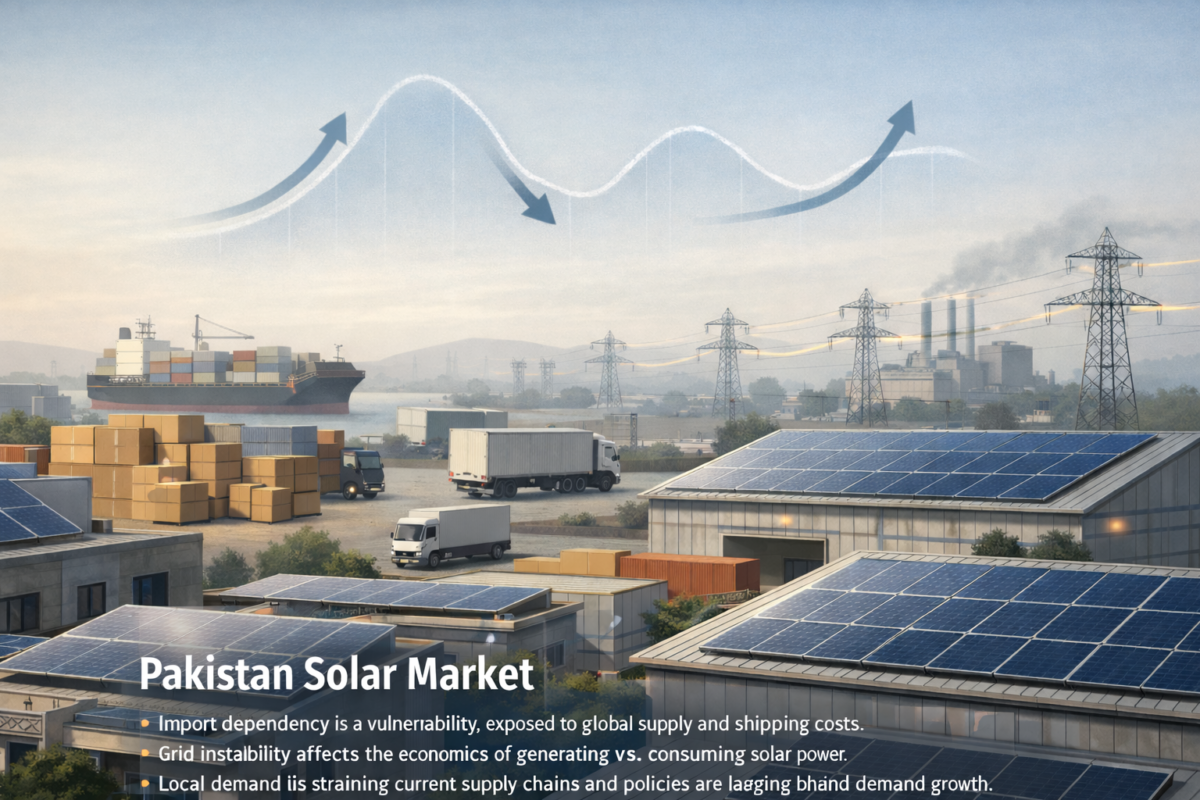
Supply Side Analysis: Import Dependency and Global Influence
Solar Panel Supply Trends
Pakistan relies heavily on imported solar panels. Local pricing is influenced by:
Global oversupply cycles
• Chinese manufacturing output
• Shipping costs
• Currency exchange rate fluctuations
When global production exceeds demand, prices soften domestically. When shipping or currency pressures increase, prices tighten.
These patterns are explained further in the imported solar modules cost trends. The key takeaway: panel prices are influenced more by international manufacturing dynamics than by domestic installation rates.
Inverters, Batteries, and Balance of System
Inverters and lithium batteries follow different supply dynamics. Availability depends on:
Brand distribution networks
• Warranty credibility
• After-sales infrastructure
• Installer technical competence
Rapid installer market expansion since 2022 increased installation capacity but exposed gaps in design maturity. This is why performance issues are more frequently linked to system sizing errors rather than hardware defects.
Common installation errors are discussed in the top mistakes to avoid when installing rooftop solar in Pakistan.
Installer Market Expansion and Fragmentation
The number of solar installers has grown dramatically. However, technical standardization has not grown at the same pace.
Market characteristics:
Price-based competition dominates
• Design accuracy varies significantly
• Load assessment is often underestimated
• Long-term performance planning is inconsistent
This fragmentation impacts system reliability more than panel brand selection. The solar market in Pakistan is not hardware-limited. It is execution-sensitive.
Market Cycles: How Demand and Supply Interact
Pakistan’s solar market follows a repeating structural cycle:
- Electricity tariff increase or grid instability
- Demand spike
- Supply lag
- Installation rush
- Quality inconsistencies
- Market stabilization
- Price normalization
Understanding this cycle prevents buyers from making urgency-driven decisions.
Market rewards preparation, not perfect timing.
Grid Constraints and Structural Limits
As rooftop penetration increases, local distribution networks experience stress:
Voltage rise issues
• Export limitations
• Transformer overload risks
These structural grid realities are explained in the grid challenges in Pakistan.
High adoption density zones may experience export constraints, reinforcing the importance of accurate system sizing rather than oversized installations.
Currency Volatility and Price Perception
Exchange rate movements directly influence import costs. Sudden currency depreciation creates temporary price spikes.
However, these price shifts often reflect macroeconomic changes rather than solar-specific fundamentals. Short-term volatility should not be confused with long-term direction.
Pakistan Solar Policy Outlook
Policy evolution continues to shape timing decisions.
For upcoming structural adjustments, review the Pakistan solar policy 2026.
Future policy direction is likely to:
Emphasize grid stability
• Adjust export compensation models
• Encourage storage integration
• Refine approval procedures
The long-term viability of distributed solar remains strong even as regulatory mechanisms evolve.
5-Year Solar Market Outlook (2026–2030)
The future of solar energy in Pakistan points toward selective stabilization rather than explosive acceleration.
Expected trends:
Continued rooftop growth in residential and SME sectors
• Higher commercial and industrial penetration
• Increased battery storage integration
• Greater scrutiny of system design quality
• Market consolidation among installers
Growth will continue. The difference is that growth will be more informed.
Solar is becoming standard energy planning infrastructure rather than a reactionary installation.
What This Means for Buyers
For Homeowners
Focus on system sizing accuracy, consumption pattern understanding, and realistic ROI calculation rather than price chasing.
For structured ROI clarity, see how to calculate the payback period for your home solar system in Pakistan.
For Businesses
Monitor:
Policy signals
• Supply chain movement
• Installer competence
• Grid infrastructure constraints
Commercial success depends more on system design quality than headline panel price.
Final Perspective: Structure Over Noise
The Pakistani solar market is no longer driven by experimentation or hype. Necessity-driven demand, import-dependent supply chains, evolving grid realities, and policy timing shifts shape it.
- Prices will fluctuate.
- Availability will shift.
- Regulations will evolve.
But the long-term structural direction remains clear. Solar adoption in Pakistan has shifted from an optional backup to a core energy-planning strategy across residential, commercial, and industrial segments.
Independent Power: Connect with Enon Traders Today!
Start your off-grid journey with Pakistan’s most reliable solar partner.
| Connect With Us | Action Link |
| Chat Instantly on WhatsApp | Get an off-grid system quote: Click to Chat Now! |
| Visit Our Website | View our off-grid inverters: Official Website |
| Call Our Experts | Design your custom micro-grid: Contact Page |