Battery Backup Calculation in Pakistan: How to Calculate Backup Hours Accurately
February 20, 2026
Seasonal Solar Production in Pakistan Explained
February 24, 2026
When Pakistani citizens buy a solar system for their homes, they are primarily concerned with the solar panel, inverter, and battery power rating. Very few citizens ask a very important question:
How much energy is actually lost during battery charging?
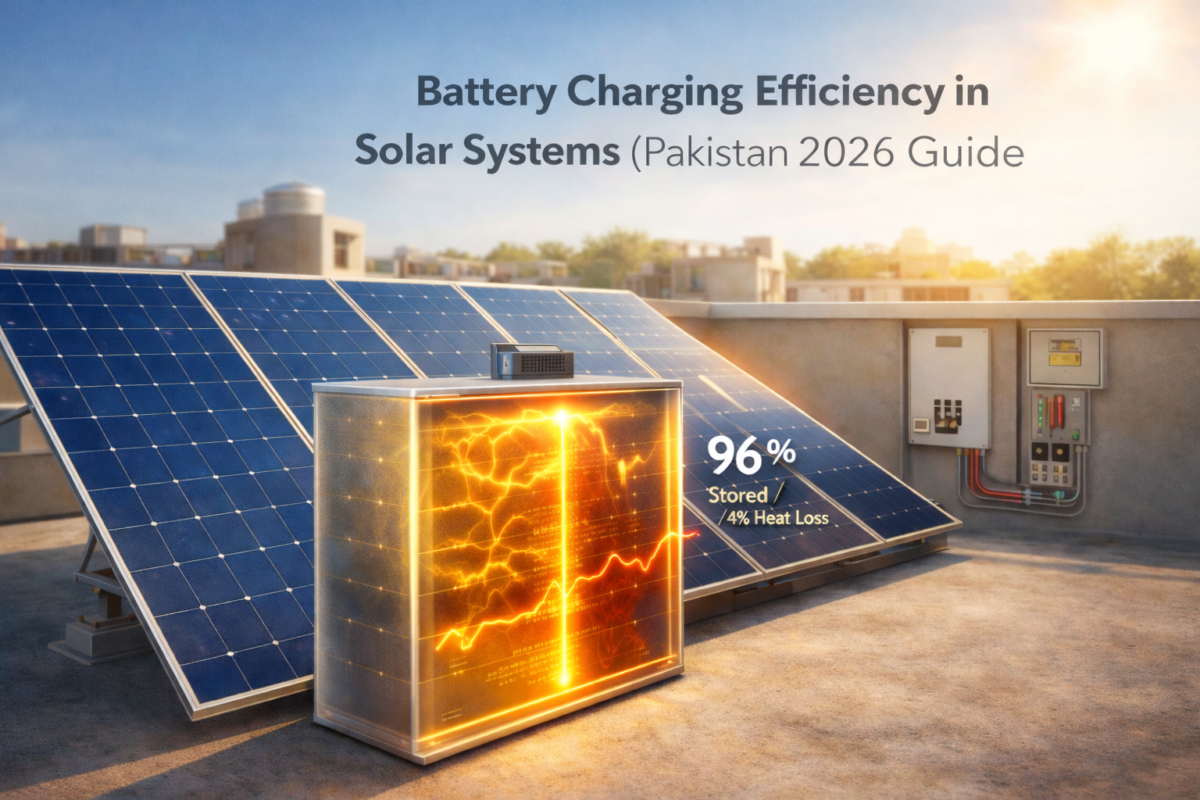
This is a lack of understanding that creates unrealistic expectations. Many citizens think that if 10 kWh of energy is supplied to the battery, 10 kWh of energy will be available later. However, every type of battery has energy losses during charging due to internal resistance, heating, chemical reactions, and design factors.
In the Pakistani climate, where high temperatures are a normal occurrence, and batteries are heavily used every day, charging efficiency becomes even more important. If you do not consider battery charging efficiency, your calculations for sizing your solar system may be incorrect. This will result in reduced backup time, increased discharge stress, and reduced battery life.
Before purchasing or upgrading a solar battery system, you must understand how much energy is lost during battery charging and what constitutes normal loss.
Quick Answer: How Much Energy Is Lost During Battery Charging?
Battery charging efficiency in solar systems usually ranges between:
- 95% to 98% for lithium batteries
- 80% to 90% for tubular and flooded lead acid
- 85% to 92% for AGM and gel batteries
If your system sends 10 kWh into the battery:
- Lithium may store about 9.6 to 9.8 kWh
- Lead acid may store about 8 to 9 kWh
The rest is lost as heat and internal resistance.
This is normal. The key is knowing what is acceptable and what signals a problem.
What Battery Charging Efficiency Actually Means
Battery charging efficiency tells you how much of the solar energy sent into a battery becomes stored energy.
Formula:
Charging Efficiency (%) = (Energy Stored ÷ Energy Input) × 100
Example:
If 5 kWh enters the battery and 4.5 kWh is stored:
Efficiency = (4.5 ÷ 5) × 100 = 90%
The missing 0.5 kWh becomes heat and internal chemical loss. Do not confuse this with round-trip efficiency. Charging efficiency measures only the charging loss. Round-trip efficiency includes both charging and discharging.
When people mix these two, they feel their system is underperforming. In reality, the numbers were misunderstood.
Charging Efficiency vs Round Trip Efficiency
If a battery charges at 90% and discharges at 90%, the combined round-trip efficiency becomes:
0.9 × 0.9 = 81%
That means 19% of energy is lost across the full cycle.
Many homeowners blame the inverter alone. But efficiency loss happens across the entire chain.
To understand inverter contribution properly, read inverter efficiency ratings.
Why Charging Loss Happens in Solar Systems
Charging loss is normal. But excessive loss signals an issue.
1. Internal Resistance
Every battery has internal resistance. When current flows, resistance converts part of the energy into heat.
Older batteries develop higher resistance. Low-quality batteries start with higher resistance. Both increase charging loss.
If you feel the battery getting hot during charging, that heat comes from lost energy.
2. Heat and Pakistani Climate Conditions
Pakistan’s rooftop conditions are harsh.
Summer temperatures cross 45°C. On rooftops or in closed store rooms, the temperature can go much higher.
High heat:
- Increases internal resistance
- Reduces charging efficiency
- Accelerates battery aging
Even lithium loses efficiency in extreme heat.
A simple improvement, like ventilation or shaded placement, can improve performance.
3. Charging Stages Matter
Charging does not happen at a constant efficiency.
Bulk stage: Faster charging, higher apparent efficiency
Absorption stage: Slower charging, more balancing
Float stage: Maintenance mode, minimal storage gain
The last 20% always feels slow. That is normal behavior.
4. Cable and Connection Losses
Loss does not happen only inside the battery.
Thin cables
Loose lugs
Poor crimping
Cheap connectors
All create resistance. Resistance creates heat. Heat creates loss.
This is one of the most ignored issues in Pakistani installations.
To avoid common setup errors, read the top mistakes to avoid when installing rooftop solar in Pakistan.
Typical Battery Charging Efficiency by Battery Type
Here is a realistic comparison under Pakistani conditions:
|
Battery Type |
Charging Efficiency |
Round Trip Efficiency |
Heat Sensitivity |
|
Lithium (LiFePO4) |
95% to 98% |
90% to 95% |
Low to Medium |
|
Tubular Lead Acid |
80% to 90% |
70% to 85% |
High |
|
AGM / Gel |
85% to 92% |
75% to 88% |
Medium |
Lithium maintains low internal resistance and stable performance.
Lead acid wastes more energy due to gassing, heat, and chemical conversion losses.
For a full chemistry comparison, read lithium vs tubular battery in Pakistan.
Real Example: Monthly Energy Loss in Pakistan
Let’s calculate a realistic scenario.
Your system sends 10 kWh daily into the battery.
Case 1: Lithium at 96%
Stored: 9.6 kWh
Loss: 0.4 kWh per day
Case 2: Tubular at 85%
Stored: 8.5 kWh
Loss: 1.5 kWh per day
Monthly impact:
1.5 kWh × 30 days = 45 kWh lost per month
If electricity costs Rs 60 per unit, that equals:
45 × 60 = Rs 2700 worth of energy difference monthly
This is why proper battery selection matters financially.
If you are evaluating whether storage makes sense, read Battery Storage for home solar: Is it worth it in Pakistan?
How Temperature Affects Battery Charging Efficiency
High Temperature Impact
High heat:
- Reduces efficiency
- Increases internal resistance
- Speeds up degradation
Batteries in closed rooms without ventilation suffer the most.
A shaded, ventilated location improves long-term performance.
Low Temperature Impact
In colder regions, lithium batteries may limit charging current to protect cells.
Efficiency may temporarily drop.
Not common in Punjab cities, but important in northern areas.
How to Reduce Charging Loss in Solar Systems
You cannot remove the charging loss fully. But you can reduce it.
Choose the Right Chemistry
Daily cycling favors lithium due to higher efficiency.
Occasional backup users may still benefit from tubular systems if cost is a concern.
Set Correct Charging Voltages
Wrong voltage settings waste energy.
Overcharging creates heat and gassing.
Undercharging leaves capacity unused and causes sulfation.
Correct MPPT configuration matters.
To understand how MPPT improves energy capture, read mppt technology guide in Pakistan.
Improve Cable Quality
Use proper cable thickness.
Ensure tight lugs.
Avoid unnecessary long runs.
Loss in wiring is silent but real.
Avoid Deep Discharge Patterns
Deep discharge increases internal heating and long-term resistance.
To understand discharge behavior, read the battery depth of discharge.
Integrate Backup Properly
Battery sizing, inverter sizing, and load planning must align.
Improper integration creates unnecessary cycling and loss.
For system planning, read how to integrate battery backup with your solar system in Pakistan.
When Should You Worry About Charging Loss?
Charging loss is normal.
Worry if:
- The battery heats excessively
- The battery never reaches full charge on sunny days
- Backup drops unusually fast
- Burning smell near terminals
- Frequent charge errors on the inverter
If you see these signs, act early. Small issues become expensive later.
Final Conclusion: Understand Charging Loss, and You Gain Control
Battery charging efficiency in solar systems is not a hidden mystery. It is a measurable reality.
Once you understand:
- Internal resistance
- Heat impact
- Charging stages
- Cable losses
- Battery chemistry
You stop guessing. You need honest expectations, a correct setup, and proper ventilation. When done correctly, solar battery backup in Pakistan becomes predictable, stable, and financially sensible.
Independent Power: Connect with Enon Traders Today!
Start your off-grid journey with Pakistan’s most reliable solar partner.
| Connect With Us | Action Link |
| Chat Instantly on WhatsApp | Get an off-grid system quote: Click to Chat Now! |
| Visit Our Website | View our off-grid inverters: Official Website |
| Call Our Experts | Design your custom micro-grid: Contact Page |