Solar System Load Calculation Guide: How to Estimate Your Real Power Needs Accurately
February 24, 2026
Imported Solar Equipment Prices in Pakistan: Why China Imports Affect Pricing
March 1, 2026
Hence, it is clear that if you are looking for information regarding the approval period for net meters in Pakistan, you are not looking for any policy-level definitions or any ideal situational examples. Rather, you are trying to get information regarding the practical scenario, i.e., how much time is consumed in the process before you actually get your approval for the solar panel system that you have installed in your home or office, and is the situation you are going through normal in any way?
Generally, the approval for the permission of net metering does not exist. It is subject to the inspection work, capacity, and the season. For example, if two different individuals have similar kinds of solar systems, the approval dates for them could be different in the utilities such as LESCO, IESCO, and K-Electric.
This article will be a form of an explanation regarding the duration taken to process the net metering application in Pakistan. As with the previous article, the language will be applicable and easily understandable, as observed with the actual approval trend by the end of 2025 and early 2026. With the reading of this article, you will become informed, comforted, and reassured regarding the process.
Net Metering Approval Time in Pakistan (Quick Answer)
In the case of most residential solar systems in Pakistan, an approval for net metering usually takes between 30 and 90 days upon submission of the application. Most delays tend to result from inspection backlogs, documentation clarification, the availability of meters, and processing backlogs, as opposed to rejection.
Approvals in less than 30 days are indeed possible. Approvals that go beyond the stated three months are also possible, which is normal system behavior depending on the timing, workload, and quality of the file..
What Net Metering Approval Time Actually Means
Net metering approval time refers to the full period between submitting your application and the moment a bi-directional meter is installed and export units begin appearing on your electricity bill. The process is complete only when exported energy is officially recorded.
Many applicants unknowingly mix three different timelines.
The first is solar installation time, which depends entirely on the installer and usually takes a few days.
The second is application preparation time, which includes drawings, forms, and supporting documents.
The third is net metering processing time, which is handled by the utility and includes inspection, verification, internal approvals, and meter installation.
When people search for net metering approval time in Pakistan, they are almost always asking about this third stage.
Typical Net Metering Processing Time in Pakistan
In practical terms, net metering approval in Pakistan usually takes several weeks to a few months. Most residential approvals cluster between 30 and 90 days, depending on conditions at the time of application.
In major cities such as Lahore, Islamabad, and Rawalpindi, approvals commonly fall in the six to ten week range during moderate demand periods. During post-tariff-hike surges or seasonal installation peaks, the same process frequently stretches closer to three months.
This variation exists because approval is not controlled by a single office or individual. It depends on document accuracy, inspection scheduling, internal review cycles, meter stock availability, and seasonal demand pressure.
Consider a common scenario.
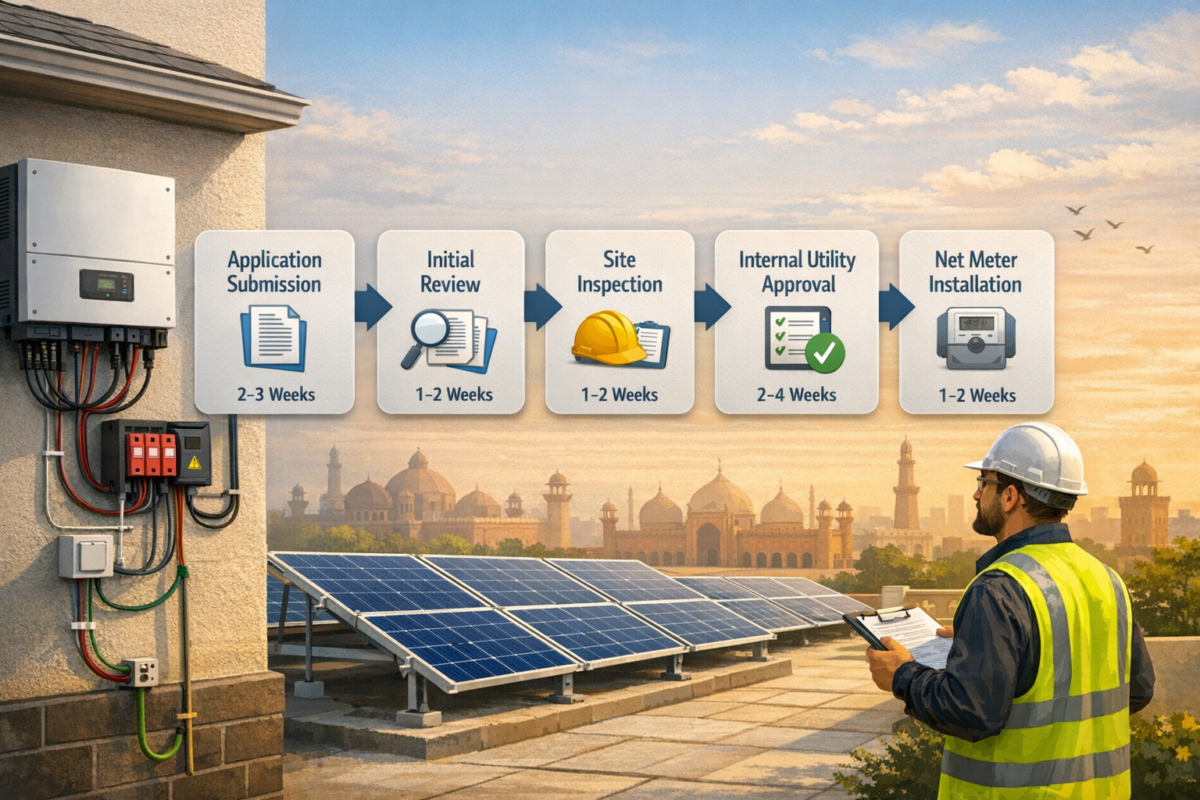
A homeowner in Lahore installs a 10 kW on-grid solar system and submits the application promptly. Initial document scrutiny takes around two weeks. A minor clarification adds another one to two weeks. Inspection scheduling and internal approvals require three to four weeks. The total timeline approaches two months.
Now consider the same application submitted during a peak installation period. Inspection teams are overloaded, scheduling slows, and internal queues lengthen. The same process stretches closer to three months without any issue in the application itself.
Planning around a range, rather than expecting a fixed date, leads to far less frustration.
How the Net Metering Approval Process Moves Step by Step
Understanding where time is consumed removes most confusion. Delays tend to occur at predictable stages rather than randomly.
Application Submission and Initial Scrutiny
Once an application is submitted, it enters a review queue at the utility. Technical drawings, inverter specifications, wiring layouts, protection devices, and ownership records are checked.
At this stage, silence does not always mean progress. In many cases, the file is paused due to missing or unclear details. The application only moves forward once all technical and administrative requirements align.
A detailed explanation of this stage is covered in how to Apply for Net Metering in Pakistan process, including eligibility tips. This article remains focused on timelines rather than procedural steps.
Site Inspection and Meter Verification
After initial scrutiny, a site inspection is scheduled. Inspectors verify earthing quality, protection devices, inverter compliance, wiring routes, export readiness, and meter placement.
This stage is one of the most common sources of delay. Installations that function well day to day may still fail inspection due to safety gaps or non-standard practices. Any required correction leads to re-inspection, which can add weeks.
Many approval delays trace back to avoidable installation mistakes, as explained in the top mistakes to avoid when installing rooftop solar in Pakistan.
Documentation Review and Internal Approvals
Once inspection is cleared, the file moves through internal approval channels. This phase is largely invisible to applicants, and updates are infrequent.
Any request for clarification restarts the approval clock. Delayed responses from the applicant side often extend timelines more than utility processing itself. Clear and prompt replies matter far more than repeated follow-ups.
Final Approval and Bi-Directional Meter Installation
Even after formal approval, meter installation may not happen immediately. Availability of bi-directional meters and installation scheduling affect this final step.
Many applicants assume rejection at this point. In reality, most files are simply waiting in the queue. On the ground, this stage is commonly described as “the file is held, not rejected”.
What Causes Delays in Net Metering Approval
Approval delays follow consistent patterns across utilities.
Documentation Issues
Incomplete forms, mismatched system details, unclear drawings, and missing attachments remain the most common causes of delay. These issues are preventable but frequent.
Inspection Backlogs
During periods of high solar adoption, inspection demand rises sharply. Inspection capacity does not scale at the same pace, creating backlogs, especially in large urban utilities.
Grid Constraints and Local Conditions
Some feeders already carry high rooftop solar penetration. Utilities apply additional scrutiny in these areas, which slows inspection and approval cycles. This dynamic is explored further in grid challenges in Pakistan with high rooftop solar uptake.
Policy Uncertainty and Procedural Slowdowns
Ongoing policy discussions influence internal processing behaviour even before official changes are announced. Export rates, billing structures, and future net billing considerations all affect approval pacing, as explained in Pakistan Solar Policy 2026 whats changing and How Will It Affect You, and the shift from net metering to net billing in Pakistan, timeline impact.
Can Net Metering Approval Be Faster or Slower Than Average
Yes, and the reasons are predictable.
Approvals move faster when documentation is complete, installations pass inspection on the first visit, responses are timely, and application volumes are moderate.
Approvals slow down when files require correction, installations fail inspection, application volumes peak, or grid scrutiny increases.
Approval time is the result of bottlenecks, not chance.
How to Plan Around Net Metering Processing Time
Waiting becomes manageable when expectations are realistic.
Apply at the Right Time
Submit the application as soon as the system fully meets requirements. Delaying submission only extends the overall timeline.
Understand Savings During the Waiting Period
Even without net metering, solar still reduces daytime grid consumption. Electricity bills often drop immediately. Export credits start later, but savings do not stop.
Know Why Export Rate Changes Matter
Some applicants rush for approval due to fear of export rate changes. Policy shifts matter, but decisions should be based on long-term value rather than panic, as explained in the impact of changing the buy-back export rate for solar in Pakistan, what homeowners should know.
Common Myths About Net Metering Approval Time
One common myth is that approval should occur within days. In practice, weeks are normal.
Another myth is that delays indicate rejection. Most delays are procedural, not negative decisions.
A third myth is that unofficial payments speed up approval. Clean documentation, compliant installation, and patience matter far more.
Net Metering Approval Time in Pakistan Today
Approval behaviour changes with adoption cycles. High installation periods slow processing. Quieter periods move faster.
At present, most applicants should plan for weeks rather than days. Many approvals are completed within one to three months. Some take longer. This reflects system capacity, not failure.
Key Takeaways and What to Do Next
Net metering approval time in Pakistan is measured in weeks and sometimes months. Most residential approvals fall within a 30 to 90 day range, with variation driven by documentation quality, inspection workload, grid conditions, and seasonal demand.
If your application is within this window, it is likely progressing normally. If it extends beyond it, the cause is usually identifiable rather than arbitrary.
While utility workload is outside your control, preparation quality, installation compliance, and response speed are not. Managing those factors makes the process predictable rather than stressful.
Net metering approval is rarely random. It follows a system. Once that system is understood, waiting becomes manageable, and confidence replaces uncertainty.
Independent Power: Connect with Enon Traders Today!
Start your off-grid journey with Pakistan’s most reliable solar partner.
| Connect With Us | Action Link |
| Chat Instantly on WhatsApp | Get an off-grid system quote: Click to Chat Now! |
| Visit Our Website | View our off-grid inverters: Official Website |
| Call Our Experts | Design your custom micro-grid: Contact Page |