Solar Battery Maintenance Guide: Practical Battery Care Tips to Extend Lifespan
March 17, 2026
Solar Equipment Tax in Pakistan 2026: GST on Panels, Inverters and Batteries Explained
March 19, 2026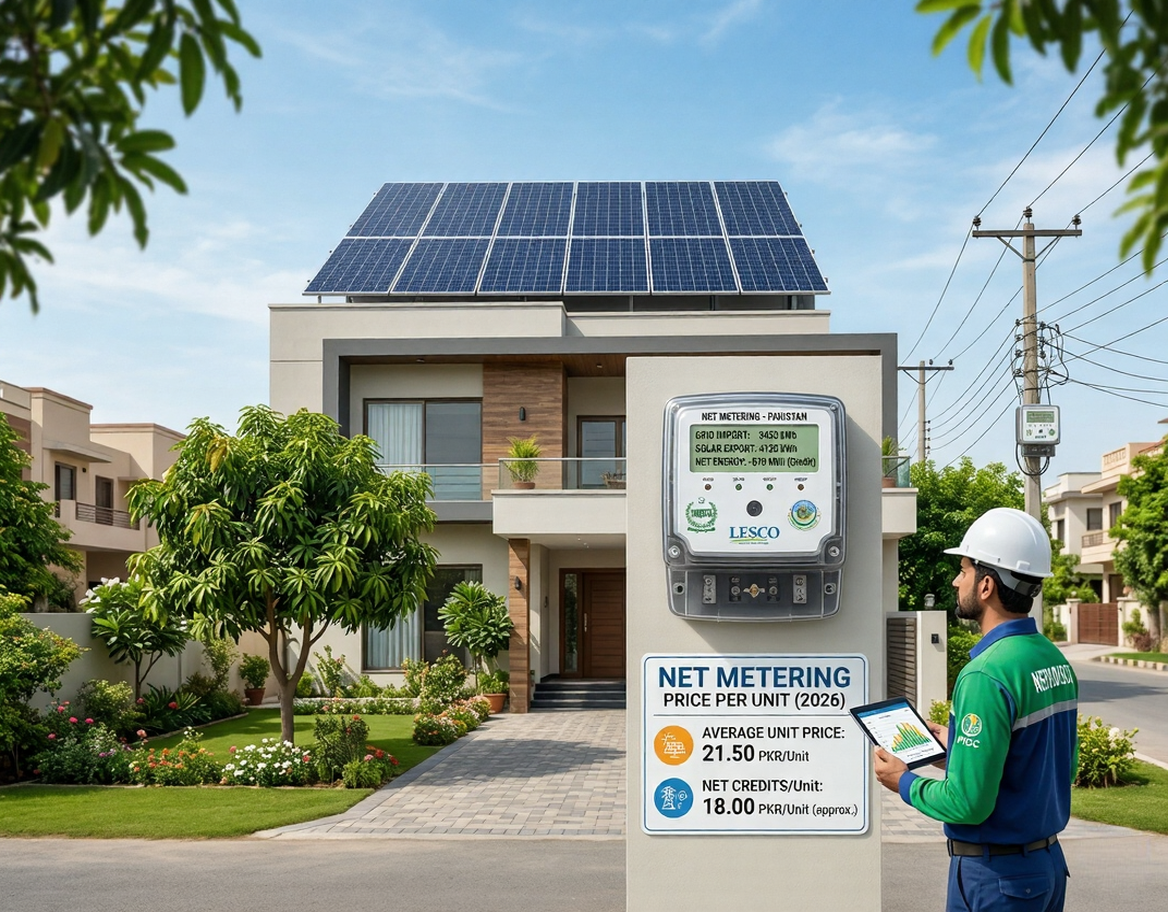
If you are searching for the net metering price per unit in Pakistan, you want one clear answer:
What rate do I actually receive for the solar electricity I export to the grid?
Here is the accurate explanation under the current NEPRA framework:
- Exported solar units receive credit under NEPRA’s approved distributed generation regulations.
- The credit applies primarily to the energy component of the tariff.
- Taxes, fuel adjustments, quarterly adjustments, and fixed charges are not mirrored in the export credit.
- Export reduces your bill. It does not generate monthly income.
This structural distinction is what most homeowners misunderstand.
Understanding it properly protects your savings calculation and payback expectations in 2026.
Understanding Net Metering in Pakistan
Before discussing price per unit, it is important to understand how net metering works across LESCO, IESCO, GEPCO, and other DISCO regions.
Net metering is regulated nationally by NEPRA. Billing implementation is handled by your regional DISCO. While formatting may vary slightly between regions, the pricing structure remains consistent under federal regulation.
What Net Metering Actually Means
Net metering connects your solar system to the national grid through a bi-directional meter.
That meter records:
- Units you import when solar production is low
- Units you export when solar production exceeds your load
In Pakistan, you typically do not receive cash payments.
Instead, exported units create a billing credit that offsets imported units within the billing cycle.
In simple terms:
Export reduces your payable bill. It does not function as salary income.
Who Determines the Net Metering Price Per Unit in Pakistan?
Net metering pricing is not market-driven.
It operates under NEPRA’s distributed generation regulatory framework. The buy-back structure is defined through official determinations and implemented nationwide through DISCO billing systems.
Your installer does not set the rate. Social media does not define it. It is a regulated structure.
What Is the Current Net Metering Price Per Unit in Pakistan (2026)?
This is the core question.
Under the prevailing framework:
- Export credit reflects the approved energy component of the tariff.
- It does not include fuel price adjustments.
- It does not include quarterly tariff adjustments.
- It does not include taxes or fixed charges.
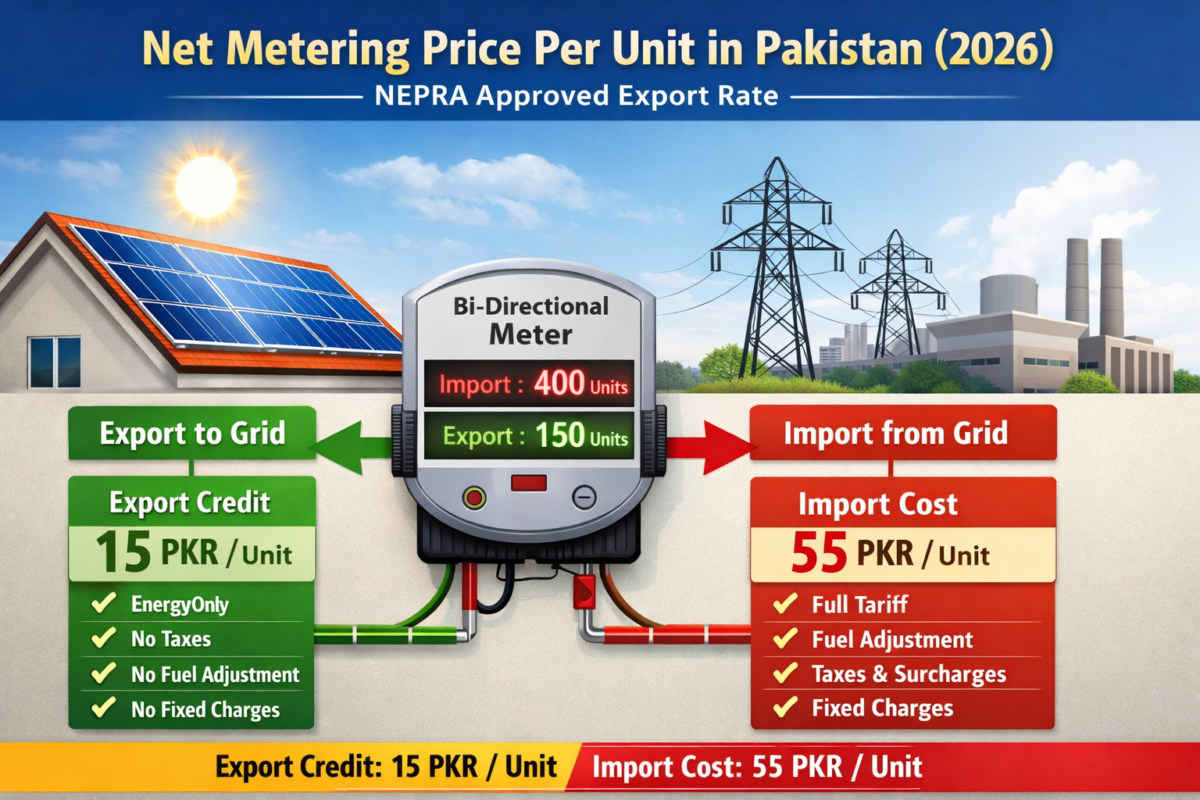
Many homeowners assume: “If I import at 55 per unit, I export at 55 per unit.” That assumption is incomplete.
Your import bill typically contains:
- Base tariff
- Fuel price adjustment
- Quarterly adjustments
- Taxes
- Fixed charges
- Surcharges
Export credit applies to the approved energy structure, not the entire retail bill composition. This is why exported units reduce your bill significantly, but may not cancel it entirely.
The system is working correctly. The expectation is often incorrect.
Real Example: How Export Credit Works in Rupees
Let us look at a simplified monthly scenario.
Import Units: 400
Export Units: 150
Assume your effective retail import rate averages 55 PKR per unit, including adjustments.
400 × 55 = 22,000 PKR (gross energy cost before fixed charges)
Now, export credit applies to 150 units under the approved energy component structure.
150 units are credited against your import energy component.
However, your final bill still includes:
- Fixed charges
- Taxes
- Fuel adjustments
- Meter rent
So even with strong exports, your payable amount may not drop to zero. The credit offsets energy. It does not eliminate regulatory layers. This is where confusion usually begins.
Import vs Export: Structural Comparison
|
Component |
Import Tariff |
Export Credit |
|
Base Energy Rate |
Yes |
Yes |
|
Fuel Adjustment |
Yes |
No |
|
Quarterly Adjustment |
Yes |
No |
|
Taxes |
Yes |
No |
|
Fixed Charges |
Yes |
No |
|
Additional Surcharges |
Yes |
No |
This structural difference explains the perceived gap between import and export value.
Where to Verify Your Actual Export Credit
The most reliable source is your electricity bill.
Look for:
- Import Units
- Export Units
- Net Units
- Export Credit Amount
If clarification is needed, request a breakdown from your DISCO office. Do not rely solely on installer marketing claims.
How the Buy Back Rate Affects Your Solar Savings
Export credit supports savings. Self-consumption creates maximum savings.
Here is how the economics work:
- Your home consumes solar electricity first.
- Excess solar exports to the grid.
- Export credit offsets imported units.
The more electricity you consume during daylight hours, the stronger your financial outcome.
Does Exporting More Always Increase Savings?
Not necessarily.
Oversizing a system purely for export can reduce financial efficiency because:
- Export credit does not mirror the full retail tariff
- Grid voltage issues can limit export
- Inverter clipping can reduce usable generation
Before finalizing your system size, review how to size your home solar system properly so export remains secondary to self-consumption.
Practical Factors That Influence Your Effective Rate
Even when the regulatory structure remains stable, your real-world benefit depends on system design and grid behavior.
Grid Limitations and Voltage Issues
High rooftop solar penetration in certain Lahore and Islamabad neighborhoods has created voltage rise challenges.
Inverters may:
- Limit output
- Reduce export
- Trip during peak production
This reduces exported units and affects your perceived benefit. To understand this issue in depth, review common grid challenges faced in high rooftop solar areas.
Phase Type and Inverter Selection
Single-phase systems may behave differently from three-phase setups under export conditions.
Your inverter choice affects:
- Voltage tolerance
- Export stability
- Long-term reliability
Before installation, evaluate whether a single-phase inverter suits your load pattern and grid condition.
Net Metering vs Net Billing: Why the Difference Matters
There is increasing discussion about structural shifts toward net billing. Under net metering, exported units offset imported units within the billing cycle.
Under net billing:
Exported units may be valued separately and settled at defined rates independent of your import tariff. Understanding the shift from net-meteung to net-billing in Pakistan is essential for long-term planning.
Common Misunderstandings About Net Metering Price Per Unit in Pakistan
Misconception 1: The Government Pays a Monthly Income
Net metering reduces your electricity bill.
It does not function as passive salary income.
Misconception 2: Export Rate Equals Import Rate
Import tariff includes layered regulatory components. Export credit follows a defined energy structure only. They are not identical.
Misconception 3: Bigger System Means Bigger Profit
Oversizing without proper load analysis reduces ROI efficiency.
To calculate payback accurately, review how to calculate the payback period for your home solar system in Pakistan.
Is Net Metering Still Worth It in 2026?
Yes. But expectations must be realistic.
Net metering remains financially strong when:
- You consume significant daytime electricity
- Your system is sized correctly
- Export is treated as support, not primary income
If nighttime usage is high, evaluate battery storage for home solar to increase self-consumption. Additionally, understanding how policy changes in 2026 may shape rooftop solar ROI helps you plan responsibly.
Final Conclusion
When you search for net metering price per unit in Pakistan, you are not looking for marketing. You are looking for clarity.
Here is the honest summary:
- The buy-back rate applies to exported units under NEPRA regulation.
- Export credit offsets energy but does not mirror the full retail tariff structure.
- Self-consumption delivers the strongest savings.
- Proper system sizing protects ROI.
- Regulatory awareness prevents unrealistic expectations.
Net metering remains financially meaningful in 2026 for well-designed systems. Clarity creates confidence. Confidence protects your investment.
Independent Power: Connect with Enon Traders Today!
Start your off-grid journey with Pakistan’s most reliable solar partner.
| Connect With Us | Action Link |
| Chat Instantly on WhatsApp | Get an off-grid system quote: Click to Chat Now! |
| Visit Our Website | View our off-grid inverters: Official Website |
| Call Our Experts | Design your custom micro-grid: Contact Page |