Solar Panel Warranty in Pakistan (2026): Coverage and Performance Explained
March 20, 2026
Inverter Overload Capacity in Pakistan (2026): How Much Load Your Inverter Can Handle Safely
March 25, 2026
If you searched for solar charge controller Pakistan, you are not looking for textbook definitions.
You want a clear decision.
You want to know:
- Which controller fits your system
- How to size it correctly
- Whether PWM or MPPT is better
- What mistakes destroy batteries in Pakistan’s heat
A solar charge controller may look small, but it protects one of the most expensive components in any battery-based solar system: the battery bank.
When the controller is wrong:
- Batteries overheat
- Charging becomes unstable
- Backup time drops
- Battery life shortens quietly
Most homeowners notice months later. They blame the panels or battery quality. In reality, the issue often sits inside the controller box.
This practical guide explains:
- What a solar charge controller actually does
- The real difference between PWM and MPPT
- How to size a controller correctly
- What fails in Pakistani conditions
- Typical price expectations
- How to choose safely in a market full of look-alike products
What a Solar Charge Controller Actually Does
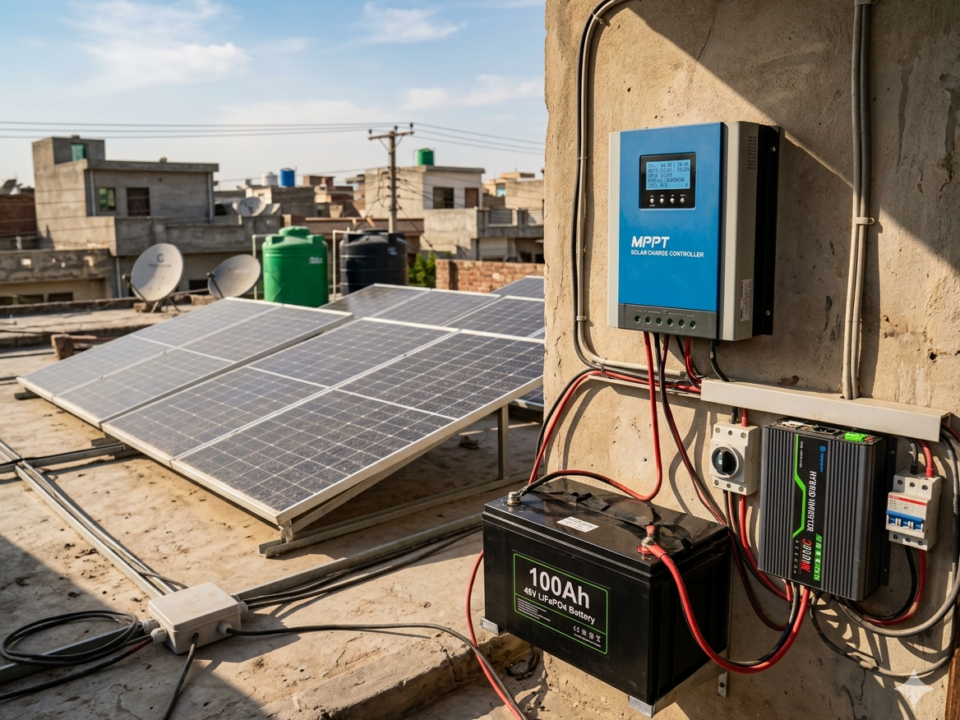
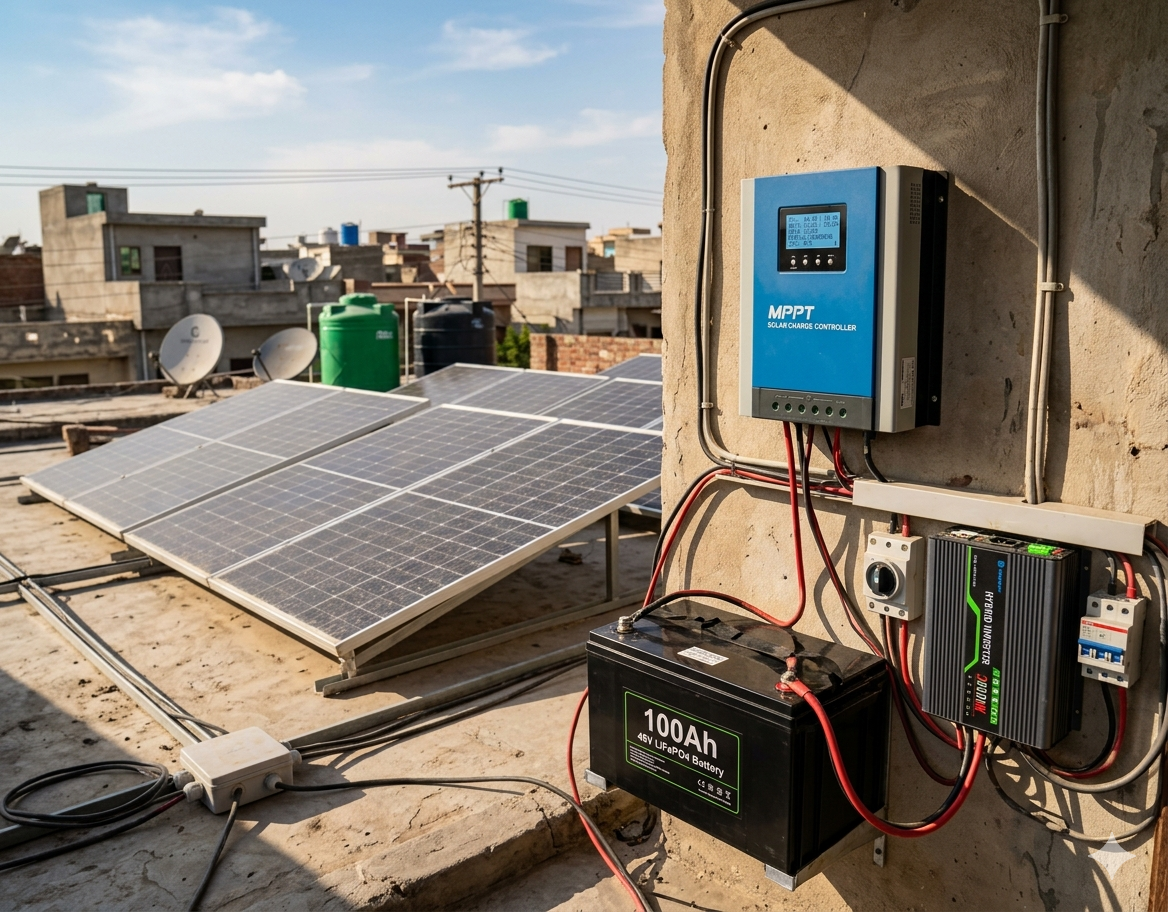
A solar charge controller sits between your solar panels and battery bank.
Its job is simple but critical:
- Prevent overcharging
- Prevent deep discharge
- Stabilize charging current
- Protect against reverse current at night
Without a controller, batteries can overcharge within hours on a sunny day. Over time, this causes:
- Excess water loss in tubular batteries
- Plate damage
- Reduced backup capacity
- Shortened battery life
In Pakistan, this becomes worse during peak summer. High ambient temperature increases the battery’s internal temperature. Charging voltage must be controlled carefully. A weak or incorrectly sized controller struggles under these conditions.
If you are building a battery-based setup, understand the system layout first. Many homeowners skip planning and patch later. You get better long-term performance when you understand off-grid solar system design before selecting components.
Solar Charge Controller Types in Pakistan: PWM vs MPPT
Most controllers in Pakistan fall into two categories:
- PWM (Pulse Width Modulation)
- MPPT (Maximum Power Point Tracking)
They are not interchangeable. Each serves a different system type.
PWM Solar Charge Controller Explained Simply
A PWM controller works like a controlled switch. It connects the panel to the battery in pulses to regulate voltage.
Best suited for:
- Small 12V systems
- Panel voltage close to battery voltage
- Short wiring runs
- Budget setups
Limitations:
If the panel voltage is higher than the battery voltage, PWM does not convert the extra voltage into usable current. That extra potential is lost.
In small rural lighting systems or backup-only mini setups, PWM works fine when correctly sized.
MPPT Solar Charge Controller Explained Clearly
An MPPT controller actively tracks the panel’s optimal voltage point and converts excess voltage into additional charging current.
In practical terms:
- Higher panel voltage
- Converted into a more usable current
- Faster battery charging
MPPT performs better when:
- System size is 1kW and above
- The battery bank is 24V or 48V
- Panels are wired in series
- You depend heavily on evening backup
MPPT makes the biggest difference:
- Early morning
- Cloudy conditions
- Winter
- Long wiring distances
If you want a deeper technical breakdown in Pakistani conditions, read the mppt technology guide in Pakistan.
PWM vs MPPT Comparison (Clear Technical Summary)
|
Feature |
PWM |
MPPT |
|
Cost |
Lower |
Higher |
|
Efficiency |
Moderate |
High (10–25% gain depending on setup) |
|
Best For |
Small 12V systems |
24V/48V and larger systems |
|
Voltage Conversion |
No |
Yes |
|
Expansion Friendly |
Limited |
Yes |
|
Heat Performance |
Moderate |
Better under stress |
Honest Conclusion:
MPPT is not magic.
But for serious battery-based systems in Pakistan, MPPT usually delivers more stable charging and longer battery life.
Solar Charge Controller Price in Pakistan (2026 Market Reality)
Prices vary based on:
- Amp rating
- PV input voltage
- Build quality
- Protections included
- Brand authenticity
Typical Market Ranges (Approximate)
- 20A PWM: Lower bracket entry level
- 40A–60A PWM: Mid-range
- 40A–100A MPPT: Higher bracket
- High-voltage MPPT (150V+ input): Premium tier
Do not select purely on price.
A cheap controller can shorten battery life.
Replacing batteries costs far more than upgrading the controller once.
If you want to avoid low-quality imports that fail during summer, read how to choose quality solar equipment in Pakistan, avoiding substandard imports.
How to Size a Solar Charge Controller Correctly
Sizing mistakes cause more damage than brand choice.
Follow this method.
Step 1: Confirm Battery Bank Voltage
Is your bank:
- 12V
- 24V
- 48V
The controller must match this.
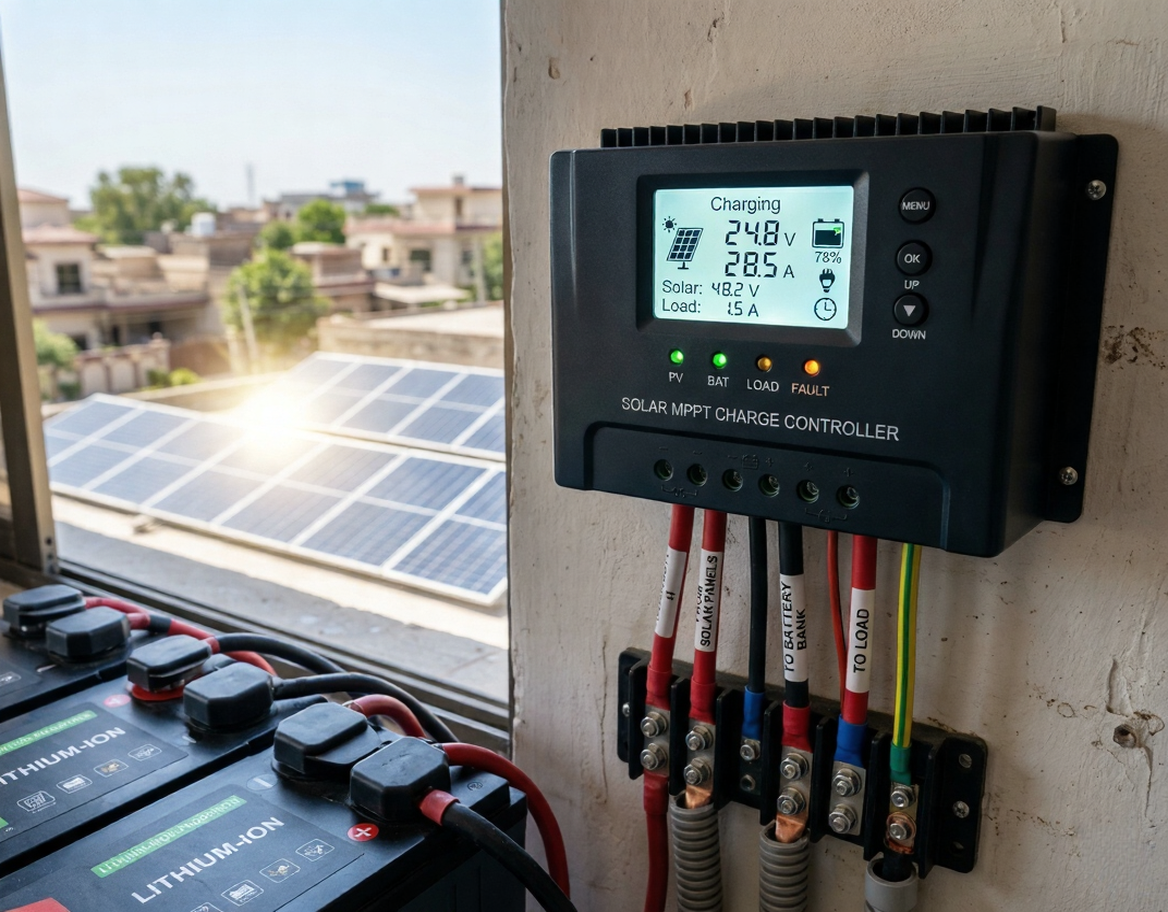
Step 2: Calculate Required Charging Current
Use this formula:
Controller Amps ≥ Total Panel Watts ÷ Battery Voltage
Then add 25% safety margin.
Example:
800W panels
12V battery bank
800 ÷ 12 = 66A
You should choose a ~80A controller minimum.
Pakistan’s heat, dust, and long charging hours demand headroom.
Step 3: Check Maximum PV Input Voltage (Critical for MPPT)
If you wire panels in series, the voltage increases. Cold mornings can raise panel voltage further.
If the PV voltage exceeds the controller limit, it can fail instantly. This is one of the most common silent mistakes in local installations.
Step 4: Do Not Ignore Wiring
Many installers oversize controllers but use thin DC cables.
Results:
- Voltage drop
- Heating
- Reduced charging efficiency
Use the correct cable sizing from the solar DC cables guide.
Battery Compatibility: Lead Acid vs Lithium
Battery chemistry changes charging behavior.
Tubular lead-acid:
- More forgiving
- Needs correct float and absorption settings
- Sensitive to chronic undercharging
Lithium:
- Requires precise voltage control
- Often integrates BMS protection
- Benefits from stable MPPT charging
If you are comparing battery types, read lithium vs tubular battery in Pakistan.
If adding batteries to an existing system, do not mix blindly. Follow a structured approach on how to integrate battery backup with your solar system in Pakistan.
Common Solar Charge Controller Failures in Pakistan
Here is what actually happens in the field.
1. Batteries Overheat, and Water Drops Quickly
Usually caused by incorrect charging voltage or lack of temperature compensation.
2. Backup Time Drops After 6-12 Months
Chronic undercharging reduces battery capacity gradually.
3. Controller Fails in June or July
Heat plus maximum current exposure kills low-quality units.
4. Fake MPPT Controllers
Some units display “MPPT” but operate like PWM internally.
Performance never matches true MPPT behavior.
Can a Hybrid Inverter Replace a Charge Controller?
Many modern hybrid inverters include built-in MPPT.
If your inverter:
- Accepts PV input
- Charges battery directly
Then you may not need a separate controller for that PV line.
However, you still need a separate controller when:
- Running a DC-only system
- Building a small independent backup setup
- Operating panels outside the inverter MPPT input
Do not duplicate charging paths without planning.
Rooftop Installation Safety Reminder
Charge controllers fail more often in poorly installed systems.
Before finalizing installation, review the top mistakes to avoid when installing rooftop solar in Pakistan to prevent:
- Poor ventilation
- Cable routing errors
- Improper fusing
- Unsafe panel series configuration
Practical Buying Checklist (Save This Before Purchase)
- Confirm system voltage
- Calculate required amps + 25% buffer
- Choose PWM vs MPPT logically
- Verify PV max voltage
- Ensure proper ventilation
- Check protections (reverse polarity, overload)
- Match cable size to current
- Plan expansion in advance
Final Verdict: Choose With Numbers, Not Labels
A solar charge controller is not an accessory.
It is the protection system for your battery investment.
Make your decision using:
- Panel wattage
- Battery voltage
- Required charging current
- PV input limits
- Expansion plans
Avoid marketing labels and under-sizing. Avoid copying someone else’s system blindly.
When you calculate correctly and choose with headroom, your batteries last longer, your charging remains stable, and your system performs reliably through Pakistan’s toughest summers.
That is the real purpose of this guide.
Independent Power: Connect with Enon Traders Today!
Start your off-grid journey with Pakistan’s most reliable solar partner.
| Connect With Us | Action Link |
| Chat Instantly on WhatsApp | Get an off-grid system quote: Click to Chat Now! |
| Visit Our Website | View our off-grid inverters: Official Website |
| Call Our Experts | Design your custom micro-grid: Contact Page |