
Why This Comparison Gets Framed Wrong
Most UPS-vs-solar comparisons stop at sticker price, which makes UPS look like the obvious budget choice. But our series opener flagged this exact problem: UPS systems drain fast on extended outages and need recurring battery replacement, while a hybrid solar system is a one-time investment that keeps generating free backup power for a decade or more.
Want a real cost comparison based on your actual outage hours? Ask our team on WhatsApp.
Head-to-Head Comparison
| Factor | Standard UPS | Solar Hybrid + Lithium Battery |
|---|---|---|
| Upfront cost | Rs 25,000–60,000 | Rs 800,000+ (full system) |
| Backup duration | 30 min – 2 hours | Full-day/night with correct sizing |
| Recharge source | Grid electricity (costs money) | Free sunlight during the day |
| Battery lifespan | 2-3 years (lead-acid) | 8-10+ years (lithium) |
| Ongoing cost | Battery replacement + electricity to recharge | Near-zero after installation |
| Net metering eligible | No | Yes, if grid-tied |
The 5-Year Real Cost Picture
When a UPS Still Makes Sense
- Renters who can't install rooftop equipment and need short-term backup only
- Areas with genuinely brief, infrequent outages (under 1 hour, a few times a month)
- As a temporary bridge solution while saving up for or planning a full solar installation
- Backing up a single critical device (like a router or medical equipment) rather than a household
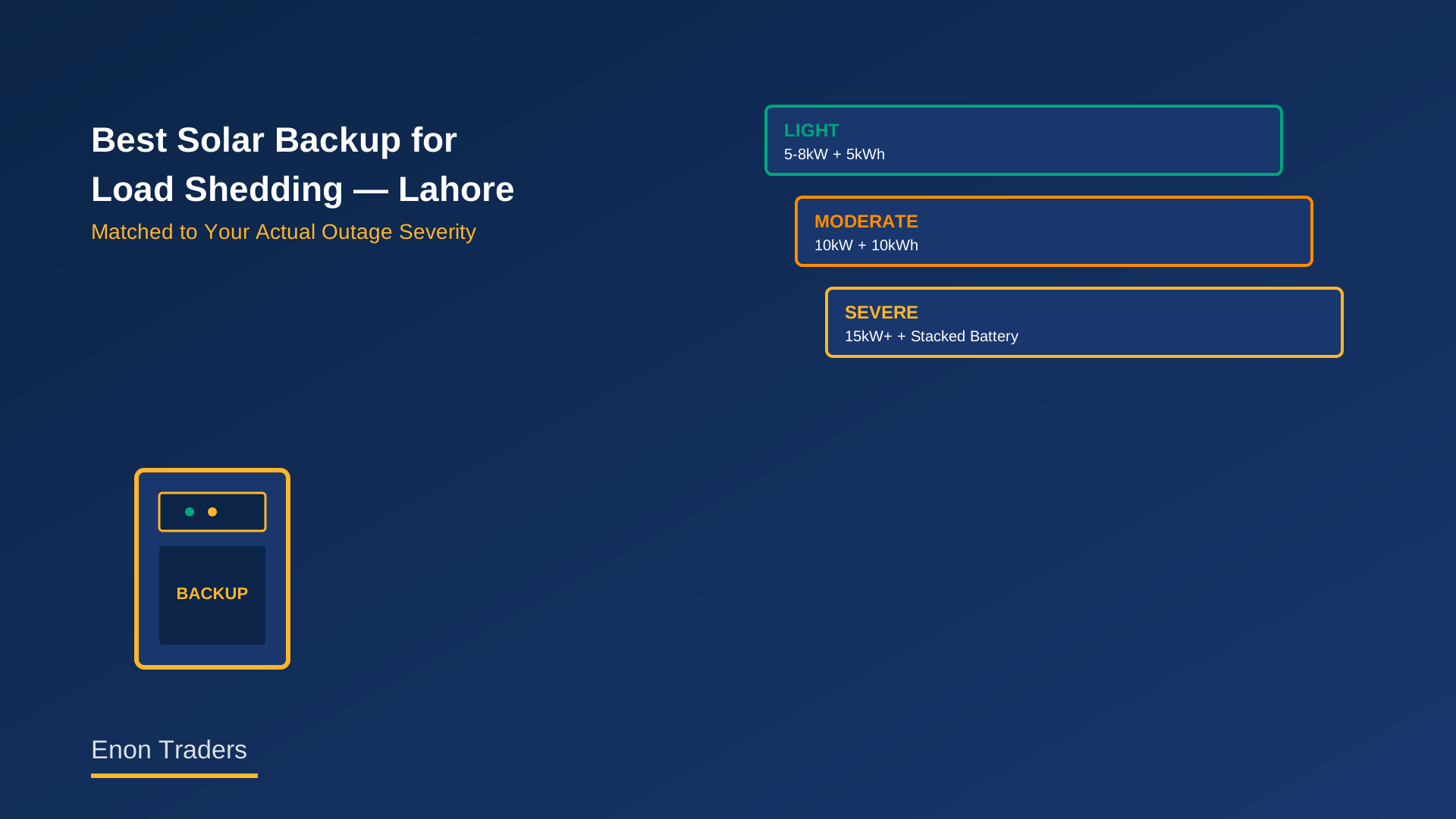
For anyone facing the moderate-to-severe outage patterns described in our system tier guide, a UPS simply isn't built to solve the problem at scale — it's a stopgap, not a real backup solution.
If load shedding in your area is a recurring, meaningful problem — not an occasional inconvenience — a solar hybrid system is the financially smarter choice over a 5+ year horizon, not just the more reliable one. A UPS remains a sensible stopgap for light, short outages or as a bridge while you plan a full solar installation, but it was never designed to solve daily multi-hour load shedding.
We'll walk you through the real cost comparison for your specific outage pattern. Get a free consultation on WhatsApp →
Related Guides in This Series
System Tiers by Severity
Match your solar backup system to your area's actual outage pattern.
View system tiers →Best Solar Batteries Guide
Compare lithium battery brands for the best cost-per-kWh over their lifetime.
View battery guide →Solar Financing Guide
Financing options that make the upfront solar cost manageable monthly.
View financing guide →Frequently Asked Questions
In some setups, yes, though it's generally more efficient and reliable to let the solar hybrid inverter and its dedicated battery handle backup entirely, rather than running two separate systems in parallel.
Frequent deep discharge cycles during extended outages accelerate lead-acid battery wear, which is why UPS batteries in heavy load-shedding areas often need replacement sooner than the typical 2-3 year estimate.
For genuinely light, infrequent outages, a UPS's lower upfront cost can make sense — the cost calculus shifts toward solar specifically when outages become frequent or extended.
A quality hybrid inverter includes voltage regulation as part of its normal operation, similar to a UPS's stabilizing function, though this varies by inverter model and specification.
Yes — see our financing guide for options like SBP Green Line and bank loans that turn the upfront solar cost into a manageable monthly payment, often below what you'd spend on UPS electricity and battery replacement combined.
A smaller off-grid solar setup with a modest battery, sized just for essential loads, can serve as a middle ground — see our on-grid vs hybrid vs off-grid guide for scaled-down options.