Residential Load-Based Solar System Sizing in Pakistan: Calculate the Right kW for Your Home
May 6, 2026
Canadian 620/625 Watt Bifacial HJT Solar Panel: The Ultimate Power Upgrade for Pakistan
May 8, 2026
The Pakistani solar industry has undergone an unprecedented level of development compared to any other. Pakistan currently stands among the biggest importers of solar panels globally, importing up to 17 gigawatts worth of solar panels in a year. However, behind this figure lies a whole system that many consumers know little about, and a lack of knowledge can be quite costly.
This guide will cover everything a distributor, installer, or business should know about wholesale solar in Pakistan and how to navigate bulk buying of solar products without losing any money.
Why Pakistan’s Wholesale Solar Market Looks Nothing Like Retail
Wholesale Solar vs Retail Buying in Pakistan
|
Factor |
Wholesale |
Retail |
|
Price per watt |
Lower |
Higher |
|
MOQ |
High |
Low |
|
Warranty risk |
Medium |
Low |
|
Best for |
Businesses |
Homeowners |
The Gap Between What Installers Pay and What Homeowners Are Quoted
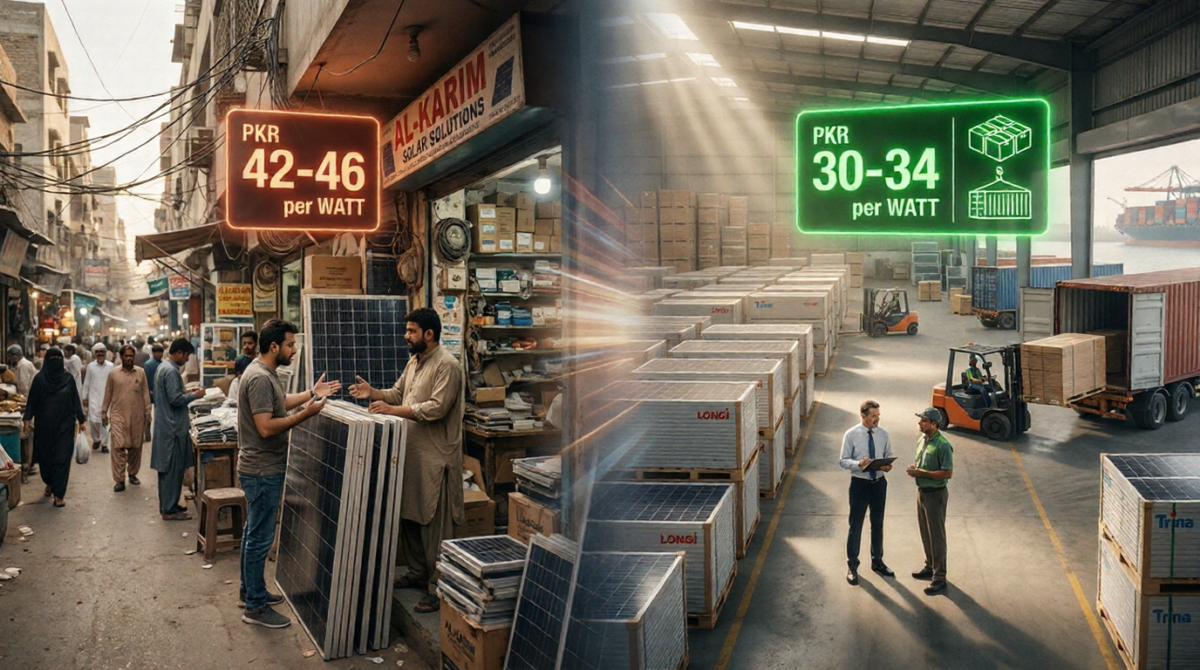
Walk into any solar shop in Lahore or Karachi, and you will see a price on the shelf. But that price is rarely what the installer actually paid. The spread between wholesale and retail in Pakistan’s solar market can range from PKR 5 to PKR 15 per watt, depending on brand, volume, and payment terms.
A homeowner buying a 10kW system sees the retail-marketed price. A contractor buying 50 pallets per month sees something very different. That gap is the wholesale solar market, and most online content in Pakistan completely ignores it.
How the Informal Supply Chain Creates Price Confusion
Pakistan does not have a centralized solar wholesale market the way other commodity markets work. There is no single exchange or official price board. Prices shift daily based on the dollar rate, import clearances, and how much stock a distributor is holding at any given time.
This confusion is common, especially for new entrants who assume the per-watt prices listed on websites reflect actual bulk rates. They rarely do.
How Pakistan’s Bulk Solar Supply Chain Is Actually Structured
Where Panels, Inverters, and Batteries Enter the Country
Almost all solar panels in Pakistan come from China. The supply chain starts at the Chinese factory, moves through Karachi port, clears customs, and enters the hands of large-scale importers. These importers buy at the container level, typically 20 to 40-foot containers holding between 500 and 1,000 panels, depending on wattage.
To understand how imported solar modules and batteries affect cost trends in Pakistan, it helps to know that import duty, customs clearing charges, and dollar fluctuations all sit between the factory price and what the end distributor actually pays.
The Role of Importers, Distributors, and Regional Wholesalers
Here is how Pakistan’s bulk solar supply chain actually looks:
|
Level |
Who They Are |
What They Buy |
Typical MOQ |
|
Importer |
Large national trading companies |
Full containers |
1 container minimum |
|
City Distributor |
Authorized brand resellers |
Pallets (20 to 50 panels) |
1 pallet minimum |
|
Regional Wholesaler |
Mid-tier traders in markets |
Small lots |
10 to 20 panels |
|
Installer / Retailer |
Local solar companies |
Per project |
1 panel and above |
Each layer adds margin. The further you are from the importer, the higher your per-watt cost. This is why serious bulk buyers try to go as high up the chain as their order volume allows.
Which Cities Anchor the Wholesale Solar Trade
Three cities dominate Pakistan’s bulk solar trade:
- Lahore: Hall Road and surrounding markets handle a large share of panel and inverter distribution across Punjab.
- Karachi: The Saddar market area hosts authorized distributors for most major international brands.
- Rawalpindi: College Road serves buyers from KPK and northern Punjab.
What Is Driving Bulk Solar Demand Right Now
Load Shedding, Net Metering, and the Commercial Installation Boom
The residential boom is well documented, but the bigger wholesale demand driver today is commercial and industrial buyers. Factories, textile mills, hospitals, and housing societies are buying solar at scale. These buyers often place single orders worth tens of millions of rupees.
For factories specifically, the savings via solar installations are significant enough that procurement teams now buy direct from importers rather than going through installers.
Why the Market Shifted Permanently After the Supply Glut
A major supply glut reshaped the entire wholesale market. Importers had ordered aggressively when the rupee stabilized, but demand slowed faster than expected. The result was an oversupply so severe that some traders were offloading panels at a loss.
What this means for buyers in 2026: per-watt prices have dropped significantly from their peak of PKR 110 to 140, down to current levels in the PKR 33 to 42 range. Buyers now have real pricing power that did not exist before.
Wholesale Solar Pricing in Pakistan: What to Realistically Expect
How Bulk Pricing Tiers Work
Pricing in Pakistan’s wholesale solar market works on volume bands. The more you buy, the lower your per-watt cost. Here is a general structure based on current market conditions:
- Retail or single panel: PKR 38 to 46 per watt
- Small lot (10 to 50 panels): PKR 35 to 40 per watt
- Pallet (100 to 200 panels): PKR 33 to 37 per watt
- Container (500 or more panels): PKR 30 to 34 per watt
These are indicative ranges. Actual pricing depends on brand, technology type, and the current dollar rate. Checking imported solar equipment prices regularly is essential because rates move week to week.
Why PKR Volatility and Import Duties Make Prices a Moving Target
When the rupee weakens against the dollar, wholesale prices rise almost immediately. Importers absorb very little currency risk and pass it directly to buyers. This is why you should never lock into a price without confirming the delivery date and whether the quote is dollar-indexed.
The impact of inflation on solar prices in Pakistan has been a recurring issue, and any serious wholesale buyer needs to factor in short delivery windows or currency-adjusted agreements.
The Difference Between Grey Market and Officially Imported Stock
Grey market panels exist in Pakistan. These are panels imported through unofficial channels, often without original warranty documentation or proper customs clearance. They look identical to genuine stock but carry no enforceable warranty.
Learning how to choose quality solar equipment and avoid substandard imports is critical before making any bulk purchase. Always ask for the serial number sheet and cross-verify it with the manufacturer’s database before making any payment.
How to Actually Source Solar in Bulk in Pakistan
Direct Importer vs. Regional Distributor: Which Route Makes Sense
If your order volume is above two containers per month, going direct to an importer makes financial sense. Below that volume, a city-level authorized distributor usually offers better flexibility on MOQ, payment terms, and after-sales support.
Before committing to any supplier, always work through a checklist before buying solar panels or inverters from Pakistan’s market.
What Documentation and MOQs Typically Look Like
Standard documentation for a wholesale solar purchase in Pakistan includes:
- Commercial invoice from the importer
- Packing list with panel serial numbers
- Original warranty card, not a photocopy
- Import clearance documentation for container-level orders
MOQs vary by seller. Most city distributors will sell from a single pallet. Container-level importers typically require one full container minimum. Payment is usually 100 percent advance for first-time buyers, with credit terms opening after an established relationship.
Red Flags to Watch for When Sourcing Wholesale
- Prices that are PKR 5 to 8 per watt below the current market rate, with no explanation
- No physical address or warehouse available to inspect stock
- Warranty cards that are photocopied or missing brand holograms
- Pressure to pay cash with no formal invoice
Knowing how to identify genuine solar panels and spot fake ones can protect you from major losses on bulk orders before it is too late.
Where Pakistan’s Wholesale Solar Market Is Heading in 2026
Supply, Margins, and What It Means for Buyers Today
Distributor margins remain compressed from the oversupply period, which is good news for buyers but difficult for mid-tier traders. Many wholesalers have reduced inventory exposure and now buy in smaller lots more frequently rather than holding large stock positions.
Understanding why Pakistan is becoming a major solar market and what constraints exist helps explain why, despite short-term margin pressure, the long-term demand trajectory remains strong. Commercial and industrial projects will continue driving bulk orders even as residential demand adjusts to the revised net metering buy-back rate.
Brands and Product Categories Gaining Ground in Bulk Orders
N-type TOPCon panels are now the dominant technology in serious bulk orders. Brands like Longi, Jinko, and Canadian Solar continue to lead, but newer entrants offering competitive N-type pricing are gaining ground fast. On the inverter side, hybrid inverters are increasingly ordered in bulk by developers supplying commercial projects.
For buyers evaluating N-type solar panels for Pakistan’s market, the technology shift from P-type is already well underway at the wholesale level and shows no sign of reversing.
Final thoughts
The Pakistan solar wholesalers favor customers who comprehend the logistics involved, check their inventories, and have connections with the importers themselves. The difference between what is being talked about on the internet and what really happens around Hall Road or Saddar is enormous.
Gray market inventory is a reality. Pricing structures are real, too. And finally, in 2026, there will be real power for any bulk purchaser that knows how to wield it. Now that you know both sides of the business.
Independent Power: Connect with Enon Traders Today!
Start your off-grid journey with Pakistan’s most reliable solar partner.
| Connect With Us | Action Link |
| Chat Instantly on WhatsApp | Get an off-grid system quote: Click to Chat Now! |
| Visit Our Website | View our off-grid inverters: Official Website |
| Call Our Experts | Design your custom micro-grid: Contact Page |