How to Integrate Battery Backup with Your Solar System in Pakistan
January 8, 2026
Solar Panel Size Calculator Pakistan – Load-Based System Sizing
January 12, 2026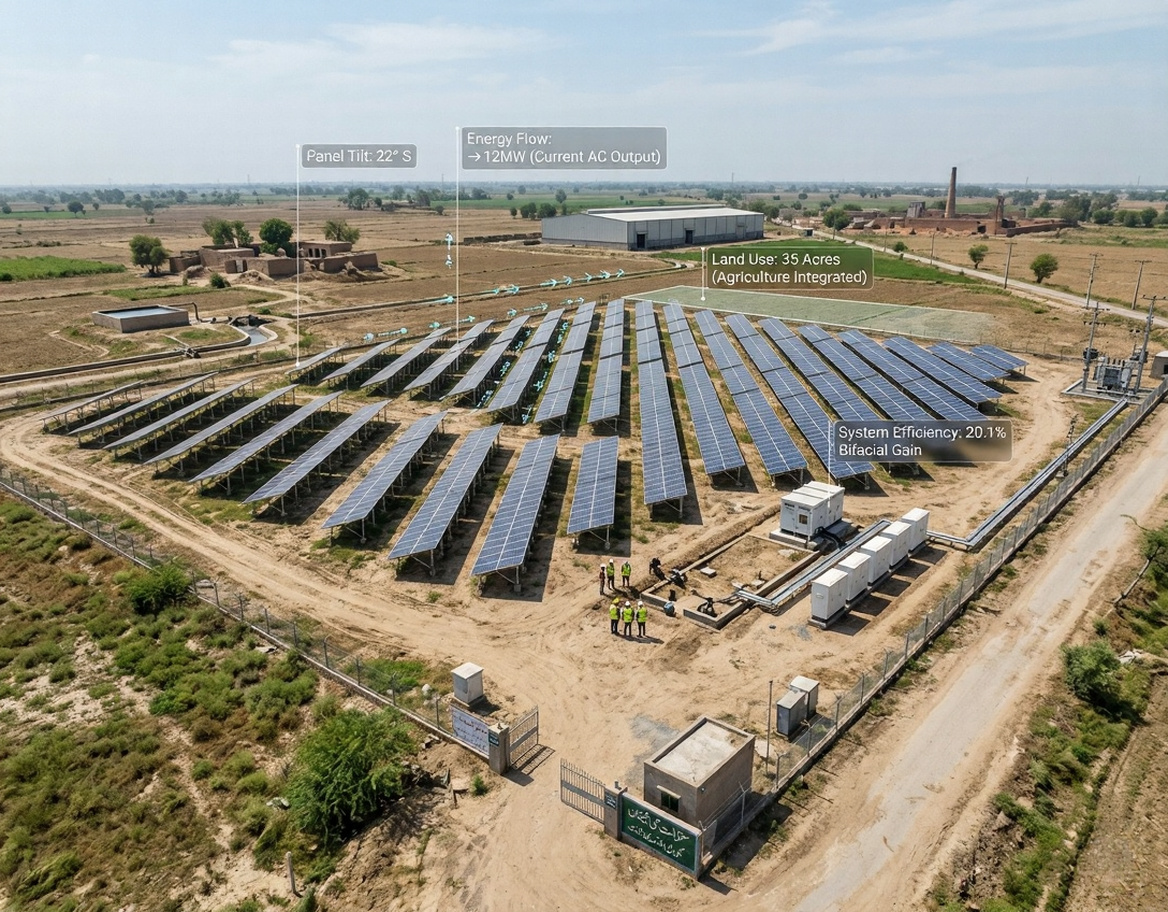
Electricity costs in Pakistan are no longer just a household problem. Factories, farms, warehouses, and commercial facilities are all facing rising operational expenses due to unstable grid supply and rising tariffs. While rooftop solar remains popular, many larger consumers are now exploring ground-mounted solar systems to overcome space limitations and expand long-term energy production.
Ground-mounted solar panels offer flexibility that rooftop systems often cannot provide. They allow better panel orientation, easier expansion, improved airflow, and simpler maintenance access. However, they also introduce additional planning challenges that many buyers underestimate during the early stages.
For agricultural landowners, industrial users, and businesses with unused open space, ground-mounted solar can become a practical long-term investment when designed correctly. But it is not automatically the right solution for every property.
This guide explains when ground-mounted solar panels make sense in Pakistan, how they compare to rooftop systems, what costs and land requirements to expect, and which mistakes buyers should avoid before installation.
What Are Ground-Mounted Solar Panels?
Ground-mounted solar systems are photovoltaic installations built directly on land instead of rooftops. The solar panels are installed on metal structures anchored into the ground using concrete foundations or pile-driven supports.
The electricity generation process remains the same as that of rooftop solar. Solar panels convert sunlight into electricity, which can then:
- Power electrical loads directly
- Charge battery storage systems
- Export excess energy through net metering
The biggest advantage lies in installation flexibility. Since installers are not restricted by roof shape or building orientation, they can optimise panel placement for better long-term performance.
Many industrial and agricultural users in Pakistan now prefer land-based systems because they can scale more easily than rooftop installations.
Why Ground-Mounted Solar Is Growing in Pakistan
Pakistan’s solar market has expanded rapidly over the last few years. Rising diesel prices, load shedding, and increasing industrial electricity tariffs have pushed businesses toward alternative energy solutions.
At the same time, many farms and factories already have unused land available.
Industrial buildings often face rooftop limitations such as:
- Weak structural strength
- Heat-sensitive roofing sheets
- Poor roof orientation
- Limited expansion capacity
This is one reason why large energy consumers are increasingly evaluating ground-mounted solar structures in Pakistan for long-term scalability.
In rural areas, ground-mounted systems are also becoming more practical for tube wells and irrigation loads. Many agricultural users are now combining solar with water pumping systems to reduce dependency on diesel and grid instability. The growth of solar-powered tube wells in Punjab reflects this shift clearly.
Ground-Mounted vs. Rooftop Solar Systems
Both rooftop and ground-mounted systems generate electricity using solar panels, but their installation conditions are very different.
|
Factor |
Rooftop Solar |
Ground-Mounted Solar |
|
Expansion Flexibility |
Limited |
High |
|
Installation Complexity |
Lower |
Higher |
|
Cooling Efficiency |
Moderate |
Better |
|
Maintenance Access |
Difficult |
Easier |
|
Civil Work Requirement |
Minimal |
Significant |
|
Theft/Security Risk |
Lower |
Higher |
Ground-mounted systems generally perform better in high-temperature environments because airflow around the panels improves cooling. This becomes important in cities like Multan, Bahawalpur, and Rahim Yar Khan, where summer temperatures heavily affect panel efficiency.
Proper panel placement also allows installers to optimise solar tilt angle in Pakistan for better seasonal energy generation.
When Ground-Mounted Solar Panels Make Sense
Ground-mounted systems are most practical when energy demand is large and open land is available.
Best Use Cases in Pakistan
Ground-mounted solar works particularly well for:
- Factories with heavy daytime electricity usage
- Agricultural tube wells
- Cold storage facilities
- Warehouses with surrounding land
- Farmhouses and large residential estates
- Industrial plots planning future expansion
For example, a textile factory operating multiple shifts may require much larger solar capacity than its rooftop can support. In such cases, land-based installations provide expansion flexibility without structural limitations.
Similarly, agricultural users can install solar arrays near irrigation systems where direct daytime energy consumption matches solar production.
How Much Land Does Ground-Mounted Solar Require?
Land requirement depends on system size, panel wattage, spacing, and tilt design.
Here is a general estimate:
|
System Size |
Approximate Land Requirement |
Typical Use |
|
5 kW |
Small open plot |
Farmhouse |
|
20 kW |
Medium land area |
Small commercial unit |
|
100 kW+ |
Large field |
Industrial or agricultural use |
Spacing between panel rows is extremely important. Poor spacing increases self-shading and reduces airflow, which can lower long-term output.
System designers must also account for maintenance access, cable routing, and future expansion space.
Engineering and Structural Considerations
One of the biggest mistakes buyers make is treating ground-mounted solar as a simple panel installation. In reality, structural planning is critical.
Soil and Foundation Planning
Different soil conditions require different structural approaches.
Common foundation methods include:
- Concrete footings
- Driven piles
- Ballasted mounting systems
Agricultural land often presents additional challenges because soft soil conditions may affect long-term structural stability.
Wind Load and Open Field Exposure
Unlike rooftop systems, ground-mounted arrays face stronger wind pressure because they are fully exposed.
Proper structural calculations become essential in regions prone to storms and dust-heavy winds. Ignoring wind load calculation for solar systems can lead to structural damage over time.
Cable Trenching and Electrical Losses
Ground-mounted systems usually require longer cable runs compared to rooftop installations. Poor cable planning increases voltage drop and energy losses.
This is why correct DC cable sizing for solar systems becomes especially important for large industrial and agricultural installations.
Performance Expectations in Pakistan’s Climate
Pakistan receives strong solar irradiance throughout most of the year, which makes ground-mounted systems highly productive when designed correctly.
However, performance still depends on several real-world factors:
- Dust accumulation
- Ambient temperature
- Cleaning frequency
- Panel quality
- System orientation
In dusty regions of South Punjab and interior Sindh, cleaning frequency significantly affects output stability.
Many installers now recommend bifacial solar panels in Pakistan for ground-mounted systems because reflected sunlight from open land can improve generation performance under suitable conditions.
Costs and Long-Term Financial Planning
Ground-mounted solar systems generally cost more upfront than rooftop systems.
Additional costs may include:
- Land preparation
- Structural foundations
- Trenching
- Security fencing
- Longer electrical wiring
- Drainage planning
Despite higher initial investment, ground systems often deliver stronger long-term scalability for large energy users.
Factories planning future expansion usually benefit more from land-based systems because adding capacity later becomes much easier.
Businesses should also evaluate future tariff changes and policy developments. Pakistan’s evolving solar regulations and industrial billing structures continue to influence project economics. Understanding net metering for commercial solar systems is therefore important before finalising project size.
Common Mistakes Buyers Should Avoid
Many performance problems come from poor planning rather than poor equipment.
Underestimating Security Requirements
Open-field systems are more vulnerable to theft and vandalism. Remote installations often require fencing, surveillance, and controlled access.
Ignoring Drainage Conditions
Poor drainage around foundations can weaken structural stability over time, especially during monsoon seasons.
Installing Oversized Systems
Some buyers focus only on installing maximum capacity without evaluating actual consumption patterns.
A proper energy analysis and realistic financial calculation should always come first. Using a solar ROI calculator guide can help estimate payback expectations more accurately.
Is Ground-Mounted Solar Right for You?
Ground-mounted solar panels are not automatically better than rooftop systems. The right choice depends on land availability, energy demand, future expansion goals, and installation conditions.
For most urban homes, rooftop solar remains simpler and more cost-effective.
However, ground-mounted systems become far more practical when:
- Energy demand is great
- Roof space is insufficient
- Future expansion is planned
- Land is already available
- Industrial or agricultural operations run during daytime hours
When properly designed, these systems can provide reliable, long-term energy generation for farms, factories, and commercial users across Pakistan.
Final Thoughts
Ground-mounted solar panels are becoming increasingly relevant in Pakistan as businesses and agricultural users look for scalable alternatives to rooftop installations.
Their biggest strength lies in flexibility. They allow better panel orientation, easier maintenance access, and long-term expansion potential that rooftops often cannot provide.
At the same time, they demand more serious planning. Structural engineering, land preparation, cable routing, drainage, and security all play a major role in long-term system performance.
For factories, warehouses, tube wells, and large landowners, ground-mounted solar can become a highly effective energy solution when approached with realistic planning rather than short-term assumptions.
Independent Power: Connect with Enon Traders Today!
Start your off-grid journey with Pakistan’s most reliable solar partner.
| Connect With Us | Action Link |
| Chat Instantly on WhatsApp | Get an off-grid system quote: Click to Chat Now! |
| Visit Our Website | View our off-grid inverters: Official Website |
| Call Our Experts | Design your custom micro-grid: Contact Page |