Solar Combiner Box in Pakistan: What It Does, What to Buy, and Where to Find It
May 1, 2026
AC Protection for Solar Systems in Pakistan: How to Protect Your Inverter and Home
May 5, 2026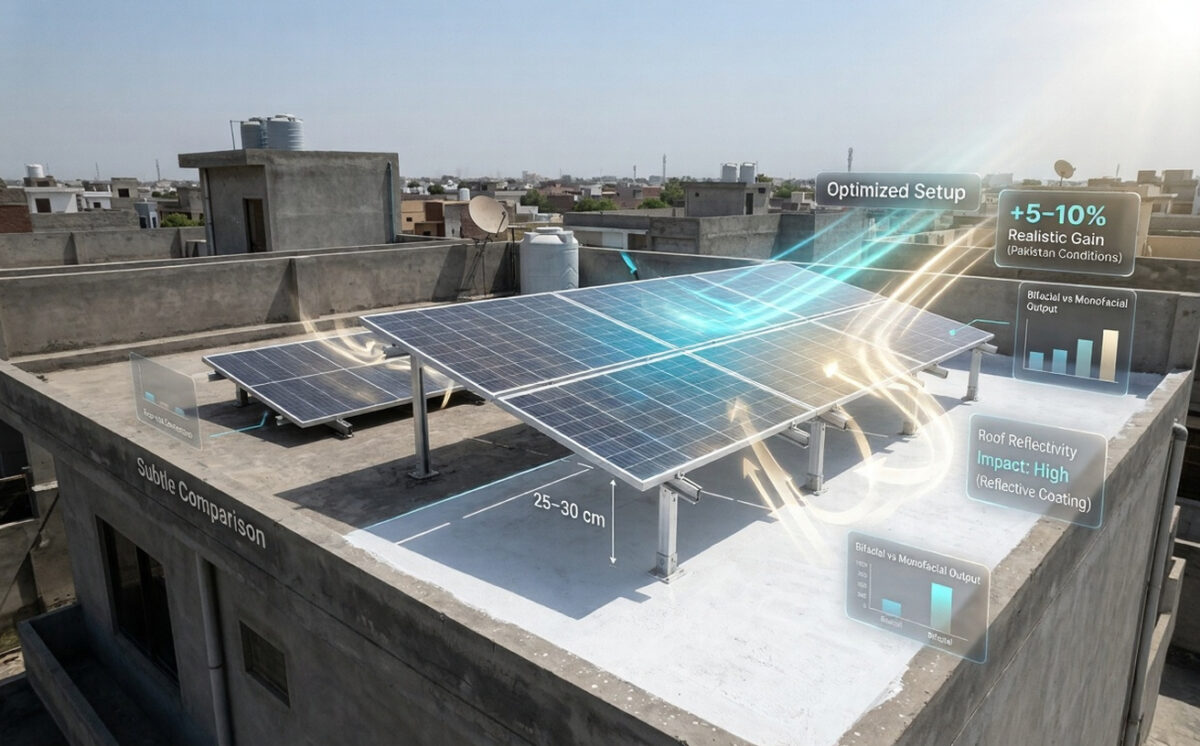
Electricity costs in Pakistan seem to never come to a halt; they just keep increasing and forcing people to move towards solar as a means to deal with this problem in the long run. When one visits any solar market in Lahore, Karachi, or Multan, there is one thing that one would definitely hear:
These panels are touted as the “big next upgrade” when it comes to solar. However, one question remains to be asked:
Are these bifacial solar panels actually capable of providing enough additional electricity to make up for their high cost in Pakistan?
What Makes a Solar Panel “Bifacial” and Why It Matters Here
A standard solar panel only generates electricity from its front side. A bifacial panel does it from both sides. The rear glass captures sunlight reflected off the surface below, whether that is a concrete rooftop, white-painted floor, or open ground.
How Bifacial Panels Capture Light from Both Sides
The key difference lies in the construction. Instead of an opaque white backsheet, bifacial panels use dual glass on both sides. This transparency allows reflected light to reach the rear solar cells and convert into usable electricity.
Pakistan’s flat concrete rooftops are actually a natural fit here. Concrete reflects a decent amount of light, especially if it is light-coloured or freshly poured. This is one reason bifacial panels have gained popularity in cities like Multan, Faisalabad, and Rawalpindi, where flat cement roofs dominate.
The Role of Dual Glass Panels in Durability
Dual glass panels offer more than just rear-side energy gain. The glass-on-glass build resists moisture, UV degradation, and physical impact better than standard backsheet panels. Most manufacturers back this with 30-year performance warranties, compared to 25 years on traditional panels. That extra five years matters when you are calculating long-term return.
For more on evaluating panel warranties before buying, read this guide on solar panel warranties.
Bifacial Efficiency in Pakistan’s Climate
Pakistan receives over 300 sunny days a year. That makes it one of the best countries in the world for solar energy. But high irradiance alone does not guarantee bifacial panels will perform as advertised.
How Pakistan’s Sun Intensity Affects Rear-Side Gain
The rear-side gain in bifacial panels depends on three things: surface reflectivity below the panel, the clearance height between the panel and the roof, and the tilt angle. In Pakistan, here is what realistic numbers look like:
- White or light-coloured concrete roof, panels raised 25 to 30 cm: expect 8 to 15% additional rear gain
- Standard grey cement roof, panels at standard low tilt: expect 3 to 6% rear gain
- Dark or shaded surface, flush-mounted panels: expect close to 0% rear gain
The “10 to 30% more energy” claim you see everywhere is real only under ideal conditions. For most Pakistani residential rooftops, 5 to 8% is a more honest estimate.
One thing competitors do not tell you: panels sitting just 3 to 4 inches above a roofline gain almost nothing from the rear side. The air gap is too narrow. You need meaningful elevation for bifacial panels to actually deliver their advertised benefit.
When Bifacial Efficiency Delivers and When It Does Not
Bifacial panels perform well in commercial installations, ground-mounted setups, and elevated residential structures. They underperform when flush-mounted on a dark roof with no reflective coating.
Understanding the solar panel temperature coefficient also matters here. Pakistan’s summer temperatures regularly exceed 45°C. N-type bifacial panels handle heat better than older P-type models, losing less output as temperatures rise.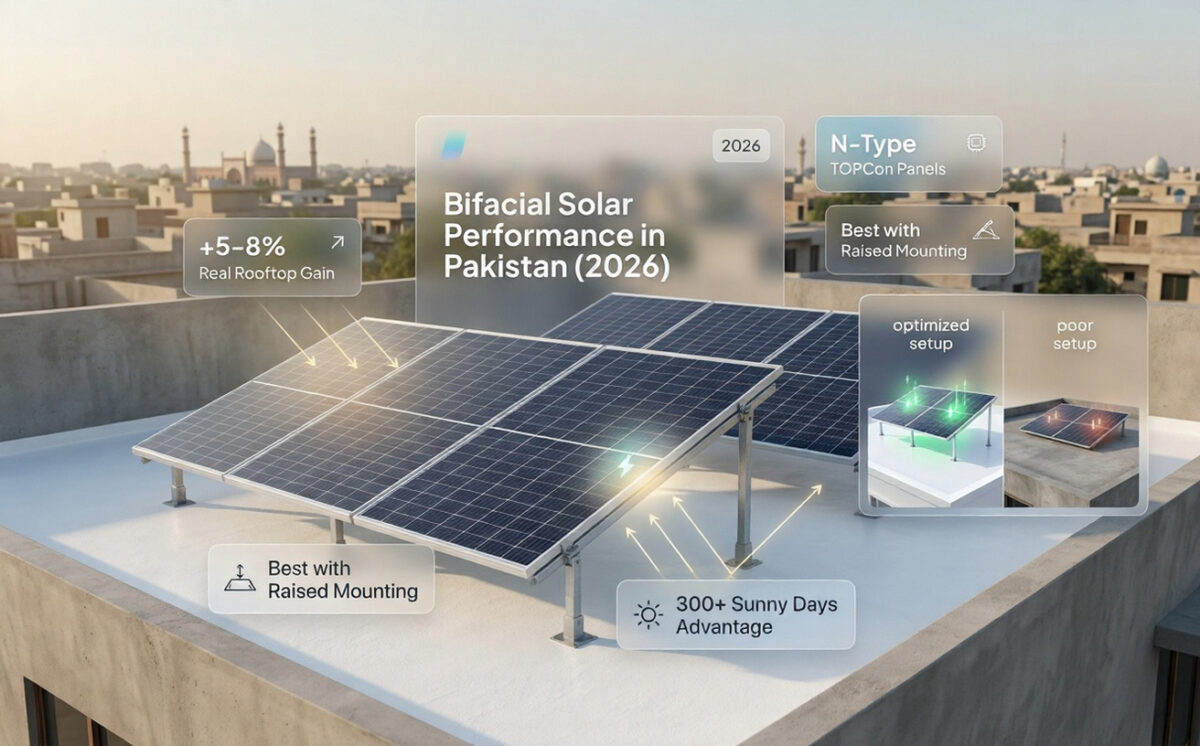
Bifacial Solar Panel Prices in Pakistan (2026)
Prices have shifted since 2024. The dollar rate, import duties, and increased availability of N-type TOPCon panels have all influenced the market. Here are the current approximate figures:
|
Brand |
Model |
Technology |
Approx. PKR per Watt |
|
LONGi |
Hi-Mo 7 610W |
N-Type TOPCon Bifacial |
Rs. 40 to 45/W |
|
Jinko |
Tiger Neo 610W |
N-Type TOPCon Bifacial |
Rs. 39 to 44/W |
|
Canadian Solar |
TOPCon 615W |
N-Type TOPCon Bifacial |
Rs. 40 to 46/W |
|
JA Solar |
N-Type 610W |
N-Type TOPCon Bifacial |
Rs. 36 to 42/W |
|
Huasun |
650W HJT Bifacial |
HJT Dual Glass |
Rs. 45 to 52/W |
Prices vary based on order volume, distributor, and dollar rate at the time of purchase. Always confirm before finalising. You can also check imported solar equipment prices for updated market trends.
One important point: in 2026, there is no strong reason to buy P-type bifacial panels. N-type TOPCon and HJT bifacial panels are widely available in Pakistan at competitive prices and offer better performance, especially in high-heat conditions.
Are Bifacial Panels Right for Your Roof?
This is the question most articles avoid answering directly. Here is an honest breakdown.
Residential Rooftops: The Honest Answer
Most Pakistani homes have flat cement rooftops. If your panels are properly elevated with a raised mounting structure and your roof surface is light-coloured, bifacial panels can add value. Apply white paint or a reflective coating under the panel area, and you increase rear-side gain noticeably.
However, for a small 3 to 5 kW home system with standard flush mounting, the rear-side gain may not justify the extra cost per watt. A high-quality N-type monofacial panel from a Tier 1 brand might deliver better value at that scale.
Ask yourself these questions before deciding:
- Is your roof surface white, light grey, or reflective?
- Will your panels be raised at least 25 cm above the surface?
- Is your system 8 kW or larger?
- Is this a commercial or ground-mounted setup?
If you answered yes to three or more, bifacial panels are worth considering seriously. If most answers are no, prioritise panel quality and N-type technology over the bifacial feature.
Commercial and Ground-Mounted Setups: Where They Shine
For factories, warehouses, and ground-mounted solar installations, bifacial panels are a clear winner. Open space allows proper elevation, reflective ground surfaces are common, and the scale of the system means even a 6 to 8% rear-side gain translates into meaningful additional energy over a 25-year lifespan.
Bifacial vs Monofacial: A Straightforward Comparison
|
Factor |
Bifacial |
Monofacial |
|
Upfront Cost |
10 to 15% higher |
Lower |
|
Rear-Side Gain |
3 to 15% (condition-dependent) |
None |
|
Warranty |
30 years typical |
25 years typical |
|
Weight |
Heavier (dual glass) |
Lighter |
|
Best Use |
Commercial, ground-mount, elevated rooftop |
Small residential, flush-mount |
The verdict is not that one is better. It is that each fits a different situation. For half-cut solar panel technology combined with a bifacial design, you get the best of both worlds in larger systems.
What to Check Before Buying Bifacial Panels in Pakistan
Warranties to Look For
Confirm two separate warranties: a product warranty (typically 12 years) and a performance warranty (25 to 30 years). Do not accept vague “lifetime warranty” claims from unknown brands.
Mounting Structure Requirements
Bifacial panels need a raised mounting structure to unlock rear-side gain. Standard low-profile mounts will not work. This adds cost, but it is non-negotiable for performance. Learn about solar mounting structures before finalising your installation design.
Verifying Panel Authenticity
Pakistan’s market has a real grey-market problem. Some panels are sold as “bifacial” but use a cheap transparent backsheet instead of genuine dual glass. Genuine dual-glass bifacial panels are heavier, have visible glass on both sides, and come with verifiable serial numbers from Tier 1 manufacturers. Check how to spot fake solar panels before making a purchase.
Final Verdict: Should You Go Bifacial in 2026?
Yes, if:
- You are installing a commercial or industrial system
- Your setup is ground-mounted or elevated with a reflective surface below
- Your system is 8 kW or larger
- You can use a raised mounting structure
Not necessarily, if:
- Your home system is 3 to 5 kW and flush-mounted
- Your roof surface is dark or regularly dusty
- Your budget is tight, and a quality N-type monofacial panel gives better per-watt value
Bifacial panels are not a scam. They are a genuinely good technology placed in the right setup. In Pakistan’s 2026 solar market, the smarter question is not just “bifacial or not” but “am I setting up the right conditions for bifacial to actually deliver?” If yes, go for it. If not, a premium N-type monofacial panel from a Tier 1 brand will serve you just as well.
To understand the total system cost before deciding, use this guide on how to calculate the payback period for your solar system.
Independent Power: Connect with Enon Traders Today!
Start your off-grid journey with Pakistan’s most reliable solar partner.
| Connect With Us | Action Link |
| Chat Instantly on WhatsApp | Get an off-grid system quote: Click to Chat Now! |
| Visit Our Website | View our off-grid inverters: Official Website |
| Call Our Experts | Design your custom micro-grid: Contact Page |