Net Metering for Homes in Pakistan in 2026: Real Savings, Bill Calculation, and Whether It’s Still Worth It
May 11, 2026
Canadian 710 Watt Bifacial N-Type TOPCon Solar Panel: Maximum Power for Less Space
May 13, 2026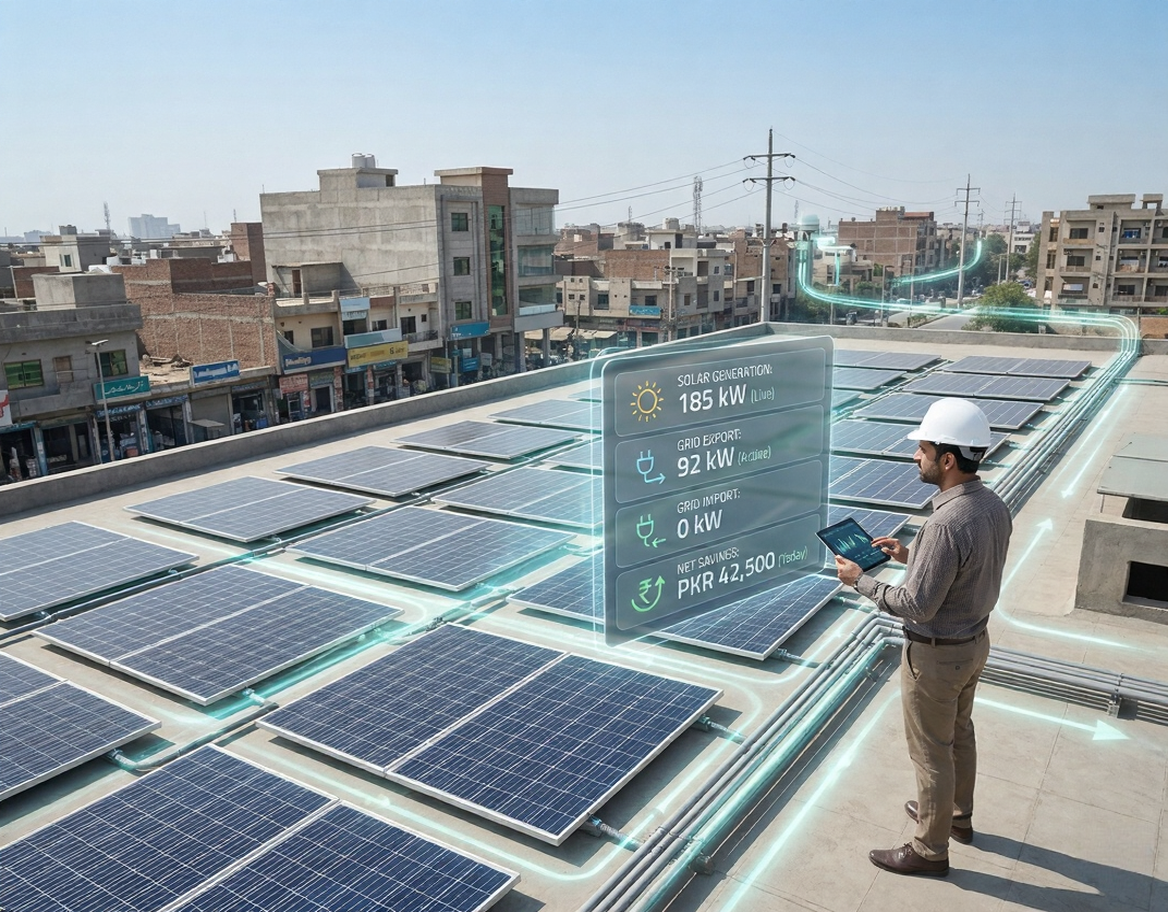
The electricity bill has emerged as one of the biggest expenditures incurred by the business community in Pakistan. Owners of factories, plaza owners, school management, and cold storage all have a common complaint regarding rising electricity bills every quarter, along with load-shedding.
Fortunately, commercial net metering serves as an effective solution in this regard because it enables you to harness solar energy in your commercial building, feed excess solar energy to the grid, and minimize your final electricity bill.
The following article will elaborate on the exact mechanism of commercial net metering in Pakistan, including which customers can get the benefit of net metering, how the billing works, and the entire process involved.
What Net Metering Means for a Commercial Consumer in Pakistan
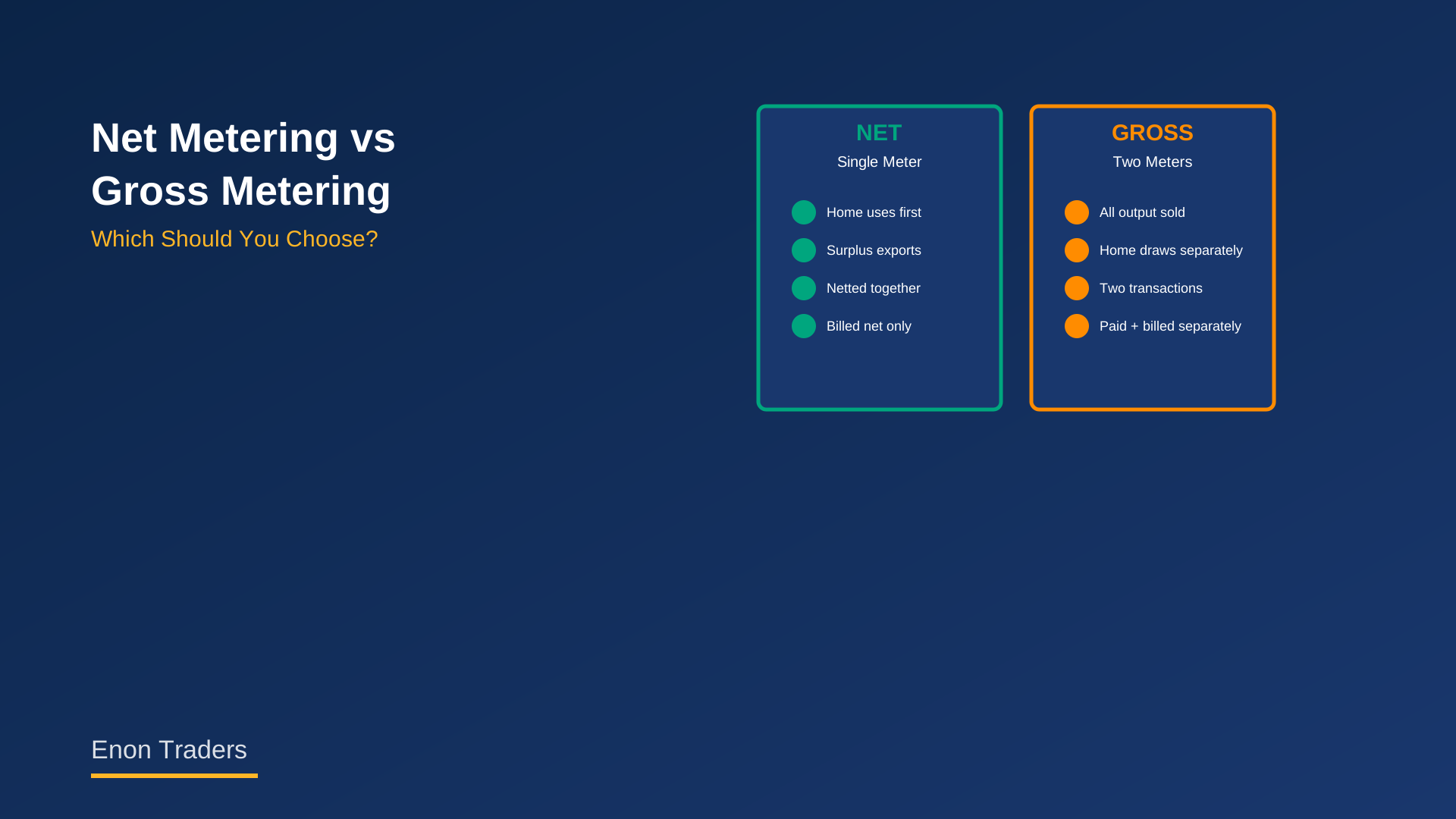
Net metering is simply a method of settling accounts between you and the local DISCO. When your rooftop solar panel produces electricity, you use whatever is needed by your business, and the remaining units will be returned to the national grid.
The two-way meter keeps track of all the transactions, recording units imported from the grid as well as those exported to it. By the time the DISCO bills you, they subtract one amount from another. What is important to note is that there is no sale of electricity in this equation. It is merely a way of adjusting your consumption against the units exported.
In the case of commercial consumers, the above statement assumes greater significance because the slab rates applicable to commercial customers in Pakistan are higher than those available for residential customers.
Who Regulates Commercial Net Metering and What the Law Says
NEPRA’s Role
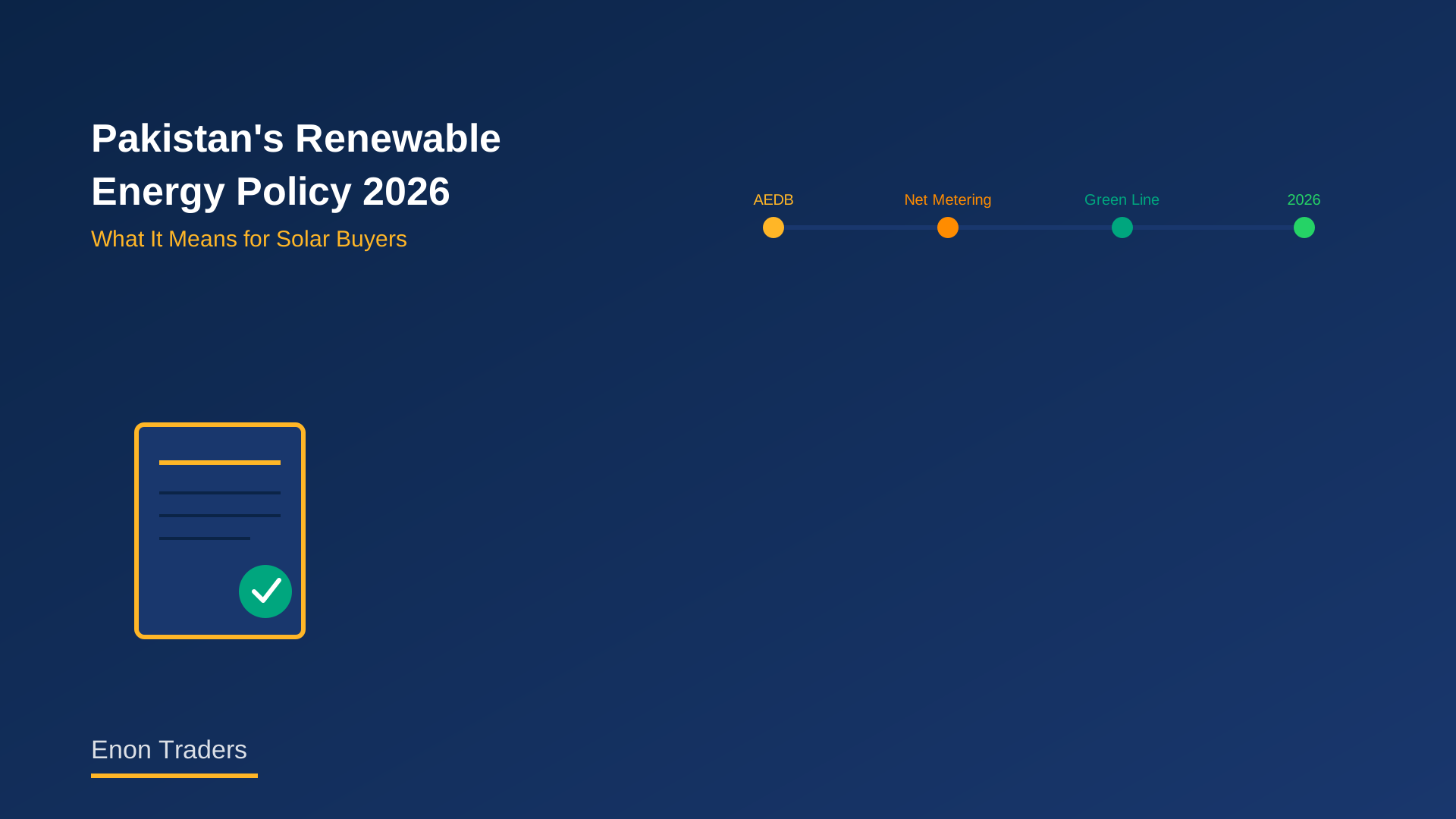
Net metering in Pakistan operates under NEPRA’s Distributed Generation and Net Metering Regulations, which came into force on September 1, 2015. NEPRA defines the eligible system sizes, sets the buyback rate methodology, establishes technical standards for inverters and meters, and protects consumer rights throughout the process.
Before you plan anything, read the current NEPRA net metering policy to understand what rules apply to your setup today.
Which DISCO Is Involved
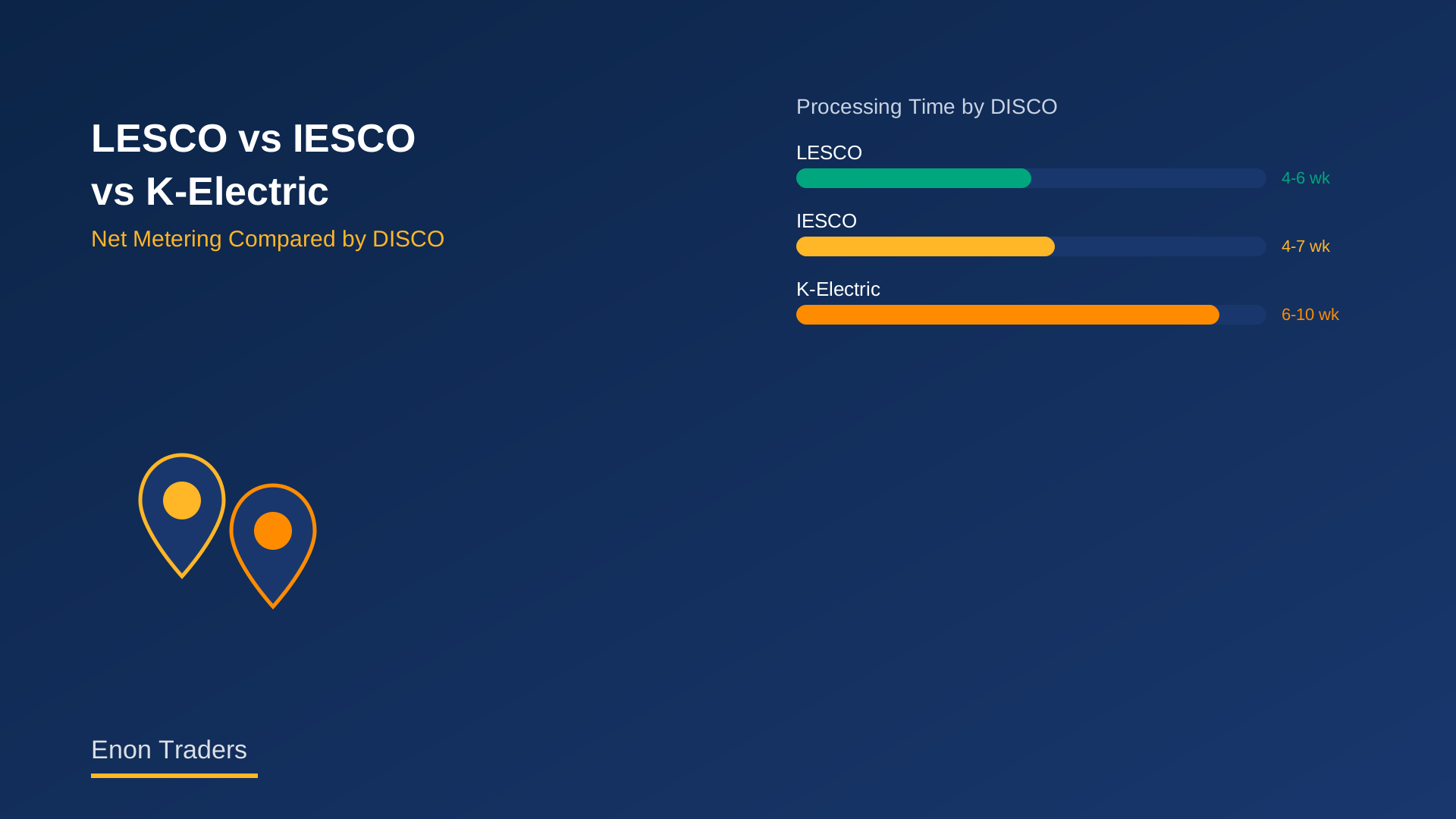
Your local distribution company handles the actual process on the ground. LESCO covers Lahore, FESCO covers Faisalabad, IESCO covers Islamabad, MEPCO covers Multan and surrounding districts, and K-Electric handles Karachi.
All DISCOs follow NEPRA’s framework, but each has its own internal timelines and document requirements. A process that takes six weeks under one DISCO can stretch to twelve or fourteen weeks under another. Knowing your DISCO before you plan your timeline saves you a lot of frustration later.
Eligibility Criteria for Business Net Metering in Pakistan
Before you approach a solar company, confirm you meet these conditions:
- You have an existing three-phase grid connection
- Your renewable energy system falls between 1 kW and 1 MW in capacity
- You own or hold legal rights over the premises where the system is installed
- Your system type is on-grid or hybrid (off-grid systems are excluded)
- Installation is done by an AEDB-registered solar company
Check your specific net metering eligibility conditions based on your connection type and DISCO area before you move forward.
How the Net Metering Billing System Works for Commercial Properties
The Import-Export Mechanism
Your green meter records two numbers every billing cycle: units you imported from the grid and units you exported to it. The DISCO nets these figures against each other. If you exported more than you consumed from the grid that month, your account carries a credit forward into the next billing cycle.
What Happens to Your Exported Units
NEPRA compensates exported units at the off-peak rate, regardless of the time of day you actually exported them. This is the most important detail for commercial consumers, and it is the one almost no competitor explains clearly. If your business runs air conditioning, machinery, or commercial refrigeration from 6 PM to 10 PM, those units cost you at the higher peak tariff rate.
But the credits you earn during the day are valued at the lower off-peak rate. The gap between what you pay at night and what you earn during the day directly affects your real savings. Understanding how the net metering billing system works in practice helps you set realistic savings expectations before you commit to an investment.
Net Billing vs Net Metering
Pakistan is actively considering a shift from net metering to net billing for larger consumers. Under net billing, exported units are compensated at a lower avoided-cost rate rather than the retail import rate.
If NEPRA finalises this change before your application is processed, your setup may fall under net billing rules. Read about the shift from net metering to net billing and what it means for businesses planning long-term solar investments.
System Size and Capacity Limits for Commercial Properties
Your sanctioned load determines your maximum allowed system size. Find this figure on your DISCO connection documents or your electricity bill. If your sanctioned load is 100 kW, your solar installation cannot exceed 100 kW, regardless of how much roof space you have available.
A garment factory in Lahore with a 150 kW sanctioned load can install up to 150 kW of solar. A plaza in Multan with a 60 kW sanctioned load is capped at 60 kW. If you want a larger system, you must first apply to increase your sanctioned load, which is a separate process and adds weeks to your timeline.
|
Sanctioned Load |
Maximum System Size |
Estimated Daily Generation |
|
25 kW |
25 kW |
125 to 150 units |
|
50 kW |
50 kW |
250 to 300 units |
|
100 kW |
100 kW |
500 to 600 units |
|
150 kW |
150 kW |
750 to 900 units |
The Net Metering Application Process: Step by Step
Step 1: Technical Feasibility from Your DISCO
Submit your application at the sub-divisional office of your local DISCO. The DISCO conducts a site inspection and checks whether the local grid can handle your system’s output.
If the distribution transformer in your area is already at capacity, the DISCO can reject your application at this stage, before any installation takes place.

Step 2: System Installation by a Certified Company
You cannot apply for net metering directly as an individual or as a business entity. NEPRA requires an AEDB-registered company to handle the application on your behalf. Your installer also ensures the inverter meets IEC 61727 technical standards, including harmonic distortion limits and a power factor above 0.9. Review the complete net metering application process so you understand what your installer handles and what documents you need to provide.
Step 3: Meter Installation and Agreement Signing
After the inspection is approved and the NOC is issued, your DISCO installs a bidirectional green meter at your premises. You then sign a net metering agreement with the DISCO. For commercial consumers, this agreement typically runs for three years and is renewable.
The net metering cost in Pakistan for the meter itself and the associated documentation fees varies by DISCO and by the size of your system.
Step 4: Commissioning and Billing Activation
A final inspection confirms your system meets all technical standards. Once cleared, your first net metering billing cycle starts. Realistic timeline from application submission to first net metered bill: 6 to 14 weeks, depending on your DISCO’s workload and your area’s grid condition.
Realistic Financial Impact for Commercial Businesses
Your actual savings depend on three things: your consumption pattern, your tariff slab, and how much of your solar generation you consume directly versus export. Businesses that operate primarily during daylight hours get the most out of net metering. Schools, offices, retail outlets, and showrooms consume solar power as it is generated, which directly offsets grid import at the full commercial tariff rate.
Businesses that run heavy loads after sunset export during the day and import at night. Since exported credits are valued at off-peak rates and nighttime consumption is billed at peak rates, the net savings are smaller. Before committing to a system size, use a structured solar ROI calculator that accounts for your actual load profile and today’s buyback rates.
Common Challenges Businesses Face With Commercial Net Metering
- DISCO delays in technical feasibility review and meter installation often push timelines past the official estimates
- Sanctioned load limits cap system size below what many commercial rooftops can physically accommodate
- Grid saturation in dense industrial or commercial zones leads to technical rejections before installation begins
- Non-compliant inverters cause failures at the inspection stage; verify inverter efficiency ratings and NEPRA compliance before purchasing
- Choosing an AEDB-registered installer without checking their commercial track record leads to documentation errors and delays
Final thoughts
Commercial net metering in Pakistan is a regulated, proven, and accessible mechanism. It is not experimental. Since 2015, businesses across all sectors have used it to cut electricity costs in a meaningful way.
The right starting point is not calling a solar company. It is knowing your sanctioned load, understanding when your business consumes the most electricity, and checking whether your DISCO’s local grid can accommodate your proposed system size.
Once those three questions have clear answers, the rest follows a defined path with predictable steps and a realistic timeline.
Independent Power: Connect with Enon Traders Today!
Start your off-grid journey with Pakistan’s most reliable solar partner.
| Connect With Us | Action Link |
| Chat Instantly on WhatsApp | Get an off-grid system quote: Click to Chat Now! |
| Visit Our Website | View our off-grid inverters: Official Website |
| Call Our Experts | Design your custom micro-grid: Contact Page |