Canadian 620/625 Watt Bifacial HJT Solar Panel: The Ultimate Power Upgrade for Pakistan
May 8, 2026
Why Solar Demand Growth in Pakistan Is Accelerating Across Homes and Businesses
May 10, 2026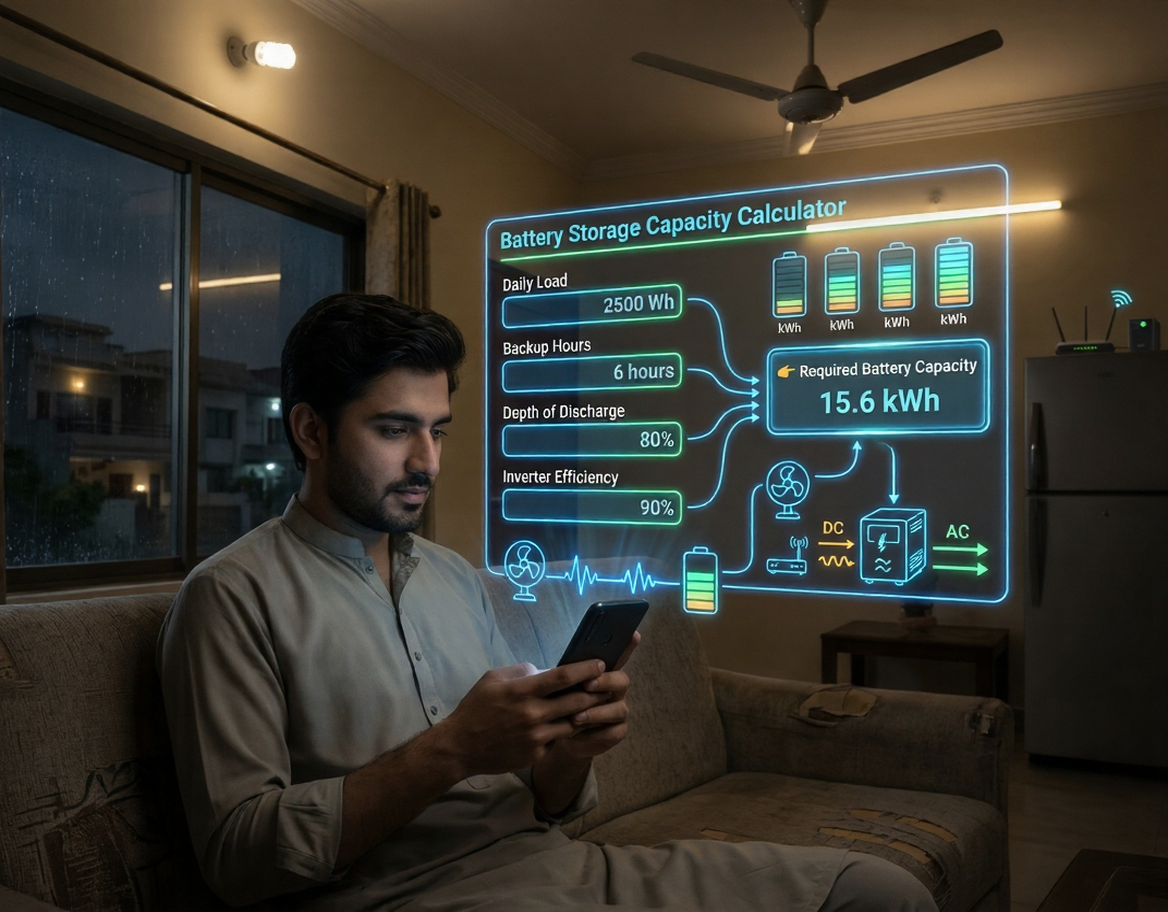
Having insufficient storage capacity will cost you big time. With excess, you’ll be wasting tons of money on excess battery power that is of no use to you.
Neither situation is ideal in light of ever-rising prices of electricity and load shedding being a part of everyday life all around Pakistan. Our battery capacity calculator will take into account five factors and give you the precise nominal battery size in kWh.
The calculation formula, a sample calculation for a Pakistani household with a detailed solution for each step, and an elaboration of all variables included will go alongside our tool.
Battery Storage Capacity Calculator
Enter the values below to calculate your required battery bank size in kWh.
Required inputs:
- Total daily load (Wh)
- System voltage (V)
- Desired backup hours
- Depth of discharge (%)
- Inverter efficiency (%)
[Calculator embed: Inputs: Daily Load Wh, Backup Hours, DoD %, Inverter Efficiency %. Output: Required kWh]
What Is Battery Storage Capacity?
Battery storage capacity is the total amount of energy a battery can hold, measured in kilowatt-hours (kWh). Think of a water tank. The kWh figure is the size of the tank. The watts your appliances draw is how fast the water drains out.
Why kWh Is the Number That Actually Matters
Both voltage and amp-hours (Ah) appear on battery labels, but kWh is the figure that tells you how long the battery will run your home. A 200Ah battery at 12V holds 2.4 kWh. The same 200Ah battery at 48V holds 9.6 kWh.
Same Ah, four times the energy. Every battery storage capacity calculation starts and ends with kWh, not Ah alone.
How Capacity Differs From Power Output
Capacity (kWh) measures how much energy is stored. Power output (kW) measures how fast the battery can deliver it. A battery can have a large tank and a small tap.
If you run an air conditioner, a refrigerator, and lights all at once, the battery must deliver enough kW to handle that combined surge, not just enough kWh to last the night.
How to Calculate Battery Storage Capacity
The calculator handles the arithmetic. Understanding the formula helps you trust the result and adjust it when your load changes.
The Core Formula
Required kWh = (Daily Load in Wh x Backup Hours / 24) / Depth of Discharge
- Daily Load (Wh): Total energy your household uses in one day
- Backup Hours: The number of hours the battery must supply power
- DoD: The usable fraction of the battery’s total rated capacity
AC Calculation: Accounting for Inverter Losses
This is the most commonly skipped step in battery storage sizing. Every household appliance runs on AC power. Your battery stores DC power. The conversion happens inside the inverter, and that conversion carries a cost.
Checking the inverter efficiency ratings of your unit before sizing is not optional. Most inverters in Pakistani homes run at 85 to 92% efficiency, which means 8 to 15% of your battery energy turns to heat before reaching your appliances.
Adjusted kWh = Required kWh / Inverter Efficiency (divide by 0.90 for a 90% efficient unit)
If your load calculation gives 10 kWh and your inverter runs at 90% efficiency, the battery must store 11.1 kWh to actually deliver those 10 kWh. Ignore this step, and the system comes up short every time the load-shedding window stretches past your estimate.
Real-World Worked Example: Multan Household
A family needs backup power for essential loads during an 8-hour daily load-shedding window.
|
Appliance |
Wattage |
Daily Hours |
Daily Wh |
|
3 ceiling fans |
150W |
8 hrs |
1,200 Wh |
|
LED lights (10 bulbs) |
100W |
6 hrs |
600 Wh |
|
Refrigerator |
150W |
24 hrs |
3,600 Wh |
|
Phone and router |
50W |
4 hrs |
200 Wh |
|
Total daily load |
5,600 Wh |
8 hours out of 24 = 33% of daily load = 1,867 Wh needed from the battery.
With 85% LFP DoD and 90% inverter efficiency: Required nominal capacity = 1,867 / 0.85 / 0.90 = 2.44 kWh
A 2.5 kWh or 5 kWh LFP battery covers this load with room to spare. This Pakistan-specific answer is what most global battery calculators never provide.
Key Inputs You Need Before You Run the Calculator
Your Total Daily Load (Wh)
List every appliance that operates during load-shedding hours. Multiply each item’s wattage by its daily run-time in hours and add all the totals together.
These items cause the most common undersizing mistakes in Pakistani homes because their actual draw is higher than most people expect:
- Split air conditioners: 1,000 to 2,000W
- Water motors: 750W to 1,500W
- Inverter ACs: 500 to 900W at running load
Including even one of these items can double your total load estimate.

System Voltage
Most residential solar systems in Pakistan run at 48V. Higher voltage means lower current for the same power output, which reduces cable heating and improves efficiency. Any battery bank above 3 kWh benefits from a 48V configuration.
The guide on integrating battery backup with your solar system in Pakistan covers voltage selection alongside every other connection decision in a full system design.
Depth of Discharge (DoD)
DoD is the percentage of rated capacity you can safely use before recharging. It directly determines how large a nominal bank you need and varies significantly by battery chemistry.
|
Battery Type |
Recommended DoD |
Usable Energy from a 10 kWh Bank |
|
Lead-acid tubular |
50% |
5 kWh |
|
AGM or Gel |
50 to 60% |
5 to 6 kWh |
|
Lithium LFP |
80 to 90% |
8 to 9 kWh |
Same label, very different output. The battery depth of discharge guide explains how DoD choices affect cycle life for each chemistry type.
Days of Autonomy
Days of autonomy is the number of consecutive days without solar input or grid power your battery must cover.
- Grid-tied with daily load shedding: 1 to 1.5 days
- Hybrid system in areas with irregular grid supply: 1.5 to 2 days
- Full off-grid or rural setup: 2 to 3 days
For most urban and peri-urban households in Pakistan, 1 to 1.5 days is the right working target.
Battery Chemistry and How It Changes Your Required Capacity
Lithium Iron Phosphate (LFP)
LFP delivers 80 to 90% usable DoD, 4,000 to 6,000 or more cycles over its lifespan, and stable performance in Pakistan’s heat. It costs more upfront but requires significantly less nominal capacity than lead-acid for the same real-world backup energy. The LiFePO4 battery advantages article breaks down the long-term cost of ownership in full.
Lead-Acid Tubular and AGM
Lead-acid costs less upfront and is widely available across Pakistan. The 50% DoD cap means you need twice the nominal capacity of LFP to deliver the same usable energy.
To supply 5 kWh of real backup, you need a 10 kWh lead-acid bank versus roughly a 6 kWh LFP bank. The purchase price is lower, but the bank size is larger.
Which Chemistry Shifts the Calculator Output Most
Changing the DoD input from 50% to 85% cuts required nominal capacity by nearly 40% for the same load and backup duration.
No other single variable has that impact on the final output. A full side-by-side covering cycle life, maintenance, and real costs is in the lithium vs tubular battery guide for Pakistan.
Three Sizing Mistakes That Cause Undersized Battery Systems
Sizing for average load instead of peak load. When a fridge compressor starts, two fans kick on, and the router reconnects all at once, the combined draw can be two to three times your average figure.
Your battery’s kW output rating must handle that surge. The inverter overload capacity guide explains how to verify whether your inverter can sustain actual peak demand before you commit to a purchase.
Skipping the AC conversion loss step. Every watt passing through your inverter loses 5 to 15% in the DC-to-AC conversion.
A bank sized without this adjustment will underperform under real household loads. The AC calculation step in the formula section is not optional.
Treating nameplate kWh as fully deliverable energy. In Punjab and Sindh, where summer temperatures regularly cross 45 degrees Celsius, battery capacity can derate by 10 to 20%. A lead-acid battery in its third year of daily cycling in a poorly ventilated room may only deliver 65 to 70% of its original rated capacity.
Size up slightly to account for heat and ageing. Consistent solar battery maintenance practices, including proper ventilation and regular terminal checks, also preserve rated capacity across seasons.
Final Word
The battery storage capacity calculator handles all the arithmetic. Your job is to bring two things to it: an honest load estimate and the correct DoD value for the battery chemistry you are buying. Adjust the backup hours input and watch how the output moves.
A one-hour change in autonomy or a switch from 50% to 85% DoD shifts the required bank size by 30 to 40%. Understanding that relationship before you finalise a purchase saves money and prevents the frustration of a system that falls short on the days it matters most.
Independent Power: Connect with Enon Traders Today!
Start your off-grid journey with Pakistan’s most reliable solar partner.
| Connect With Us | Action Link |
| Chat Instantly on WhatsApp | Get an off-grid system quote: Click to Chat Now! |
| Visit Our Website | View our off-grid inverters: Official Website |
| Call Our Experts | Design your custom micro-grid: Contact Page |