Bifacial Solar Panels in Pakistan: Are They Actually Worth It in 2026?
May 4, 2026
Inverter WiFi Monitoring in Pakistan: How to Track Your Solar System From Your Phone
May 5, 2026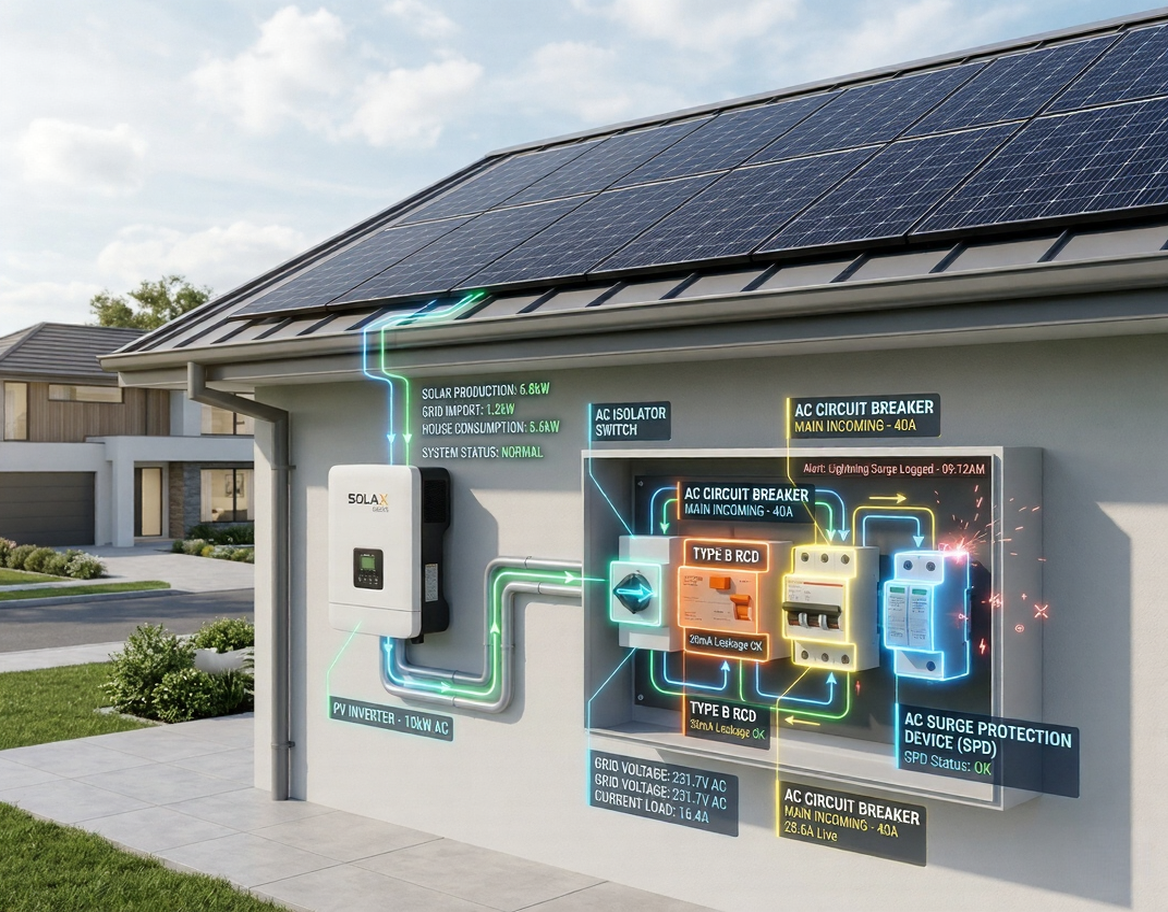
While many solar energy systems in Pakistan end up breaking down prematurely well before their projected life span, this is not due to any issues with the solar panels but because the other aspect of protecting the AC circuitry was completely neglected at the time of installation.
Many households may spend a lot of money on installing solar panels, batteries, and inverters while completely ignoring the fact that they still need proper AC protection in order to prevent damage to their systems in case of faults and sudden voltage changes.
This guide will provide an insight into the process of AC protection for solar energy systems, including the necessary equipment, the consequences of lacking AC protection, and ways for homeowners in Pakistan to develop a better system.
What Is AC Protection in a Solar System?
A solar system operates on two electrical sides:
|
System Side |
Function |
|
DC Side |
Carries electricity from solar panels to the inverter |
|
AC Side |
Carries converted electricity from the inverter to the home and grid |
AC protection refers to the safety devices installed after the inverter on the AC output side. These devices protect the inverter, household wiring, appliances, and utility connection from electrical faults and dangerous voltage conditions.
Unlike a single switch or breaker, AC protection is a complete protection layer made up of several components working together. Each device handles a different type of electrical risk.
Without proper AC protection, even a high-quality inverter can become vulnerable to voltage surges, short circuits, overloads, and grounding faults.
Why AC Protection Is Important in Pakistan
Pakistan’s electrical infrastructure creates several challenges for solar systems:
- Frequent voltage fluctuations
- Sudden grid restoration after load shedding
- Transformer instability
- Monsoon lightning activity
- Improper household earthing
- Weak distribution wiring in some areas
These conditions place additional stress on solar inverters and increase the likelihood of electrical faults.
Many inverter failures reported after thunderstorms or grid instability are linked directly to missing surge protection or incorrectly sized breakers.
Proper AC protection helps prevent:
- Inverter damage
- Fire hazards
- Electric shock risks
- Failed net metering inspections
- Warranty claim rejection
- Unsafe backfeed into utility lines
Homeowners planning grid-connected systems should also understand the net metering application process in Pakistan because protection compliance directly affects approval.
How Power Flows Through the AC Protection Layer
A solar system follows a simple electrical sequence:
- Solar panels generate DC electricity
- DC power enters the inverter
- The inverter converts DC into AC electricity
- AC output passes through protection devices
- Protected electricity enters the home distribution board
- Excess power may be exported to the grid through net metering
The protection layer sits between the inverter and the main electrical panel. Its job is to monitor and disconnect the system whenever unsafe electrical conditions appear.
Essential AC Protection Components for Solar Systems
AC Isolator Switch
An AC isolator allows the inverter to be manually disconnected from the home and utility supply. This makes maintenance and emergency shutdowns much safer.
The isolator is usually installed between the inverter output and the distribution board.
Without an AC isolator, technicians may be forced to work around live electrical circuits during servicing or repairs.
For grid-connected systems in Pakistan, AC isolation is considered a standard installation requirement.
AC Circuit Breaker (MCB)
An AC breaker protects the system from excessive current and short circuits.
If a fault causes current to rise beyond safe limits, the breaker automatically disconnects the circuit before wiring overheats or equipment becomes damaged.
Correct breaker sizing is critical.
A breaker that is too small may trip repeatedly during normal operation. A breaker that is too large may fail to disconnect dangerous current levels during a fault.
For most residential systems, breaker sizing depends on:
- inverter output current
- cable capacity
- system phase configuration
- load characteristics
Proper breaker coordination also improves long-term inverter stability.
For readers comparing protection devices on both sides of the system, this guide on DC protection devices for solar systems explains how DC breakers and related safety components work before electricity reaches the inverter.
Residual Current Device (RCD)
An RCD protects people from electric shock.
It continuously monitors the balance between live and neutral current. If electricity begins leaking toward ground due to faulty wiring or accidental contact, the RCD disconnects power almost instantly.
Modern transformerless solar inverters can generate DC leakage currents that standard household RCDs may not detect properly.
In many solar systems, Type B RCDs are recommended because they can detect both AC and DC leakage faults.
This becomes especially important in:
- hybrid solar systems
- battery-backed systems
- larger residential installations
- systems exposed to moisture or outdoor conditions
Proper grounding is equally important for RCD performance. Homeowners installing solar should understand these solar earthing requirements and safety standards before commissioning a system.
AC Surge Protection Device (SPD)
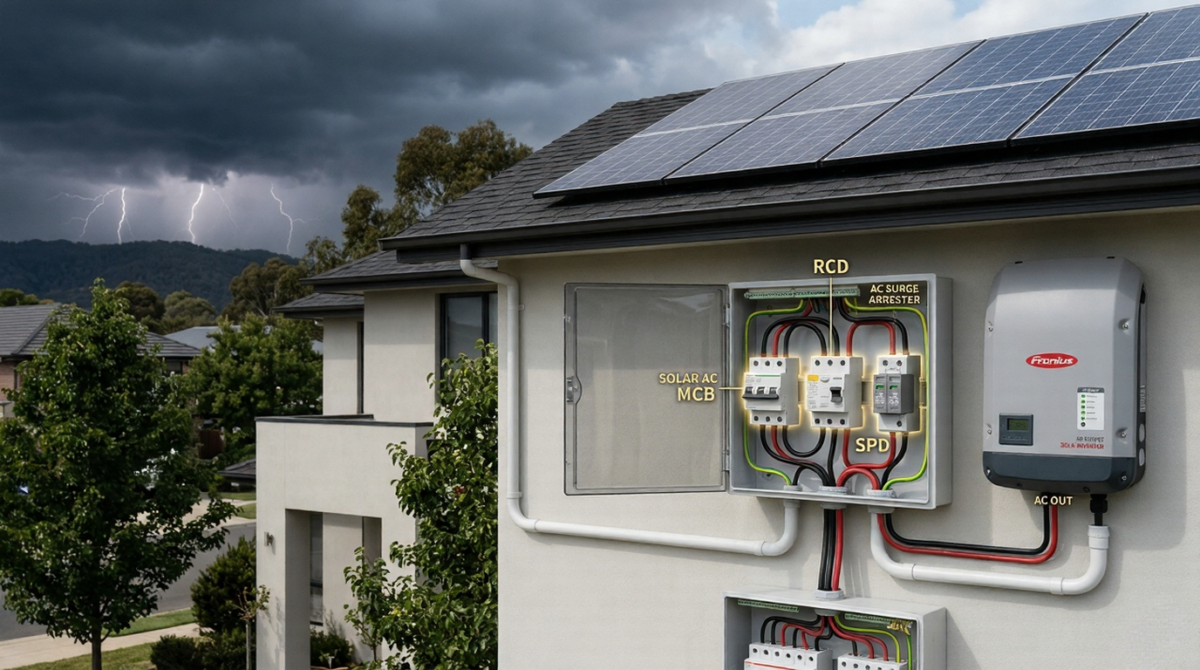
Surge protection devices protect solar inverters from sudden voltage spikes.
These surges commonly occur during:
- lightning storms
- grid switching events
- transformer faults
- sudden utility restoration
Many homeowners mistakenly believe DC surge protection alone is enough. However, surges can also enter directly from the utility grid through the AC side.
That is why a separate AC SPD is necessary.
Common SPD Types
|
SPD Type |
Purpose |
|
Type 1 |
Handles direct lightning-related surges |
|
Type 2 |
Handles switching surges and grid transients |
|
Type 3 |
Provides localized appliance-level protection |
Most residential solar systems in Pakistan require at least a Type 2 AC SPD installed inside the distribution board.
Signs Your Solar System May Lack Proper AC Protection
Many homeowners do not realize protection problems exist until equipment starts behaving abnormally.
Common warning signs include:
- Inverter restarting repeatedly
- breaker tripping during rain or storms
- burning smell near the DB box
- random inverter fault codes
- visible spark marks near breakers
- electric shock sensation from metal surfaces
- damaged inverter after voltage fluctuations
- failed net metering inspection
These issues should never be ignored because they often indicate unsafe installation conditions.
AC Protection vs DC Protection
Homeowners often confuse AC and DC protection devices.
The two systems protect different sections of the installation.
|
Protection Type |
Covers |
Typical Components |
|
DC Protection |
Solar panels to the inverter input |
DC breakers, fuses, and DC SPD |
|
AC Protection |
Inverter output to home/grid |
AC breakers, RCD, AC SPD |
Strong DC protection does not replace AC protection.
Both sides require dedicated safety devices because faults behave differently on AC and DC circuits.
The complete solar DC cables guide also explains how cable selection and DC-side wiring affect protection and overall system safety.
Recommended AC Protection Setup for Residential Solar Systems
The exact protection design depends on system size and inverter type, but most residential systems should include:
For 5kW Residential Systems
- AC isolator switch
- properly sized AC breaker
- Type B RCD
- Type 2 AC SPD
- reliable earthing system
For 10kW and Larger Systems
- dedicated AC distribution board
- higher-rated protection devices
- coordinated surge protection
- improved grounding arrangement
- phase balancing for three-phase systems
For Hybrid Systems
- battery-side protection
- backup load isolation
- changeover protection
- additional fault coordination
Proper installation matters just as much as the protection devices themselves. Even premium components can fail if wiring, earthing, or breaker coordination is incorrect.
Before selecting protection hardware, many homeowners also review this solar inverter buying checklist to ensure inverter compatibility with local protection requirements.
Is AC Protection Mandatory for Solar Systems in Pakistan?
Yes. AC protection is required for grid-connected solar systems.
Net metering approval depends heavily on electrical compliance and safety verification. Installations that fail to meet protection requirements may face rejection during inspection.
Inverter manufacturers also require compliant protection setups to maintain warranty coverage.
Important standards commonly referenced during installation include:
- IEC 60364
- local electrical safety codes
- utility net metering requirements
- Inverter manufacturer guidelines
Anti-islanding protection is also mandatory for grid-tied systems. This feature ensures the inverter shuts down automatically during a power outage.
Without anti-islanding protection, the inverter could continue feeding electricity into utility lines while technicians are performing maintenance.
Common Installation Mistakes That Cause Protection Failures
Many solar problems originate from poor installation practices rather than defective equipment.
Some of the most common mistakes include:
- using undersized breakers
- installing fake or low-quality SPDs
- poor earthing connections
- Incorrect neutral wiring
- mixing AC and DC cables
- missing RCD protection
- improper DB box ventilation
- using household breakers not rated for solar applications
Cheap installation shortcuts often become expensive repair problems later.
Hybrid installations require even more careful coordination between batteries and protection systems. This guide on battery backup integration for solar systems explains the additional considerations involved.
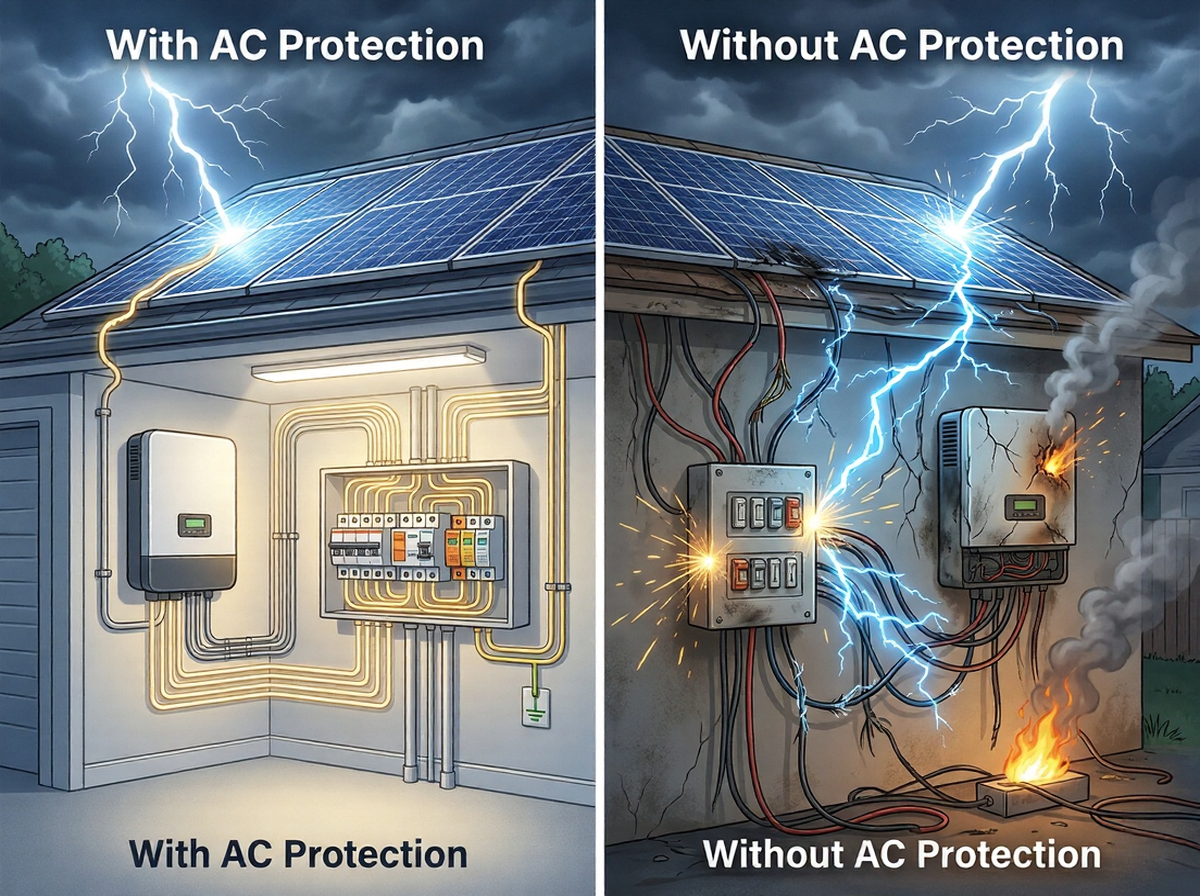
What Happens Without Proper AC Protection?
The risks extend beyond inverter damage alone.
Equipment Damage
Voltage spikes can destroy inverter components within seconds. Replacement costs for modern hybrid inverters in Pakistan can be high.
Fire Risk
Sustained overcurrent conditions can overheat wiring insulation and increase fire risk inside the distribution board.
Electric Shock Hazard
Without proper leakage protection, electrical faults may pass through anyone who touches exposed conductive surfaces.
Net Metering Rejection
Incomplete protection arrangements may fail inspection requirements during the net metering approval process.
Warranty Problems
Manufacturers may reject warranty claims if the installation lacks recommended protection devices.
Final Thoughts
AC protection is one of the most important parts of a solar installation, yet it is often overlooked during the buying process. A properly protected system is safer, more reliable, and far more likely to deliver long-term performance without unexpected failures.
Every protection device inside the AC layer serves a specific purpose. Breakers control overcurrent faults, RCDs protect people from electric shock, SPDs absorb voltage surges, and isolators make maintenance safer.
When these components are selected correctly and installed properly, they work together to protect the inverter, household wiring, and utility connection from serious electrical risks.
Before commissioning any solar system in Pakistan, homeowners should ensure the complete AC protection setup has been verified by a qualified installer or licensed electrician. Asking the right questions before installation can prevent expensive problems later and help the system operate safely for many years.
Independent Power: Connect with Enon Traders Today!
Start your off-grid journey with Pakistan’s most reliable solar partner.
| Connect With Us | Action Link |
| Chat Instantly on WhatsApp | Get an off-grid system quote: Click to Chat Now! |
| Visit Our Website | View our off-grid inverters: Official Website |
| Call Our Experts | Design your custom micro-grid: Contact Page |