Battery Temperature Tolerance Pakistan: How Much Heat Resistance
March 26, 2026
Solar Panel Direction in Pakistan (2026): Ideal Azimuth Angle for Maximum Solar Output
March 30, 2026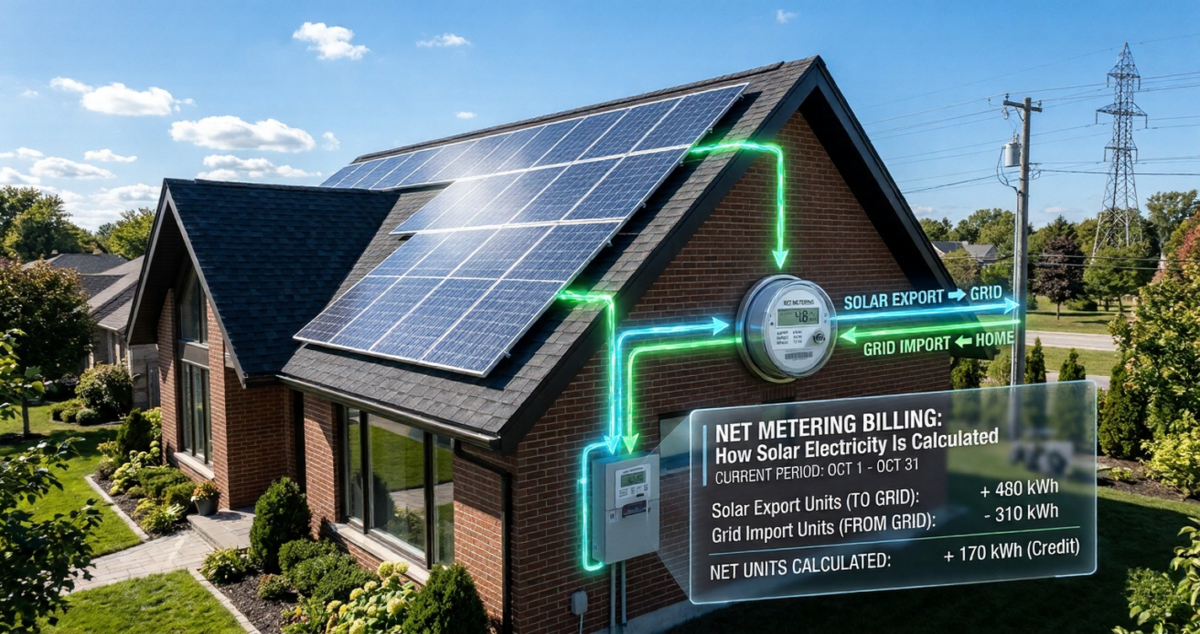
Many homeowners in Pakistan install solar panels, expecting their electricity bill to disappear. When the first bill arrives after net metering approval, confusion often begins. The bill still shows numbers. Import units appear. Export units appear. Sometimes the bill is small, but sometimes it is higher than expected.
This confusion usually happens because people do not fully understand how the net metering billing system works. Solar energy changes the way electricity billing is calculated. Instead of paying only for electricity consumed from the grid, the system compares how much electricity you imported and how much electricity you exported.
Once this concept becomes clear, reading your electricity bill becomes much easier. You can clearly see how much your solar system is saving each month. This guide explains the net metering billing system step by step so homeowners can understand how electricity billing works when solar power flows to the grid.
Understanding the Net Metering Billing System
The net metering billing system allows solar system owners to export excess electricity to the national grid. When solar panels generate more electricity than a house needs, the extra power automatically flows to the grid.
A special bi-directional meter records electricity in both directions. This meter is commonly called the green meter.
At the end of every billing cycle, the electricity company compares two values.
- Electricity imported from the grid
- Electricity is exported to the grid
The difference between these two values determines the final electricity bill. This is why the system is called net metering. The bill is calculated based on net electricity usage rather than total consumption.
Many homeowners start researching this topic when evaluating the solar system cost in Lahore. Understanding how billing works helps them estimate how much their electricity bill can actually decrease after installing solar panels.
How Net Metering Changes Traditional Electricity Billing
Before installing solar panels, electricity billing is simple. Every unit consumed from the grid is charged on the monthly bill.
Once solar panels are connected through net metering, the billing system changes.
Now the electricity meter records two different types of electricity.
- Electricity imported from the grid
- Electricity is exported to the grid
At the end of the billing cycle, the electricity company subtracts export units from import units.
The remaining number becomes the billable electricity consumption.
This adjustment is what makes solar energy financially attractive for homeowners.
Instead of paying for all the electricity used during the month, you only pay for the difference between imported and exported energy.
How Electricity Billing Works Under Net Metering
Understanding the billing calculation removes most confusion around solar electricity bills.
Import Units and Export Units
Import units represent the electricity taken from the grid. This usually happens during night hours or when solar generation drops.
Export units represent the electricity your solar panels send back to the grid during sunny hours. The green meter records both values automatically.
Net Unit Calculation
Electricity companies calculate the bill using a simple formula.
Imported units minus exported units equals net units billed.
For example:
Grid consumption: 700 units
Solar export: 450 units
Net billable units: 250 units
Instead of paying for the full 700 units, the homeowner only pays for 250 units.
This simple calculation forms the foundation of the net metering billing system.
How Net Metering Appears on Your Electricity Bill
Many homeowners open their first solar electricity bill and feel confused because the layout looks different from a normal bill. Most electricity bills now include three key sections.
Import Units
These are the electricity units taken from the grid. These units are charged according to the normal tariff.
Export Units
These units represent the electricity exported to the grid during the day. They appear as credit units.
Net Units
The electricity company subtracts export units from import units. The remaining number becomes the final billable electricity consumption.
Many homeowners first learn about these details while researching the net metering application process. Understanding the billing process helps homeowners avoid confusion once the system becomes operational.

A Practical Example of Net Metering Electricity Billing
Let us consider a realistic household example.
A home in Lahore installs a 10-kilowatt solar system.
During the month:
Electricity imported from the grid = 600 units
Electricity exported to the grid = 520 units
Net units billed = 80 units
Instead of paying for the full 600 units, the homeowner pays only for 80 units.
This difference represents the actual financial benefit of solar net metering.
Many homeowners estimate their savings using a solar ROI calculator guide. This helps calculate the payback period of a solar investment and understand how long the system will take to recover its cost.
What Happens When Solar Export Is Higher Than Consumption
Sometimes solar panels produce more electricity than the house consumes.
Example:
Import units = 400
Export units = 650
In this case, the solar system exported more electricity than the house used.
The extra 250 units become credit units.
These credits can reduce future electricity bills when grid consumption becomes higher.
However, the financial value of export credits depends on government policy and export tariffs.
Changes in export rates can influence the value of solar electricity sent to the grid. These changes are explained in the changing buy-back export rate for solar in Pakistan.
Understanding export rates is important because they affect the long-term return on solar investments.
Annual Settlement in Net Metering Billing
Another important part of the net metering billing system is the annual settlement.
Electricity companies review total imports and exports at the end of the fiscal year. If export credits remain unused, settlement rules determine whether those credits expire or are adjusted against future consumption.
Because of this rule, correct solar system sizing becomes very important. Oversized solar systems may export large amounts of electricity that do not always deliver maximum financial value.
Government policies can also change how these settlements work. Homeowners should stay up to date on the Pakistan solar policy 2026. Policy changes can influence export tariffs, settlement procedures, and net metering regulations.
Common Confusions About Net Metering Electricity Billing
Even after installing solar systems, many homeowners still have questions about their electricity bills.
Why Electricity Bills Do Not Completely Disappear
Solar panels do not produce electricity at night. Homes still rely on grid electricity at night.
Because of this, some electricity costs usually remain on the bill.
Why Winter Bills May Increase
Solar panels produce less electricity during winter because daylight hours are shorter and sunlight intensity is lower.
As solar generation decreases, grid consumption increases.
Why Export Credits Do Not Immediately Reduce Bills
Export credits accumulate gradually. Electricity companies may adjust these credits across multiple billing cycles.
Understanding these billing mechanics helps homeowners develop realistic expectations about solar savings.
Solar system owners should also follow basic maintenance tips for solar systems in Pakistan’s climate. Regular maintenance helps maintain consistent solar production and stable electricity savings.
Factors That Influence Net Metering Electricity Billing
Several factors affect how much electricity solar systems can reduce.
Solar System Size
Larger solar systems generate more electricity and export more power to the grid.
However, oversizing a system may not always deliver the best financial return.
Household Electricity Consumption
Homes that consume more electricity during the daytime benefit more from solar energy.
Daytime usage directly reduces electricity imported from the grid.
Seasonal Solar Production
Pakistan receives strong sunlight during the summer months, which increases solar generation. Winter months produce less electricity because of shorter daylight hours.
These seasonal differences affect electricity billing patterns throughout the year.
Final Thoughts on the Net Metering Billing System
The net metering billing system looks complicated at first glance, but the basic idea behind it is very simple. The amount of electricity imported from the grid is compared to the amount of electricity exported to the grid. The difference in imported and exported electricity gives us the final electricity bill.
Once the calculation is understood, the electricity bill becomes very easy to comprehend. The homeowner will be able to see the amount of money being saved on electricity bills because of the solar system.
Most importantly, once the homeowner understands the concept of the net metering billing system, he/she will be able to make better decisions regarding the solar system size and electricity consumption.
The concept of the billing system will help the solar users benefit more from the renewable energy source while minimizing the use of electricity from the grid.
Independent Power: Connect with Enon Traders Today!
Start your off-grid journey with Pakistan’s most reliable solar partner.
| Connect With Us | Action Link |
| Chat Instantly on WhatsApp | Get an off-grid system quote: Click to Chat Now! |
| Visit Our Website | View our off-grid inverters: Official Website |
| Call Our Experts | Design your custom micro-grid: Contact Page |