Why Surge Protection Devices Are Becoming Essential for Solar Systems in Pakistan
May 14, 2026
Canadian Solar 615W N-Type Bifacial Solar Panel (TOPCon) in Pakistan: The Smart Choice for Homes
May 19, 2026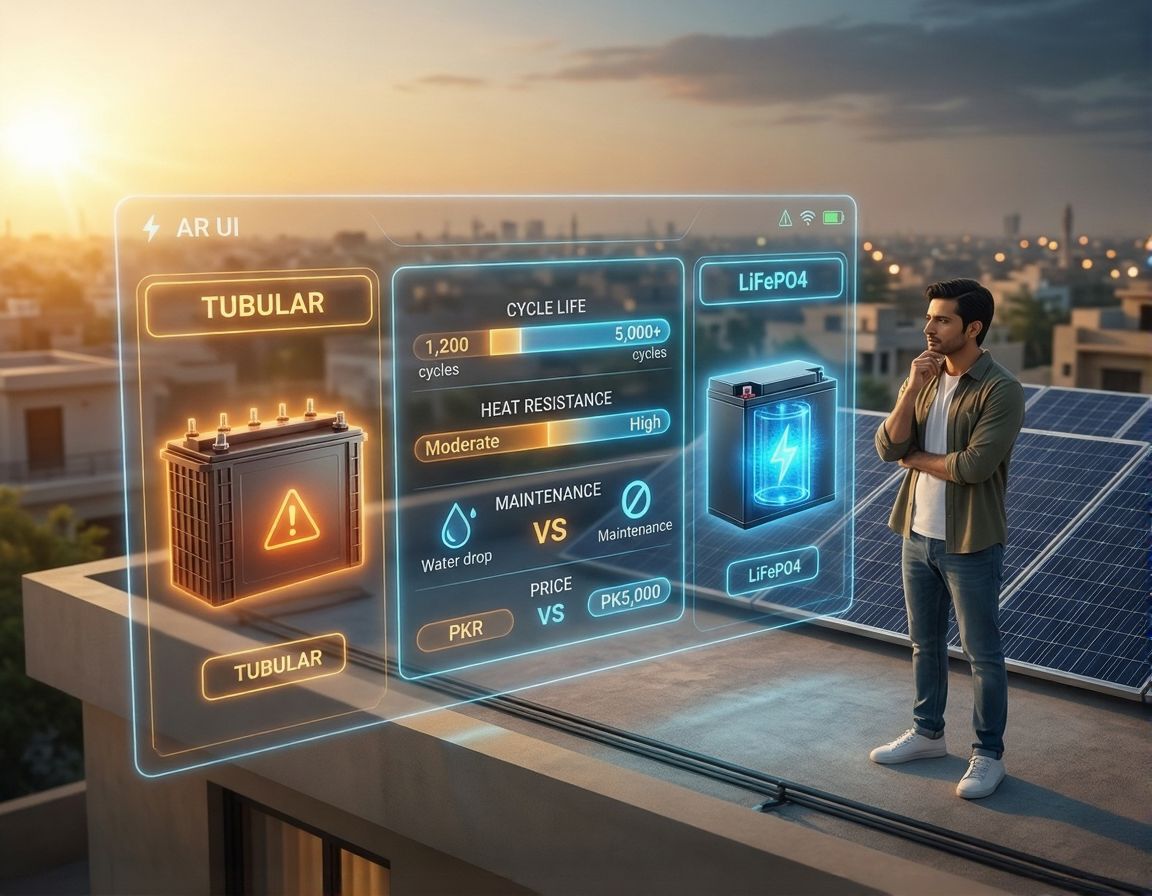
Pakistan’s energy situation has made one thing very clear – a solar system without a good battery is only half a solution. During load shedding, your panels go quiet, your inverter cuts off, and you’re left sitting in the dark despite having invested lakhs into solar. The battery is what bridges that gap. And yet, it’s the part most buyers get wrong.
This guide covers everything you need to make a confident decision in 2026 – battery types, honest PKR price ranges, which brands actually hold up, and how to figure out what you genuinely need for your home or business.
What Is a Solar Battery and Why Does Pakistan’s Context Change Everything
The solar battery acts as storage for surplus power that gets collected in your panels during the day for usage at night time or when the load-shedding period comes into play. Easy enough. However, the decision on selecting the type of battery is significantly more critical in Pakistan compared to other nations.
Why is this? For starters, the climate in Pakistan reaches temperatures of over 45 °C in cities such as Multan, Bahawalpur, and Hyderabad. Moreover, voltage variations are also quite typical with the WAPDA power supply. Lastly, people tend to operate their battery systems in numerous discharge cycles per day – far more often than just once per day, as many battery specifications assume.
That is what differentiates a battery lasting five years from one that dies after just eighteen months.
Types of Solar Batteries Available in Pakistan
Tubular Lead-Acid Batteries
Tubular batteries are the most widely used solar batteries in Pakistan right now. They use tubular positive plates that can handle deeper discharge cycles better than flat-plate lead-acid batteries. Quality tubular batteries from brands like Osaka and Phoenix deliver 1,200 to 1,500 charge cycles at 60% depth of discharge, with a realistic lifespan of 4 to 6 years under proper maintenance.
They require periodic water top-ups – every two to three months in hot climates – and need adequate ventilation because they release hydrogen gas during charging. For most Pakistani homes on a budget, a quality tubular battery remains a practical and proven option in 2026.
AGM (Absorbent Glass Mat) Batteries
AGM batteries are sealed, maintenance-free, and handle vibration well. However, they are less tolerant of deep discharges and perform poorly under extreme heat – two conditions that are both common in Pakistan. Their cycle life is also lower than that of tubular at comparable price points. Most solar installers in Pakistan recommend against AGM for primary solar storage use.
Gel Batteries
Gel batteries are sealed and more heat-tolerant than AGM, with no electrolyte spillage risk. They charge slowly and are sensitive to overcharging, which makes them a reasonable choice only when your charge controller is properly configured. Price-per-cycle, they sit between tubular and lithium – neither the cheapest nor the longest-lasting option.
Lithium-Ion (LiFePO4) Batteries
LiFePO4 (lithium iron phosphate) batteries are the fastest-growing category in Pakistan’s solar market in 2026. They deliver 3,000 to 6,000+ cycles, require zero maintenance, handle deeper discharges (80–90% DoD vs 50–60% for tubular), and are significantly lighter. Brands like Pylontech, Narada, Inverex, and BYD are all present in the market. The honest trade-off is upfront cost — they are three to five times more expensive than equivalent tubular setups.
Lithium vs Tubular Battery – The Real Comparison for Pakistani Buyers
This is the decision most buyers in 2026 are genuinely wrestling with. Here’s how they compare across the factors that actually matter in Pakistan.
|
Factor |
Tubular Lead-Acid |
Lithium (LiFePO4) |
|
Price per 200Ah unit (PKR) |
Rs. 55,000 – 90,000 |
Rs. 180,000 – 280,000 |
|
Cycle life |
1,200 – 1,500 cycles |
3,000 – 6,000+ cycles |
|
Usable DoD |
50–60% |
80–90% |
|
Lifespan (Pakistan conditions) |
3–5 years |
8–12 years |
|
Maintenance |
Water top-ups required |
Zero maintenance |
|
Heat tolerance |
Moderate (degrades above 40°C) |
Good (stable up to 50°C) |
|
Warranty (typical) |
1 year |
5–10 years |
For a detailed breakdown of why LiFePO4 chemistry performs differently, see our guide on LiFePO4 battery advantages for solar storage.
The 5-year financial reality: Two tubular batteries (200Ah each) for a typical 5kW hybrid system will cost around Rs. 160,000–180,000 at installation. You’ll likely replace them once in 5 years, making the 5-year cost Rs. 320,000–360,000 plus maintenance. A comparable lithium setup starts around Rs. 280,000–350,000 with no replacement in that window. The math is closer than most people expect — and lithium wins on convenience by a wide margin.
For buyers who want to understand exactly whether battery backup is financially justified for their situation, the article battery storage for home solar: is it worth it in Pakistan in 2026 walks through the ROI calculation in detail.
Top Solar Battery Brands in Pakistan (2026)
Osaka Batteries – The most widely available tubular brand in Pakistan. Reliable for budget-to-mid-range setups. The 185Ah and 200Ah models are the most common. Warranty claims are generally honored through dealers, though documentation matters.
AGS Batteries – Owned by Atlas Group, one of Pakistan’s most established industrial names. AGS batteries carry solid brand credibility and are a safe choice for tubular lead-acid applications. The 1-year replacement warranty is standard.
Narada – A Chinese brand with a strong presence in Pakistan for both tubular and lithium options. Their lithium batteries (NESR and NPFC series) are well-regarded by installers for deep-cycle solar applications.
Inverex – A Pakistani brand offering the INV-LV series LiFePO4 batteries, with models ranging from 2.6kWh to 5.3kWh. Their advantage is local support infrastructure and compatibility with Inverex hybrid inverters. For buyers considering the Inverex Nitrox 6.6kW hybrid inverter, pairing it with Inverex batteries eliminates most compatibility guesswork.
Pylontech – Widely regarded as the most inverter-compatible lithium brand in Pakistan. Their US5000 series communicates with almost every major hybrid inverter brand. Higher price point but near-universal compatibility.
BYD – Uses Blade Battery LiFePO4 technology with exceptional thermal stability. A strong choice for hot climates. Less common in Pakistan than Pylontech, but growing in availability.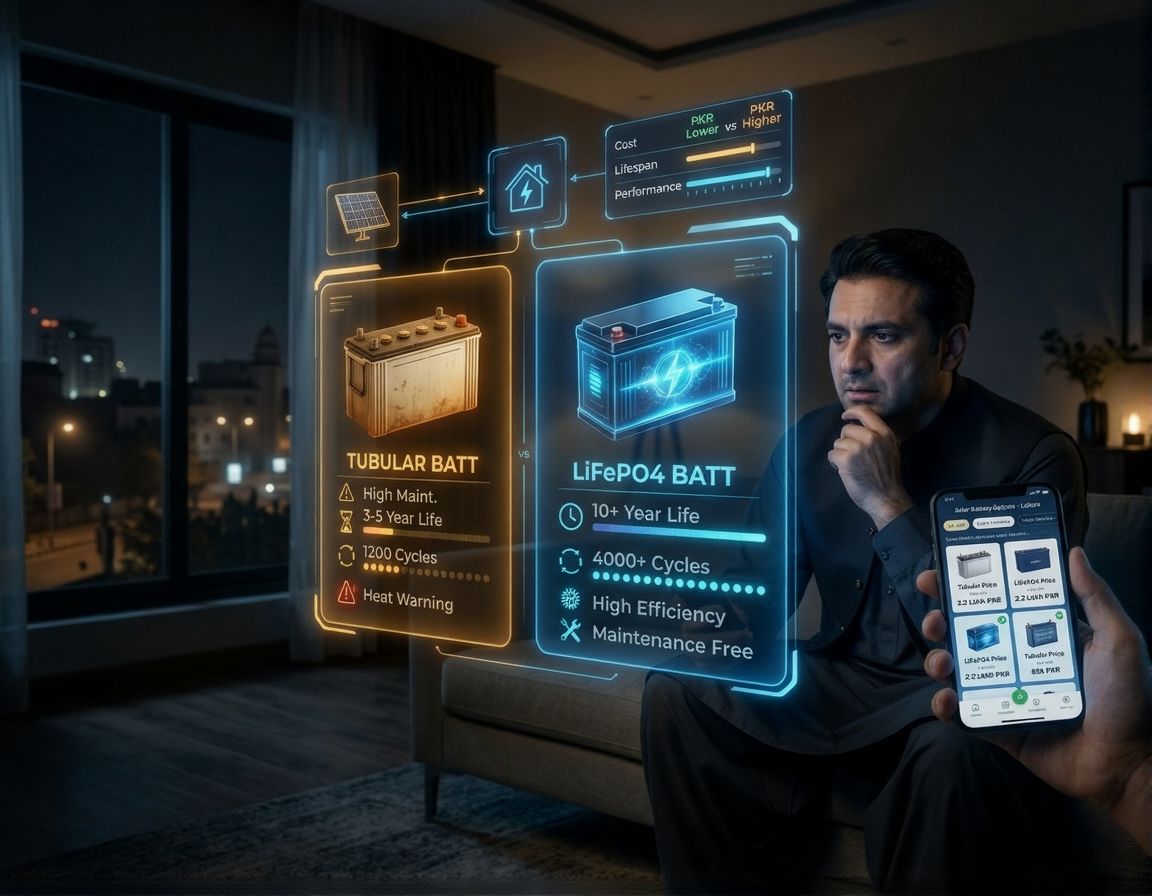
Solar Battery Prices in Pakistan (Updated 2026)
Prices are indicative ranges in PKR. Actual prices shift with USD-PKR rates and import duties.
|
Battery Type |
Capacity |
Estimated PKR Range |
Best For |
|
Osaka Tubular |
185Ah |
Rs. 52,000 – 62,000 |
Budget home backup |
|
Osaka Tubular |
200Ah |
Rs. 65,000 – 80,000 |
Standard home systems |
|
AGS Tubular |
185–230Ah |
Rs. 50,000 – 75,000 |
Mid-range home use |
|
Narada Lithium |
100Ah (48V) |
Rs. 180,000 – 220,000 |
Serious home/commercial |
|
Inverex LV5.3 |
5.32kWh |
Rs. 230,000 – 270,000 |
Hybrid home systems |
|
Pylontech US5000 |
4.8kWh |
Rs. 250,000 – 310,000 |
Premium home storage |
For the most current import pricing context — which directly affects battery costs — see our analysis of imported solar equipment prices in Pakistan.
How to Choose the Right Solar Battery for Your Home
Step 1 – Calculate your actual daily load. Add up the wattage of everything you want to run during load shedding and multiply by the hours of use. A typical 3-bedroom home in Lahore running fans, lights, a fridge, and a 1-ton AC for 6 hours needs roughly 8–10 kWh of daily backup.
Step 2 – Account for depth of discharge. For tubular batteries at 50% DoD, you need twice the Ah capacity of your actual requirement. For lithium at 80% DoD, the ratio is far more favorable – meaning fewer batteries for the same usable storage.
Step 3 – Check inverter compatibility. This is the step most buyers skip, and it causes the most problems. Not every battery works with every inverter. Lithium batteries especially require communication protocols (CAN bus or RS485) that many older hybrid inverters don’t support. Our inverter-battery compatibility guide covers this in detail before you make any purchase decision.
Step 4 – Factor in the Net Billing shift. Pakistan’s 2026 solar policy has moved from net metering to net billing, which reduces what you earn from exporting solar energy to the grid. This makes storing your own energy in a battery significantly more valuable than it was previously. The shift from net metering to net billing has direct implications for how quickly your battery investment pays back.
Common Mistakes Pakistani Buyers Make
- Buying purely on price. A Rs. 40,000 battery that lasts 18 months costs more over 5 years than a Rs. 70,000 battery that lasts 5 years.
- Ignoring heat performance specs. Most batteries are rated at 25°C. Pakistan’s summers run 10–20°C hotter than that. Always check the operating temperature range and expect reduced capacity and lifespan in extreme heat.
- Trusting verbal warranty promises. If it isn’t on paper with a stamp and dealer signature, it isn’t a warranty. Verbal guarantees at open markets mean nothing when a battery fails at 14 months.
- Mixing old and new batteries. Adding new batteries to an existing depleted bank damages the new batteries within weeks. Never mix different ages, brands, or capacities in a battery bank.
- Oversizing based on vendor advice. Some vendors recommend more batteries than you actually need. Use a genuine load calculation before accepting any proposal.
How to Extend Your Battery’s Life in Pakistan
Good battery care in Pakistan’s climate makes a bigger difference than most buyers realize.
- Ventilation is non-negotiable for lead-acid. Hydrogen gas builds up in sealed rooms. A vented battery room or outdoor cabinet prevents both safety risks and heat buildup that accelerates degradation.
- Keep temperatures below 35°C where possible. Even passive shading of your battery bank can add a year to its lifespan in Punjab summers.
- Use distilled water only for tubular batteries. Tap water introduces minerals that corrode plates. Check electrolyte levels every 8–10 weeks in summer.
- Set your inverter’s low-voltage cutoff correctly. Discharging tubular batteries below 11.5V (12V system) or lithium batteries below the BMS protection threshold regularly destroys capacity. A properly configured MPPT charge controller and inverter charge settings protect against this.
Making the Right Call
The battery decision comes down to three things: your actual load, your budget, and how long you plan to use the system. There’s no universal right answer — a farmer in Rahim Yar Khan running a tube well has different needs from a Karachi apartment owner managing a 4-hour daily load shed.
What matters is deciding with real numbers, not vendor pressure or marketing language. Calculate your load honestly, check inverter compatibility before committing, and insist on written warranty documentation regardless of which brand you choose.
The right battery, properly maintained, is an investment that pays back. The wrong one — bought cheaply or without the right information — costs you twice.
Independent Power: Connect with Enon Traders Today!
Start your off-grid journey with Pakistan’s most reliable solar partner.
| Connect With Us | Action Link |
| Chat Instantly on WhatsApp | Get an off-grid system quote: Click to Chat Now! |
| Visit Our Website | View our off-grid inverters: Official Website |
| Call Our Experts | Design your custom micro-grid: Contact Page |