Net Metering Billing Explained: How Solar Electricity Is Calculated
March 27, 2026
Inverter Compatibility with Batteries: A Practical Guide to Safe Battery Matching
March 30, 2026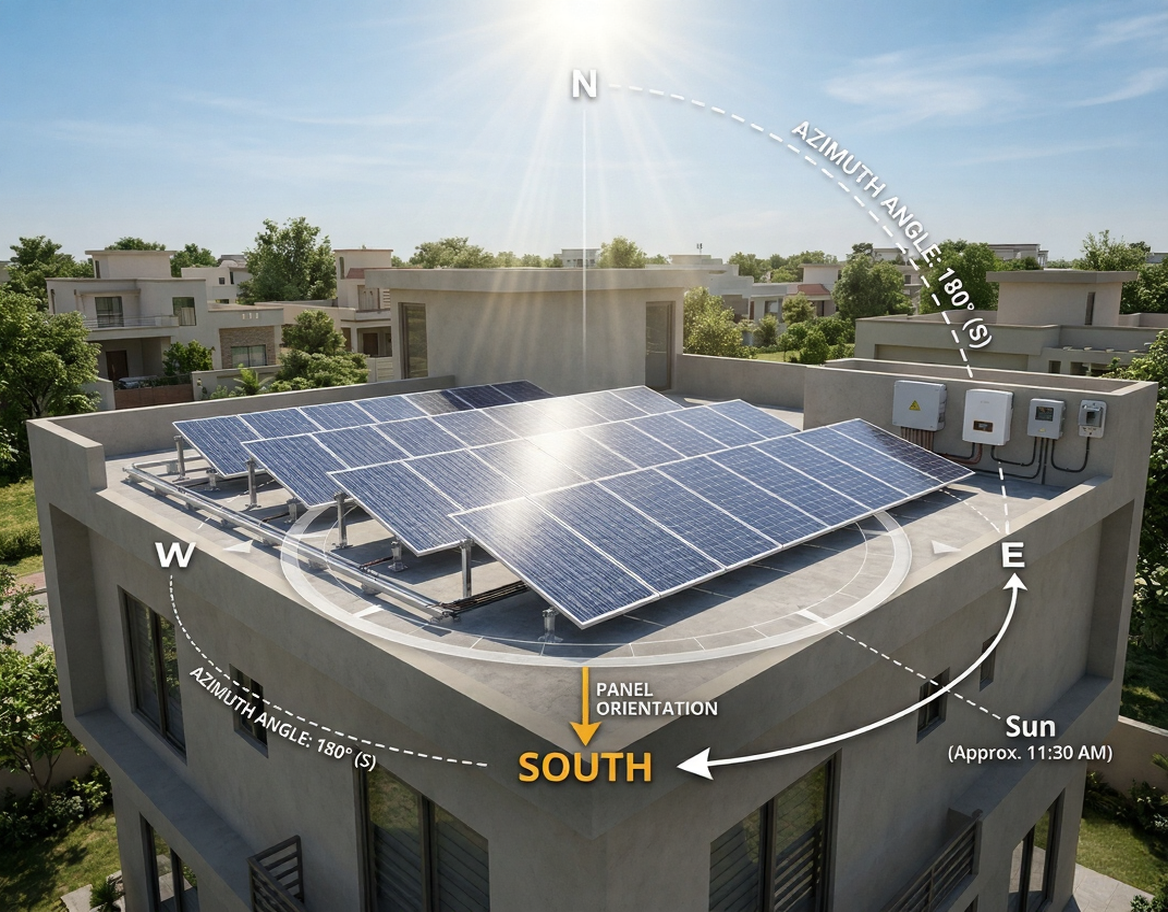
Most homeowners in Pakistan compare solar panel prices, inverter brands, and battery options. Very few pause to ask the question that determines performance for the next 25 years: Are the panels facing the correct direction?
Solar orientation azimuth in Pakistan is not a minor installation detail. It is a long-term production decision. The direction your panels face determines how much solar radiation they capture every single day for decades.
A 10° misalignment may reduce output slightly. A 25° deviation can reduce annual production by 3 to 6 percent. A north-facing system in most Pakistani cities can lose 15 to 25 percent annually. Over 20 years, that is not a small difference. That is thousands of units.
This guide explains solar azimuth clearly, practically, and in real Pakistani conditions, so you can approve your installation with full technical confidence.
What Solar Orientation Azimuth Actually Means
Azimuth refers to horizontal compass direction.
It answers one simple question:
Which direction are your solar panels facing?
It does not refer to tilt. It does not refer to panel quality.
Azimuth is measured in degrees:
0° = North
90° = East
180° = South
270° = West
Pakistan is in the Northern Hemisphere. The sun travels across the southern half of the sky throughout the year. That is why the ideal solar panel direction in Pakistan is close to true south, which is 180°.
Tilt and azimuth must never be confused:
Tilt = vertical angle
Azimuth = horizontal direction
Separating these two variables is the foundation of proper system design.
How the Sun Moves Across Pakistan
Whether you are in Lahore, Islamabad, Karachi, Multan, Faisalabad, or Peshawar, the pattern is consistent: The sun rises in the east, travels across the southern sky, and sets in the west. Seasonal variation changes height:
Summer: Higher solar path
Winter: Lower solar path
But the path always stays south-biased.
This is why south-facing panels receive the strongest and most consistent midday radiation. Panels facing north receive weaker sunlight throughout the year. In most Pakistani cities, north orientation reduces annual generation by 15 to 25 percent. That is a serious design mistake.
Ideal Azimuth Angle in Pakistan (Engineering Reality)
The ideal azimuth angle in Pakistan is:
170° to 190° (True South ±10°)
Very few rooftops are perfectly aligned. So what is acceptable?
Here is a realistic annual performance impact:
- ±10° deviation to 1 to 2 percent loss
- ±20° deviation to 2 to 4 percent loss
- ±30° deviation to 4 to 6 percent loss
- East or West to an 8 to 12 percent loss
- North to 15 to 25 percent loss
For example, a 10 kW system in Lahore producing 14,500 kWh annually at true south may produce:
- Around 14,200 kWh at 20° deviation
- Around 13,700 kWh if fully west
- Around 11,800 kWh if facing north
Over 20 years, that difference can exceed 50,000 kWh. That is not theoretical. That is the long-term financial impact.
East vs West vs South: What Works Best in Pakistan?
Orientation not only affects total production. It affects timing.
South gives balanced production throughout the day and the highest yearly output.
- Southeast produces stronger morning energy
- Southwest produces stronger afternoon energy
- East peaks in the morning
- West peaks in the late afternoon
If your home runs multiple air conditioners after 4 PM, a west orientation may reduce peak grid imports.
If your goal is maximum export and total yearly generation, South remains the strongest option.
System design must match the consumption pattern.
Magnetic South vs True South: The Hidden Mistake
Many installers use mobile compass apps. Phone compasses show magnetic south. Solar alignment requires true south.
Pakistan has a magnetic declination between approximately 2° and 4°, depending on location. If installers do not correct this, the system may be slightly misaligned.
Always confirm:
Are we aligning with true south?
Professional installers adjust for declination. That small technical correction improves long-term accuracy.
How to Check Your Roof Direction in 2 Minutes
You do not need advanced equipment.
Step 1: Open Google Maps satellite view.
>>Step 2: Rotate the map so the north arrow is visible.
>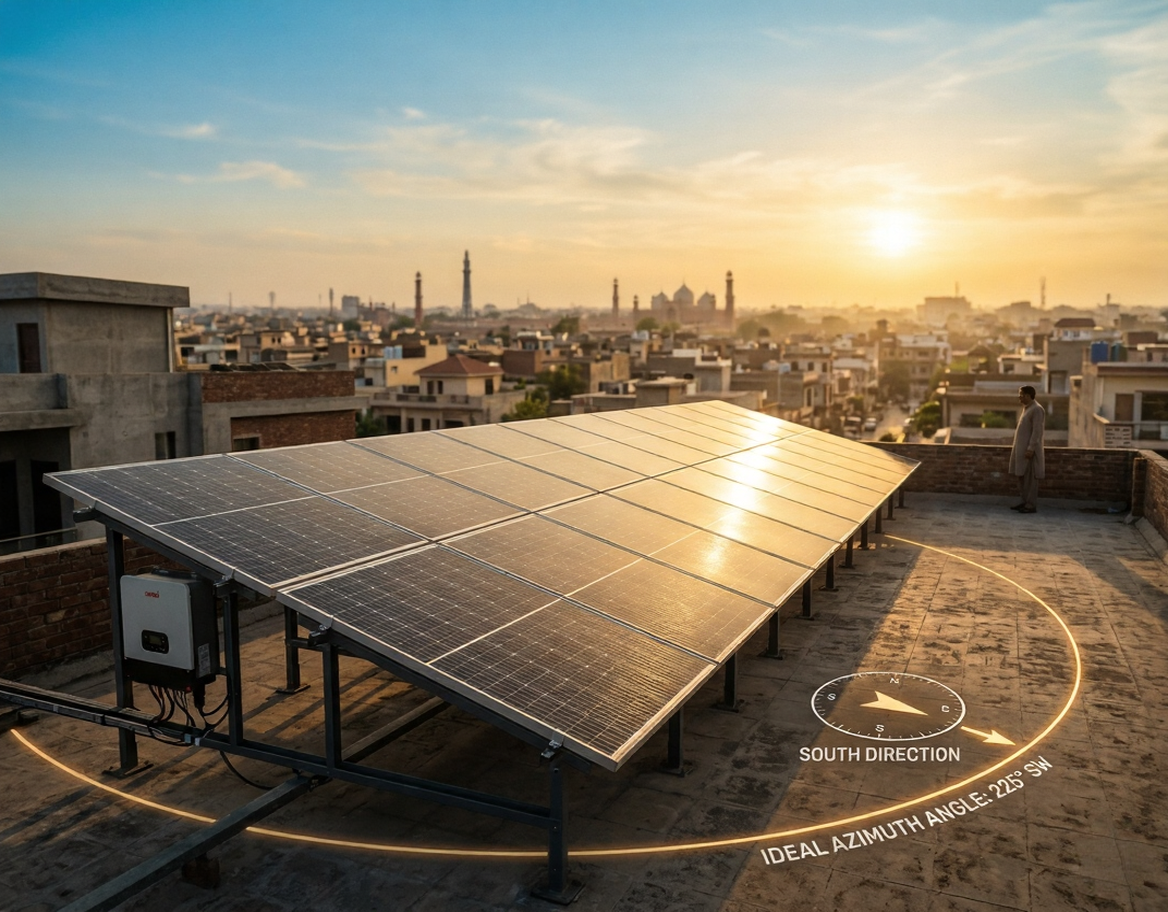 Step 3: Compare roof alignment with the true south direction.
If your roof faces southeast or southwest, it is usually acceptable.
If it faces north, reconsider the layout immediately.
Before forcing structural changes to chase perfect south, review rooftop load-bearing solar. Adding heavy steel frames increases the slab load. Structural safety always comes before minor efficiency gains.
When Perfect South Is Not Structurally Possible
Urban rooftops often restrict alignment. Split terraces and slab directions limit flexibility. Accepting 15° to 20° deviation is usually smarter than overstressing a roof.
If you have land, orientation control becomes easier. Learn how ground-mounted solar panels allow exact 180° alignment without rooftop compromise. Rooftops require practical decisions. Ground systems allow precision.
How Azimuth Affects System Size and Cost
Solar panel direction in Pakistan directly impacts production, which affects:
System size to Inverter selection to Total cost
If your system faces west and loses 5 percent annually, you may need additional panel capacity to meet your energy target.
Before finalizing the design, understand how to size your home solar system in Pakistan. Incorrect sizing due to the ignored orientation impact causes unnecessary upgrades later.
Does Solar Orientation Affect Payback Period?
Yes. Lower annual production extends payback duration. Even a 5 percent loss on a 10 kW system can delay return by several months over 20 years.
Before installation, calculate a realistic ROI using how to calculate the payback period for your home solar system in Pakistan. Solar is not a short-term purchase. Small percentage losses accumulate significantly.
Orientation and Net Metering or Net Billing
Orientation also affects billing structure.
Midday overproduction creates exports. Evening consumption creates imports.
Future policy structures may reward self-consumption more than exports. Review the shift from net metering to net billing in Pakistan. Azimuth influences timing. Timing influences billing impact. Design must align with policy direction.
Climate, Dust, and Real-World Conditions
Pakistan faces:
- High ambient temperatures
- Heavy dust
- Air pollution
Temperature reduces module efficiency. Dust blocks radiation. If orientation is suboptimal, losses compound.
Follow maintenance tips for solar systems in Pakistan’s climate. Correct direction and regular cleaning work together to protect performance.
Premium Equipment Cannot Fix Wrong Direction
High-efficiency modules cannot compensate for poor azimuth alignment.
Before investing in hardware, review this checklist before buying a solar panel inverter from the Pakistan market. Equipment enhances performance. Direction establishes baseline performance.
Get direction correct first.
Final Conclusion: Install Once, Align Correctly
Solar orientation azimuth in Pakistan is not complicated, but it is permanent. Face panels toward the true south whenever possible. Accept minor deviation when structure requires it. Match orientation with consumption timing.
Confirm true south alignment. Prioritize structural safety. Once installed, changing direction is expensive. Take time before mounting panels. Verify azimuth degrees. Ask technical questions. Precision today prevents regret tomorrow.
Independent Power: Connect with Enon Traders Today!
Start your off-grid journey with Pakistan’s most reliable solar partner.
| Connect With Us | Action Link |
| Chat Instantly on WhatsApp | Get an off-grid system quote: Click to Chat Now! |
| Visit Our Website | View our off-grid inverters: Official Website |
| Call Our Experts | Design your custom micro-grid: Contact Page |