Inverter Monitoring System in Pakistan: Catch Losses, and Take Control of Your Power
April 22, 2026
Solar Battery Degradation Rate: Understanding Capacity Loss and Longevity
April 24, 2026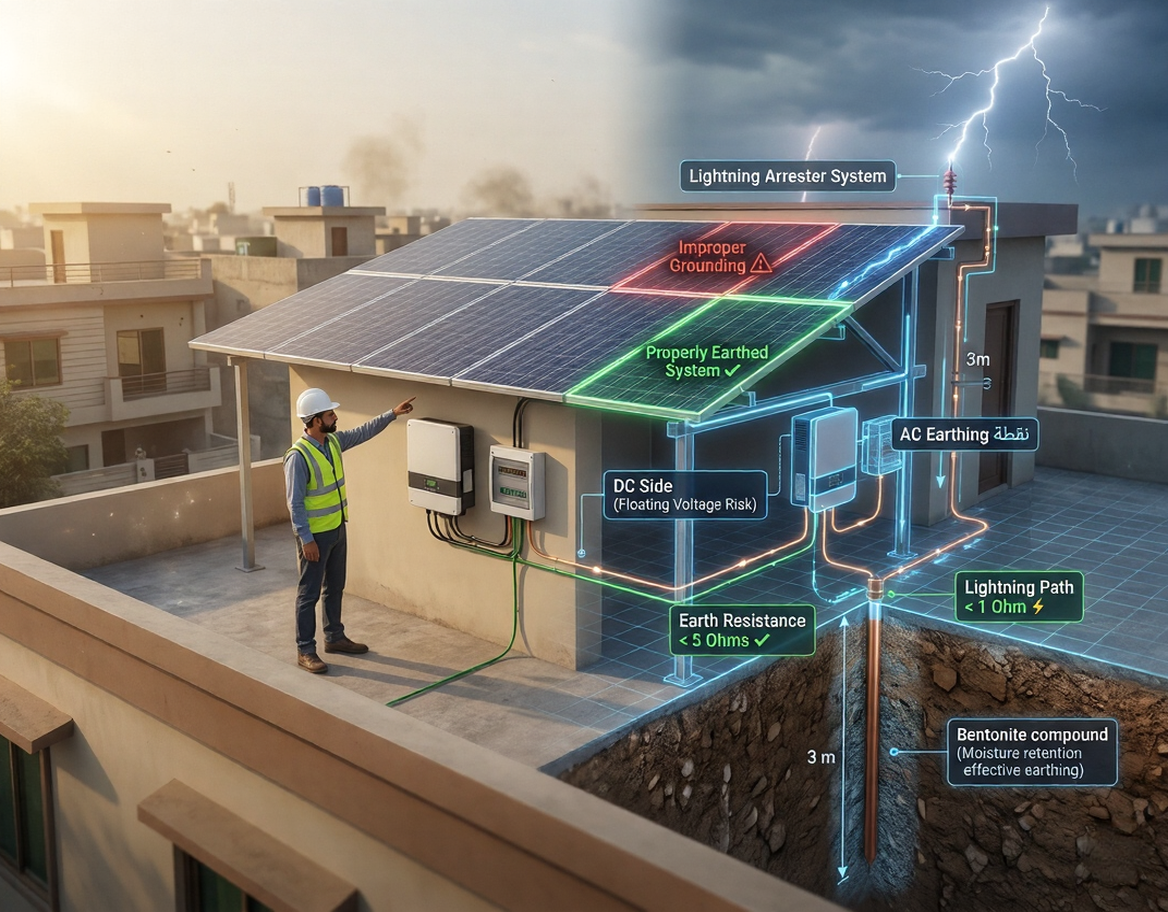
Solar installations are expanding across Pakistan faster than the industry was prepared for. Lahore, Karachi, Faisalabad, Multan – rooftop panels are now a common sight in almost every neighbourhood. But one critical part of every solar setup keeps getting skipped: earthing.
Ask three installers which earthing standard applies to a residential PV system, and you will likely get three different answers. Some cite NEPRA. Others mention IEC. A few say “5 ohm resistance is enough.” None is completely wrong, but none gives you the full picture either.
This guide fixes that. By the end, you will know which standards govern solar earthing in Pakistan, what the requirements are for both AC and DC sides, and how to verify whether your system actually meets them.
Why Solar Earthing Is More Complex Than Standard Home Wiring
In a regular home electrical system, earthing provides one function: a safe fault current path that triggers your circuit breaker. In a solar PV system, the job is significantly harder.
You are managing two voltage domains running simultaneously. The DC side operates between 300V and 600V in most residential systems. The AC side connects directly to your home wiring and the WAPDA grid. A fault on either side needs a defined, low-resistance path to ground. Without it, that fault current travels through equipment, cables, or a person.
There is also the floating DC problem. When a solar array has no defined earth reference, an undefined voltage builds between the PV conductors and ground. This accelerates panel degradation through potential-induced degradation (PID), generates leakage current, and creates a shock hazard during maintenance. On Pakistani rooftops, this is a regular occurrence, not a theoretical risk.
Which Regulatory Bodies Set the Earthing Rules in Pakistan
NEPRA and the Net Metering Framework
NEPRA regulates all grid-connected solar systems through its Net Metering Regulations and the Distribution Code. The Distribution Code sets technical requirements at the point of grid connection, including protection and earthing compliance. Any system applying for net metering must pass a DISCO technical inspection. A system without proper earthing will not pass.
If your installer never discussed earthing compliance during your net metering application process, address it before your inspection.
AEDB and Installer Licensing
AEDB licenses solar installation companies and expects licensed contractors to follow accepted technical standards. However, AEDB publishes no standalone solar earthing document. It defers to internationally adopted frameworks. This is the root cause of the inconsistency you see across Pakistani installations. Two AEDB-licensed contractors can follow different references, and both consider themselves compliant.
PSQCA and the Adopted IEC Standards
Pakistan adopts international standards through PSQCA. For solar PV earthing, the most relevant ones are:
- IEC 60364-7-712: Electrical installations for solar PV power supply systems
- IEC 62548: PV array design requirements, including earthing
- IEC 62305: Lightning protection, a separate but connected requirement
Many Pakistani electricians also reference BS 7671 informally, a legacy of British-era electrical infrastructure still present across the country. It is not wrong, but it creates inconsistency when different contractors use different frameworks on connected systems.
The Core Grounding Requirements for Solar PV in Pakistan
System Earthing vs. Equipment Earthing
These are two distinct requirements. Confusing them causes real compliance failures.
System earthing connects the neutral conductor to ground, establishing a stable voltage reference. Equipment earthing connects all metal enclosures, frames, and casings to ground so a fault does not energise any surface a person can touch. Both are required. Skipping either creates a non-compliant and dangerous installation.
DC-Side Grounding
This is where most residential installations in Pakistan fail. The answer depends entirely on your inverter type.
Transformer-based inverters allow the DC negative to be earthed at a single defined point. Transformerless inverters, which now represent the majority of systems sold in Pakistan, handle DC isolation internally. On a transformerless inverter, an external DC earth connection causes ground fault errors, triggers inverter shutdowns, and can damage the unit. Most homeowners and many installers do not know this distinction.
Before deciding on your DC earthing approach, confirm your inverter type through its inverter efficiency ratings and technical specifications.
AC-Side Earthing
The AC output of your inverter feeds your home distribution board. The neutral must be earthed at the main earth point only, not at multiple locations. Multiple neutral-earth connections create circulating currents and interfere with RCDs. Your DB box must include a proper earth busbar connected to the earthing electrode through a correctly sized conductor.
A properly specified metallic distribution box supports clean earthing terminations and is a core part of a compliant AC-side setup.
Equipment and Structural Bonding
Every metal component must be bonded: panel frames, mounting rails, inverter chassis, and junction boxes. Bonding connects all metal parts to the main earth point, eliminating touch voltage hazards during a fault.
Under IEC 60364, conductor sizing depends on the system’s fault current capacity. For most residential solar systems in Pakistan, a minimum 10mm² bare copper earth conductor is the accepted standard. Using 2.5mm flex instead is one of the most common shortcuts on budget installations. The right choice is a dedicated bare copper 10mm² earth conductor run continuously from the array to the electrode. 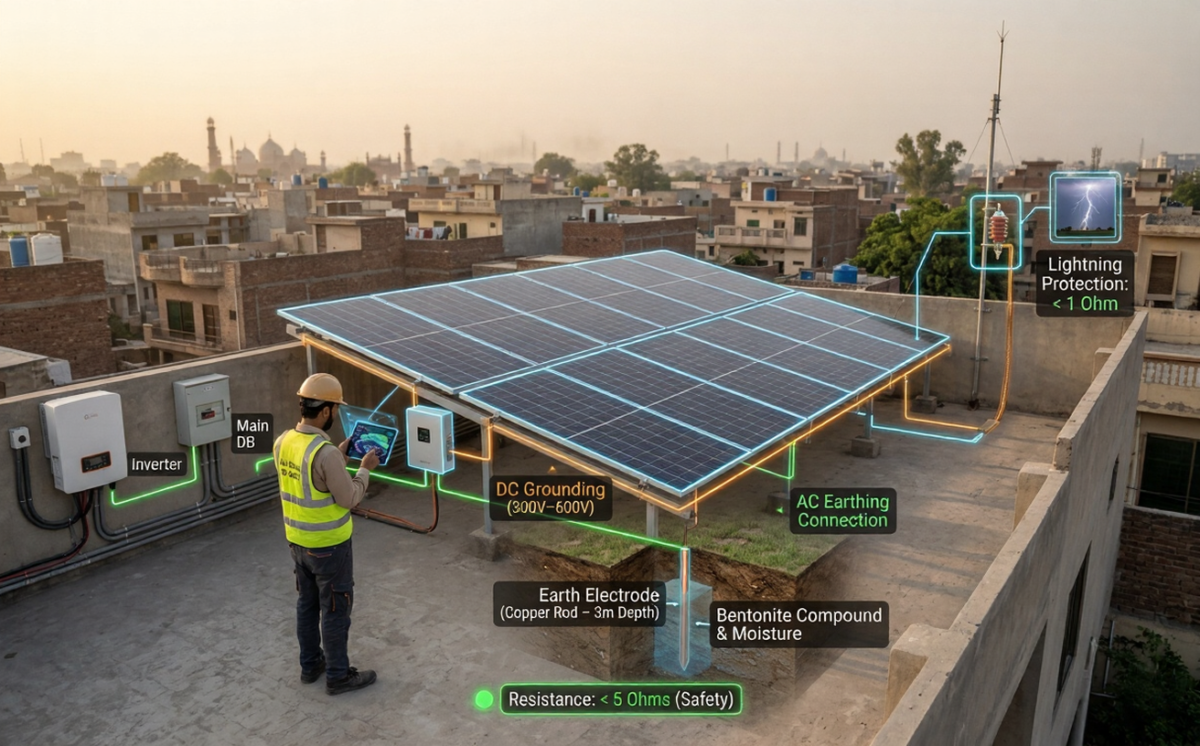
Earthing Electrode Requirements
|
Parameter |
Requirement |
|
Electrode material |
Copper-bonded rod (preferred) or GI rod |
|
Minimum burial depth |
3 metres in normal soil |
|
Safety earthing target |
Below 5 ohms |
|
Lightning protection target |
Below 1 ohm |
|
Dry or rocky soil |
Bentonite-based earthing compound required |
Soil conditions vary widely across Pakistan. In central Punjab, coastal Sindh, and rocky terrain in KPK and Balochistan, standard rod installation without soil treatment often fails to reach the required resistance. The rod sits in dry, high-resistivity soil and provides almost no real grounding. The solution is earthing powder, a bentonite-based compound packed around the electrode to reduce resistivity and retain moisture year-round.
Lightning Protection Earthing: A Separate Requirement
Lightning protection and safety earthing serve different functions and follow different standards. IEC 62305 requires a dedicated low-resistance discharge path with a target resistance below 1 ohm, separate from the safety earthing system.
Pakistan’s northern regions, KPK, and monsoon-affected areas in Punjab and Sindh see high lightning incidence. Rooftop solar arrays are elevated, metal-framed, and fully exposed. In these zones, a dedicated lightning arrester for solar systems is not optional.
The same electrode can serve both systems in some configurations, but only when the combined resistance satisfies both thresholds and conductor separation follows IEC 62305. A licensed electrical engineer should confirm this before combining them.
Common Earthing Failures in Pakistani Solar Installations
These are routine problems, not edge cases:
- No earthing installed at all, common on informal installations without licensed contractors
- DC negative earthed on a transformerless inverter, which triggers ground fault errors
- Mounting structure and panel frames are left completely unbonded
- Undersized conductors, with 2.5mm flex, are used where 10mm² is required
- The earthing rod was installed too shallow, stopping before it reaches moist subsoil
- No earth resistance test performed, with the system assumed compliant
These failures reflect a real gap in guidance. The applicable standards are spread across multiple IEC documents with no single consolidated local reference, and many installers work from habit rather than specification.
Earthing failures also tend to appear alongside other installation shortcuts. Reviewing the top mistakes to avoid when installing rooftop solar gives a broader picture of what to check.
How to Verify Your System Is Properly Earthed
Earth Resistance Testing
An earth resistance test uses the three-point fall-of-potential method with a dedicated tester such as a Megger. The result should be below 5 ohms for safety earthing. Ask your installer or an independent electrician to perform this test and provide a written result. No written result means the system has never been tested.
Visual Inspection Points
- The green-yellow earth conductor runs continuously from the array to the electrode without joints
- All panel frames and mounting rails are bonded with proper clamps
- The inverter earth terminal is connected with a correctly sized conductor
- The DB box contains an earth busbar with all conductors properly terminated
Questions to Ask Your Installer
- Which standard did you follow: IEC 60364-7-712 or BS 7671?
- Was an earth resistance test performed? Can I have the written result?
- Is this a transformerless inverter, and how is the DC side handled?
These three questions will quickly reveal whether your installer worked to a standard or guessed their way through.
Older Systems and Retrofitting
Systems installed before 2022 may predate NEPRA’s updated technical requirements. Systems installed without a DISCO inspection or an AEDB-licensed contractor almost certainly have no documented earthing compliance. Retrofitting is straightforward. The electrode, conductor, and bonding connections can be added without dismantling the panels or inverter.
If you are planning a new installation or reviewing an existing one, understanding how to size your home solar system correctly from the start helps avoid compounding problems later.
Conclusion
Pakistan’s solar earthing requirements draw from IEC 60364-7-712, IEC 62548, and IEC 62305, referenced through NEPRA’s technical framework and AEDB’s installer obligations. No single national document consolidates everything, which is exactly why so many installations fall short.
The standards are clear, the test methods are straightforward, and the materials are widely available. Whether you are commissioning a new system, auditing an existing one, or simply checking what your contractor actually did, you now have a practical reference. Ask the right questions, request the test results, and confirm your conductor sizing. That moves your system from assumed-compliant to actually-compliant.
Independent Power: Connect with Enon Traders Today!
Start your off-grid journey with Pakistan’s most reliable solar partner.
| Connect With Us | Action Link |
| Chat Instantly on WhatsApp | Get an off-grid system quote: Click to Chat Now! |
| Visit Our Website | View our off-grid inverters: Official Website |
| Call Our Experts | Design your custom micro-grid: Contact Page |