Best Hybrid Inverters in Pakistan 2026: Side-by-Side Comparison for Homes and Businesses
May 13, 2026
Solar Batteries in Pakistan: Best Options, Real Prices and Which One Actually Lasts
May 15, 2026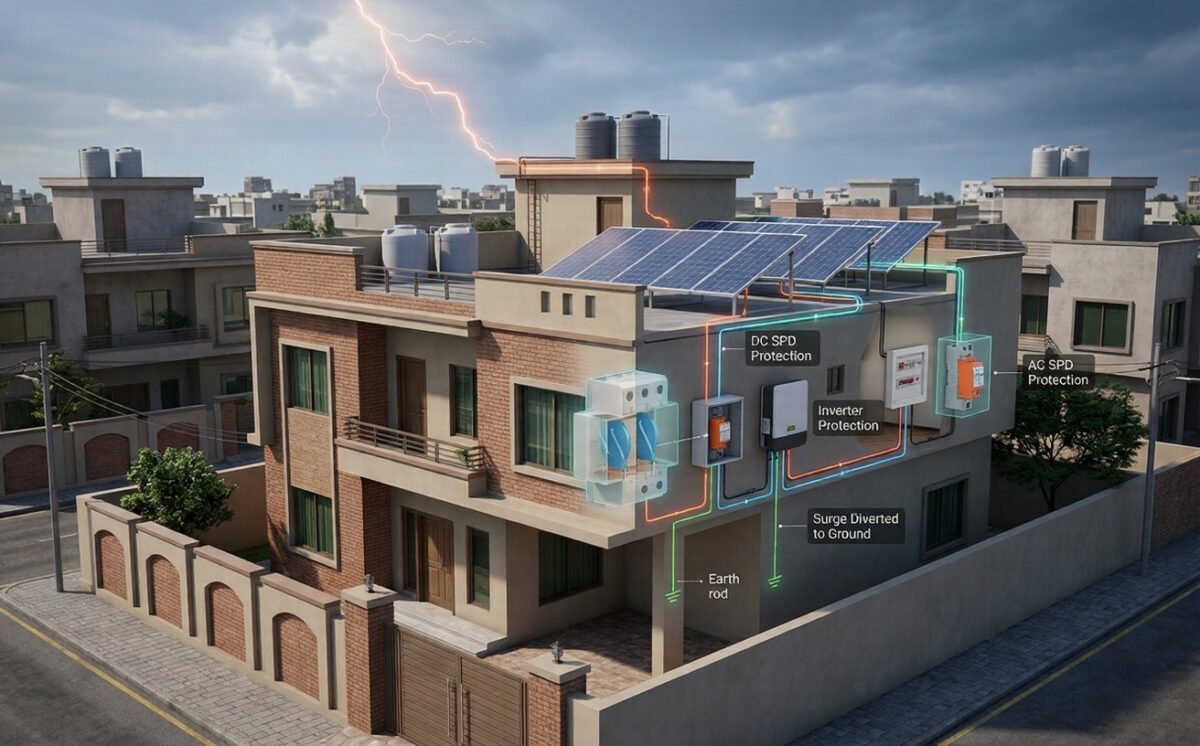
Pakistan’s solar boom has put millions of systems on rooftops across Lahore, Karachi, and Islamabad. Most of them run without any issues, until a monsoon lightning event or a grid fault destroys a Rs. 60,000 inverter overnight. In most of those cases, a Rs. 1,500 device could have prevented the entire loss.
That device is a solar surge protection device (SPD). If you have recently had a solar system installed, been quoted one by an installer, or simply want to understand what your system actually needs, this guide walks you through everything, including what type to choose, where it goes, and whether your inverter already includes one.
What a Solar Surge Protection Device Actually Does
An SPD is installed in your solar system to detect sudden spikes in voltage, absorb the excess energy, and divert it safely to earth before it reaches your inverter or other sensitive equipment.
The key component inside most SPDs is a Metal Oxide Varistor (MOV). Under normal operating voltage, it sits at high resistance and does not affect the circuit. The moment a surge occurs, it switches to near-zero resistance in nanoseconds, shunts the surge current to ground, and resets once the event passes.
This all happens faster than any breaker or fuse can react, which is precisely why a standard circuit breaker cannot replace an SPD.
How Surges Damage Solar Systems
A surge does not need to be a direct lightning strike to cause damage. Most damaging surges are indirect: lightning striking within a few hundred metres induces a transient pulse through your DC cable loops. Grid switching events, load shedding reconnections, and even heavy motors starting nearby can push damaging spikes into your system.
The inverter sits at the center of all this. It handles both the DC input from your panels and the AC output to your loads, making it the most exposed and most expensive single component in most residential systems, often representing 15 to 20 percent of total system cost. A single uncontrolled surge can permanently destroy its internal electronics.
Where Surges Enter a PV System
Surges can enter from two directions:
- The DC side: from the solar panels down through the string cables toward the inverter
- The AC side: from the grid or local loads back through the inverter’s output terminals
This dual vulnerability is why solar surge protection is more involved than protecting a standard appliance. You are dealing with two separate circuits, each with different voltage levels and different threat profiles. Understanding both is essential before selecting any device.
Lightning Arrestor vs Surge Protection Device: They Are Not the Same
This is one of the most persistent sources of confusion in Pakistan’s solar market. Many homeowners install a lightning arrestor and genuinely believe their system is now surge protected. It is not.
What a Lightning Arrestor Does
A lightning arrestor (also called a lightning rod or ESE terminal) is an external lightning protection system. Its purpose is to capture a direct lightning strike and channel that massive energy safely into the earth through a down conductor. It operates entirely outside your electrical circuit.
An SPD, by contrast, works inside your electrical wiring. It handles the residual electromagnetic pulse and induced transients that travel through your DC and AC cables, even when no direct strike occurs on your property.
When You Need Both
Think of it as two layers of defense. A lightning arrestor handles the catastrophic direct hit. An SPD handles the electrical shockwave that travels through your cables, regardless of where the strike lands.
For properties in high-lightning-risk areas like upper Punjab, KPK foothills, and Sindh’s monsoon belt, both layers are worth having. For standard urban rooftop installations, a properly rated SPD is the non-negotiable minimum. Quality lightning arrestor options for solar systems designed specifically for PV installations are available if your risk profile warrants the added layer.
DC-Side vs. AC-Side: Why Solar Needs Protection on Both Ends
This is the dimension most local installers either skip entirely or explain poorly. Your solar system has two electrically distinct circuits, and they require separate SPDs.
The DC String Side (Panels to Inverter)
Your solar panels generate high-voltage DC power, typically 400V to 1000V DC in a residential string configuration. The long cable run from the rooftop to the inverter acts like an antenna during a nearby lightning event, picking up induced transient currents directly.
DC-side surges are often the most destructive because they carry higher energy and target the inverter’s DC input stage and MPPT circuits, which are extremely sensitive electronics. A DC SPD is installed at the combiner box, the inverter’s DC input terminals, or both, depending on cable length. The solar DC cables guide explains how cable sizing and routing directly affect surge risk in practice.
The AC Output Side (Inverter to Grid/Load)
The AC side faces a different but equally real threat: grid-induced switching surges, voltage spikes from load shedding reconnections, and inductive pulses from motors and compressors on the same line. An AC SPD is installed between the inverter output and the main distribution board.
Assuming the inverter handles AC-side protection on its own is a costly mistake. Many inverters that fail in Pakistan fail from the AC side, not the DC side. The AC protection guide for solar systems covers what AC-side vulnerabilities look like in real installations.
Understanding Type 1, Type 2, and Type 3 SPDs
The IEC 61643 standard classifies SPDs into three types based on their installation location and the level of surge energy they are designed to handle.
|
Type |
Installation Point |
Handles Direct Strike Energy |
Best For |
|
Type 1 |
Main service entrance |
Yes (10/350 µs waveform) |
Systems with external lightning protection |
|
Type 2 |
Distribution board/inverter input |
No, but handles induced transients |
Standard residential and commercial solar |
|
Type 1+2 |
Combined at the main DB |
Yes |
High-lightning-risk locations |
|
Type 3 |
Device-level near sensitive equipment |
No, supplemental only |
Additional inverter or monitoring protection |
For a typical 5kW to 20kW rooftop system in Pakistan, a Type 2 DC SPD on the string side combined with a Type 2 AC SPD at the distribution board is the correct baseline configuration.
If your property has an external lightning rod system installed, you need a Type 1 or combined Type 1+2 at the main service entrance. A Type 2 alone in that scenario will fail immediately under a real partial-lightning-current event, because it is simply not rated to handle that level of energy.
Does Your Inverter Already Include Surge Protection?
This is the question most buyers arrive with, and almost nobody answers directly. The honest answer is: sometimes yes, but often not to the level your system actually requires.
Integrated vs. Standalone SPDs
Some modern inverters include internal surge protection, typically Type 2 rated on both DC and AC terminals. Premium models from brands like Huawei, SolaX, GoodWe, and Solis often include this. The Huawei SUN2000 series and several SolaX hybrid inverters are examples where integrated SPD is present and documented.
However, locally assembled inverters and many mid-range units common in Pakistan’s market either lack built-in protection entirely or include basic MOV components rated far below what a real surge event demands.
How to Read Your Inverter’s Spec Sheet
Open your inverter’s datasheet and look specifically for:
- “SPD Class II” or “Type 2 surge protection” is listed under protection features
- Separate DC input and AC output surge ratings with discharge current values (e.g., 40kA)
- IEC 61643-11 or EN 50539-11 compliance markings
If the spec sheet lists only “surge protection” without a type classification or kA discharge rating, treat it as insufficient and add a standalone device. A passing mention of surge protection as a feature bullet is not the same as compliance-grade SPD. This is one of the checks worth completing before purchasing any solar component in Pakistan.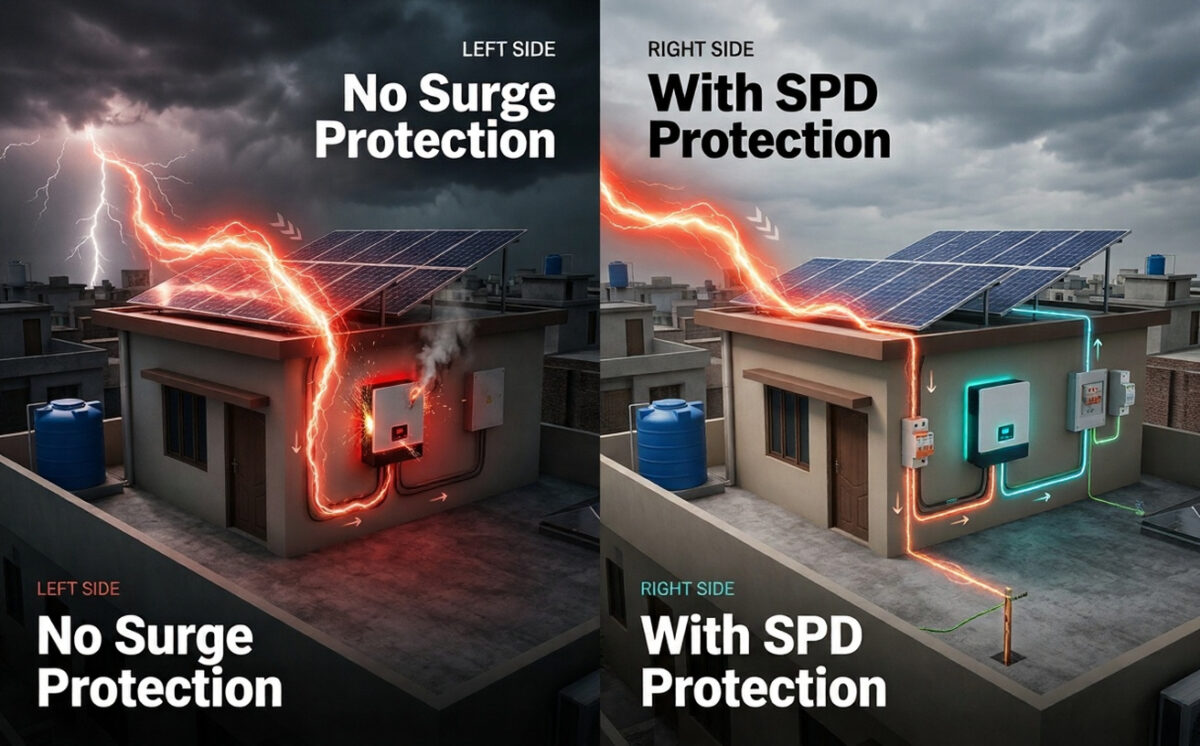
How to Choose the Right SPD for Your System
Once you confirm you need a standalone device, matching the specifications correctly to your system is the step most buyers either skip or get wrong.
The Specs That Actually Matter
Uc (Maximum Continuous Operating Voltage): Must exceed your array’s maximum open-circuit voltage by at least 1.2x. For a string with 500V Voc, you need Uc of at least 600VDC. Installing an SPD rated below your system voltage causes the MOV to conduct continuously, overheat, and fail, often posing a fire risk rather than providing protection.
Imax (Maximum Discharge Current): The highest single surge it can survive without failing. Look for 40kA or higher for residential systems.
In (Nominal Discharge Current): The level it can handle repeatedly without degradation. 20kA is standard for Type 2.
Up (Voltage Protection Level): The residual voltage that passes through to your equipment during a surge event. This must be lower than your inverter’s impulse withstand voltage. If your inverter can withstand 4kV, your SPD’s Up must sit below that threshold.
One installation detail worth noting: if the cable run between your SPD and the inverter exceeds 10 metres, the effective Up can double due to resonance effects in the cable. In that case, add a second SPD directly at the inverter terminals. This rule is widely overlooked in Pakistani solar installations and accounts for a meaningful number of protection failures. Pairing SPD placement with properly sized DC breakers for solar and AC breakers gives the system a complete protection architecture.
Where SPDs Are Placed in a Solar System
Correct placement is as important as correct specification. An SPD in the wrong location provides partial or no real protection.
The standard three-point placement for a residential installation is:
- DC combiner box or inverter DC terminals: one DC SPD per string input, or a multi-channel DC SPD at the combiner box
- AC output of the inverter: one AC SPD between the inverter and the main distribution board
- Main DB (only if a lightning protection system is present): a Type 1 or Type 1+2 at the service entrance
All SPDs, both DC and AC, must be connected to the same earthing system. Poor or absent earthing is one of the primary reasons SPDs fail to protect even when correctly sized and installed. The solar earthing standards guide details what a proper earth electrode system looks like for PV installations in Pakistan, including soil conditions across different regions.
IEC 61643-32, the international standard specifically covering SPD use in PV systems, has been in effect since 2017. While Pakistan does not currently mandate SPD installation across all solar projects by law, NEPRA-compliant net-metering systems are increasingly expected to include surge protection as part of their safety documentation. Beyond compliance, skipping SPDs can void your inverter manufacturer’s warranty and significantly complicate any insurance claim following a surge event.
Mistakes That Leave Your System Exposed
Protecting only the AC side. Many installers fit an AC SPD at the distribution board and consider the system protected. The DC string side remains completely exposed, including the inverter’s most vulnerable input stage. This is the single most common and costly error in the field.
Using a mismatched voltage rating. A 500VDC SPD on a 1000V system does not just fail to protect; it actively fails by conducting continuously under normal operating voltage, generating heat, and potentially causing a fire. Always verify Uc against your array’s actual cold-condition Voc, not the nominal figure.
Assuming integrated protection covers everything. As discussed, integrated SPD in modern inverters is often partial or absent in locally sourced units. Verifying the spec sheet before installation, rather than after a failure, is the correct approach. This applies equally to avoiding substandard solar equipment more broadly.
Neglecting the 10-metre rule. This installation detail is rarely discussed locally but accounts for real protection failures. If your SPD is more than 10 metres of cable away from what it is supposed to protect, add a second device closer to the equipment.
The Bottom Line
Solar surge protection devices are not optional accessories. They are the difference between a surge event that your system absorbs silently and one that takes out your inverter, voids your warranty, and leaves you replacing expensive hardware.
For most residential systems in Pakistan, the requirement is straightforward: a Type 2 DC SPD on the string side, a Type 2 AC SPD at the distribution board, both connected to a properly installed earth. If your inverter is a premium branded unit with documented integrated SPD, confirm the ratings before assuming it is sufficient. If it is a locally assembled or mid-range unit, add standalone devices regardless of what the product description says.
The cost of proper surge protection for a typical system is a small fraction of what a single inverter replacement costs. It is one of the few components in solar where the investment-to-protection ratio is almost impossible to argue against.
Independent Power: Connect with Enon Traders Today!
Start your off-grid journey with Pakistan’s most reliable solar partner.
| Connect With Us | Action Link |
| Chat Instantly on WhatsApp | Get an off-grid system quote: Click to Chat Now! |
| Visit Our Website | View our off-grid inverters: Official Website |
| Call Our Experts | Design your custom micro-grid: Contact Page |