Single Phase Inverter for Home in Pakistan: Why It Works in Some Homes and Fails in Others
February 19, 2026
Battery Charging Efficiency in Solar Systems: Complete Guide to Improving Battery Performance
February 23, 2026
Power outages are a common occurrence in Pakistan. Houses and small businesses rely on batteries to power fans, lights, and other devices during power outages. However, most people resort to estimates when calculating battery backup time.
Battery backup calculation eradicates this issue. It enables you to grasp battery backup hours clearly and realistically. Once you are familiar with the concept of battery backup calculation, it becomes easy for you to plan and keep your expectations realistic.
This article will help you comprehend battery backup calculation in Pakistan in a simple way.
Quick Battery Backup Rule for Pakistan (Realistic)
If you don’t want calculations, remember this simple rule of thumb:
- 1 ceiling fan uses ≈ 75 watts
- 1 LED light uses ≈ 15 watts
- A Wi-Fi router uses ≈ 10–15 watts
- 1 x 12V 200Ah tubular battery provides ≈ 1.2–1.4 kWh usable energy
- Always assume only 80% inverter efficiency
- Do not plan to use 100% battery capacity (safe usage is about 50% for tubular batteries)
Quick estimate method:
- Add the wattage of appliances you will run during an outage
- Divide usable battery energy by total load
Example:
A 450W load with two 200Ah batteries typically provides 4-5 hours of practical backup in Pakistani conditions.
Why does this work in Pakistan?
Power outages are long, inverter losses are real, and batteries cannot be fully discharged safely.
What Battery Backup Calculation Means in Pakistan
Many people believe that the higher the ampere-hour rating, the longer the backup time. This is the reason for frustration during outages. Backup time is based on many related factors, not just battery size.
The right calculation is based on the usable energy provided by the batteries. It also takes into account the efficiency losses and safe battery limits.
What Determines Battery Backup Hours in Pakistan
Your connected load is the total power drawn by appliances running during an outage. This is not your full household load. During load shedding, most households run fans, lights, a router, and sometimes a refrigerator.
Many people overestimate their load. This mistake shortens calculated backup hours on paper. In reality, disciplined load selection can significantly extend backup. For a clear explanation of how losses affect output, review inverter efficiency ratings.
The Basic Formula for Battery Backup Calculation
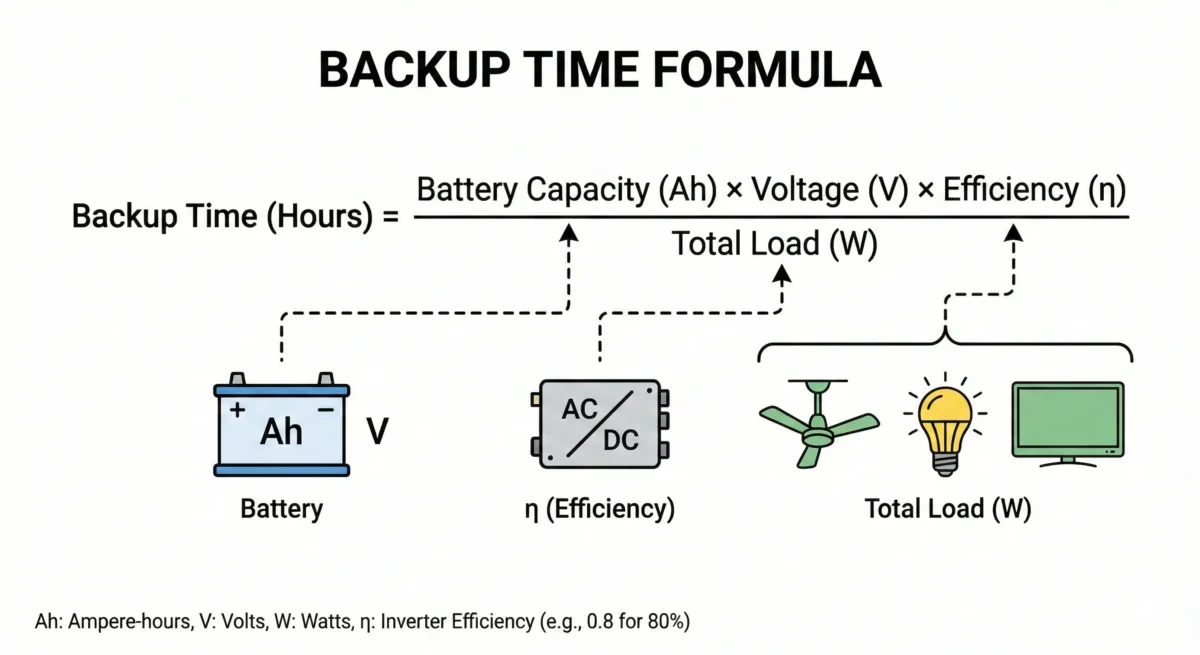
Battery backup calculation converts battery capacity into usable energy. That energy is then divided by the connected load to estimate backup hours.
Battery energy is measured in watt-hours. While the formula looks simple, assumptions make a major difference. This step separates realistic estimates from marketing figures.
Step-by-Step Battery Backup Calculation
Step 1: Identify essential appliances
List only the appliances you plan to use during outages. Fans, lights, and routers usually come first. Heavy appliances drain batteries quickly.
Step 2: Calculate total running watts
Add the wattage of each selected appliance. Use actual ratings instead of estimates. Some appliances, such as refrigerators, draw extra power during startup.
Step 3: Adjust battery capacity realistically
Batteries should not be fully discharged. Most tubular batteries operate safely at around 50 percent depth of discharge. Lithium batteries allow deeper discharge.
This concept is explained clearly in the battery depth of discharge.
Step 4: Estimate realistic backup hours
Divide usable battery energy by the total load. Then reduce the result slightly to reflect real-world losses.
Example Battery Backup Calculations for Pakistani Homes
Small home backup example
Minor changes in usage can increase or reduce this time.
Transparent Battery Backup Calculation Example (Real Numbers)
To understand how backup hours are calculated in real life, let’s break one example down step by step.
- Battery bank: Two 12V 200Ah tubular batteries
- Total stored energy:
12V × 200Ah × 2 = 4800 watt-hours (Wh) - Usable energy at a safe depth of discharge (50%):
4800 Wh × 0.50 = 2400 Wh - Energy after inverter efficiency losses (85%):
2400 Wh × 0.85 ≈ 2040 Wh - Connected load during outage:
450 watts (fans, lights, router) - Estimated backup time:
2040 Wh ÷ 450 W ≈ 4.5 hours
Small changes in load or battery
Medium home backup example
A medium home adds a refrigerator to the same setup. The load increases to around 900 watts.
Using the same battery bank, backup drops to roughly two to three hours. This drop surprises many users.
Common Mistakes in Battery Backup Calculation
Many users assume full battery capacity is usable. Another common mistake is mixing solar generation with night backup expectations. Solar panels do not help after sunset unless energy is stored.
Poor system planning also affects results. These issues often begin during installation. You can avoid them by reviewing the top mistakes to avoid when installing rooftop solar in Pakistan.
Battery Backup vs UPS Expectations in Pakistan
A UPS system is designed for short-duration backup. It usually powers lights and fans for one to two hours. UPS batteries are frequently discharged deeply, which reduces their lifespan. Backup time drops quickly as batteries age.
A battery-based solar inverter system focuses on planned load management. Backup hours are calculated using usable battery energy, safe discharge limits, and inverter efficiency. When sized correctly, these systems provide more predictable and stable backup during long outages.
A generator behaves differently. It can run heavy loads for long hours, but it consumes fuel, produces noise, and requires regular maintenance. Generators are not limited by battery capacity, but operating costs rise during extended outages.
Battery backup calculation helps users understand these differences clearly. It sets realistic expectations for batteries and prevents disappointment caused by comparing them directly with generators or short-term UPS behavior.
How Battery Type Changes Backup Behavior
Tubular batteries deliver stable output but require shallow discharge to maintain life. Backup calculations must remain conservative.
Lithium batteries behave differently. They support deeper discharge and maintain voltage stability. This difference increases usable backup hours under the same load. For a clear comparison, read lithium vs tubular battery in Pakistan.
Tubular vs Lithium Battery Backup Behavior in Pakistan
Comparison Table
| Feature | Tubular Battery (Lead-Acid) | Lithium Battery (LiFePO4) |
|---|---|---|
| Safe Depth of Discharge | ~50% recommended | 80% to 95% usable |
| Usable Energy from 200Ah | ~1.2–1.4 kWh | ~2.0–2.2 kWh equivalent |
| Backup Stability | Voltage drops gradually | Stable voltage until near empty |
| Efficiency | Lower round-trip efficiency | Higher round-trip efficiency |
| Performance in Heat | Performance drops in extreme heat | Handles heat better but needs BMS protection |
| Maintenance | Requires water topping | Maintenance-free |
| Backup Hours (Same Load) | Shorter runtime | 30–50% longer runtime |
| Lifespan | 3–5 years typical | 8–12 years typical |
| Cost | Lower upfront cost | Higher upfront cost |
| Best For | Budget-conscious homes | Long backup + limited space in homes |
Temperature affects battery performance. High summer temperatures in Pakistan reduce efficiency. Battery age also lowers capacity. A two-year-old battery will not perform like a new one.
Load behavior changes during long outages. Fans may run at higher speeds, increasing consumption. Routine care helps preserve performance. Practical guidance is available in maintenance tips for solar systems in Pakistan’s climate.
How Backup Calculation Helps Better Decisions
Battery backup calculation helps you decide whether to add batteries or reduce the load. It also supports future solar planning. Battery sizing should complement solar design instead of creating conflicts. If you plan to integrate solar later, review battery backup integration.
Backup planning also links to financial recovery. This relationship is explained in how to calculate the payback period.
Final Thoughts on Battery Backup Calculation in Pakistan
Once you calculate realistic battery backup hours, decisions become clearer. Add more batteries if your essential load is correct, but backup time is short. Reduce connected load, but the backup drops quickly, as removing non-essential appliances can extend runtime.
Consider lithium batteries for longer backup, deeper discharge, and limited space. Plan solar integration when battery-only backup is not economical.
Independent Power: Connect with Enon Traders Today!
Start your off-grid journey with Pakistan’s most reliable solar partner.
| Connect With Us | Action Link |
| Chat Instantly on WhatsApp | Get an off-grid system quote: Click to Chat Now! |
| Visit Our Website | View our off-grid inverters: Official Website |
| Call Our Experts | Design your custom micro-grid: Contact Page |