AC Breakers in Solar Installation: How to Choose the Right Size for Safe AC Protection
April 28, 2026
Rooftop Solar Panels in Pakistan (2026): Costs, System Sizes and What to Know Before You Install
April 30, 2026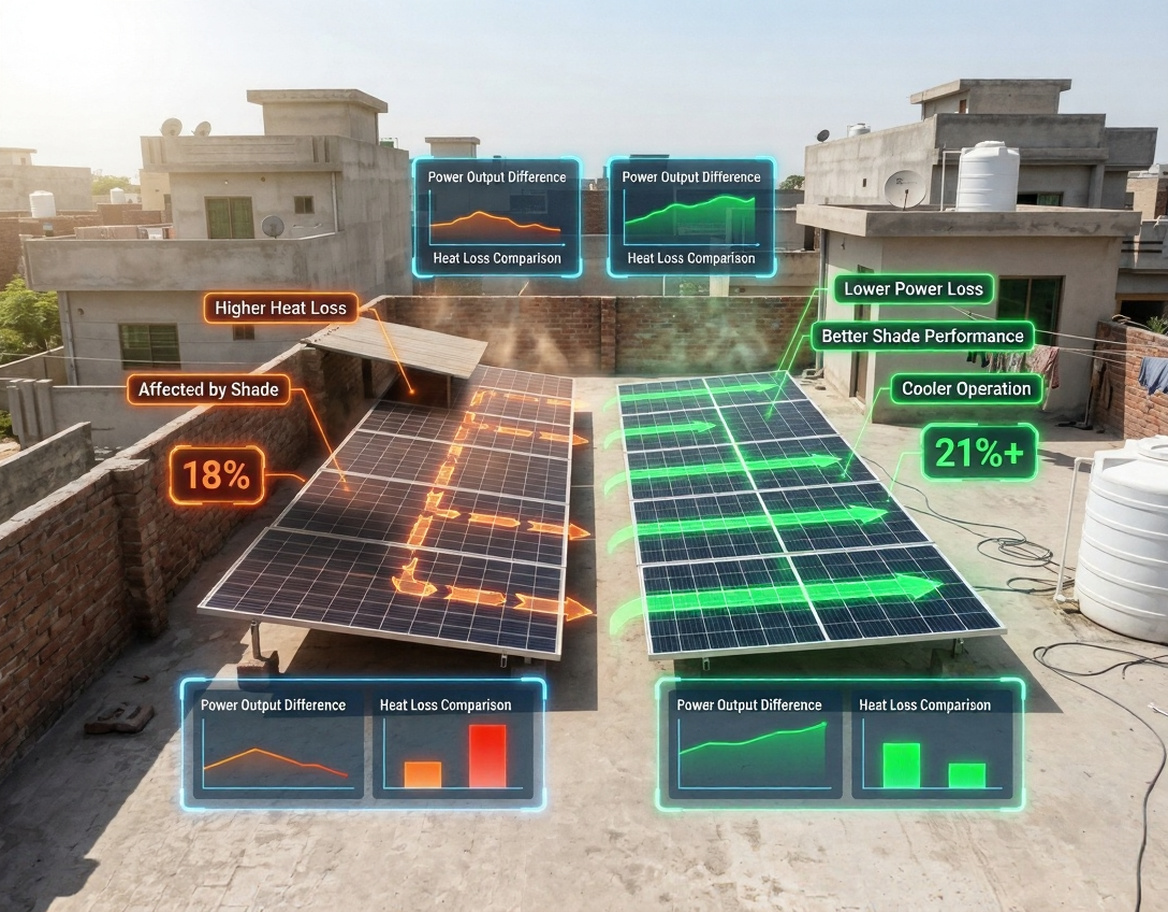
Solar panels in Pakistan have become a serious household decision, not just an environmental one. With electricity bills crossing Rs. 60 per unit for high-consumption homes and load shedding still disrupting daily life in 2026, more families are committing to rooftop solar. But as soon as you start collecting quotes, one phrase keeps coming up: half-cut panels.
Your installer probably mentioned them while pointing at a slightly higher price, and you probably nodded without fully knowing what changed inside the panel. This article breaks it down clearly so you can decide whether the upgrade is worth it for your specific roof.
What Makes a Solar Panel Half Cut
A half-cut solar panel is exactly what the name suggests. The silicon cells inside the panel are laser-cut into two halves. A standard 60-cell panel becomes a 120-cell panel. A 72-cell panel becomes 144 cells. The physical size of the panel stays the same. Only the internal cell configuration changes.
In a standard panel, electricity flows through full-sized cells connected in a series string. Larger cells carry more current, and higher current produces more resistive heat loss inside the panel. That lost heat is energy that never reaches your inverter.
Smaller cells carry less current. Less current means less resistive loss. The panel runs cooler and delivers more of what it generates to your system. That is the entire physics argument, and it is a strong one.
Why Power Loss Hits Harder in Pakistan
Every solar panel carries a solar panel temperature coefficient, a number that tells you how much output drops per degree above 25°C. A standard panel typically loses 0.35% to 0.45% of its rated output per degree of heat. In Multan, Rahim Yar Khan, or Karachi in June, rooftop surface temperatures regularly climb to 60°C or higher.
At 65°C, your panel is already operating 40 degrees above its rated test condition. That translates to a 14% to 18% output loss on your hottest days, which happen to be your highest-consumption days. To understand how this number affects your system’s real-world performance, read our detailed guide on solar panel temperature coefficient.
Pakistani rooftops create another problem that most global solar content ignores entirely. Water tanks, parapet walls, boundary walls, antennas, and neighbouring buildings cast partial shade that shifts throughout the day. In a conventional panel, cells run in a single series string. One shaded cell chokes the output for the entire string. It is like one blocked lane shutting down a full motorway.
Half-cut panels solve this through a different wiring design.
How Half Cut Panels Reduce Power Loss
Here is what actually changes when cells are cut in half:
- Lower resistive losses: Each half cell carries roughly half the current of a full cell. Since resistive power loss follows the formula P = I²R, cutting the current by half drops losses to one quarter. That is a 75% reduction in internal power waste before the electricity even leaves the panel.
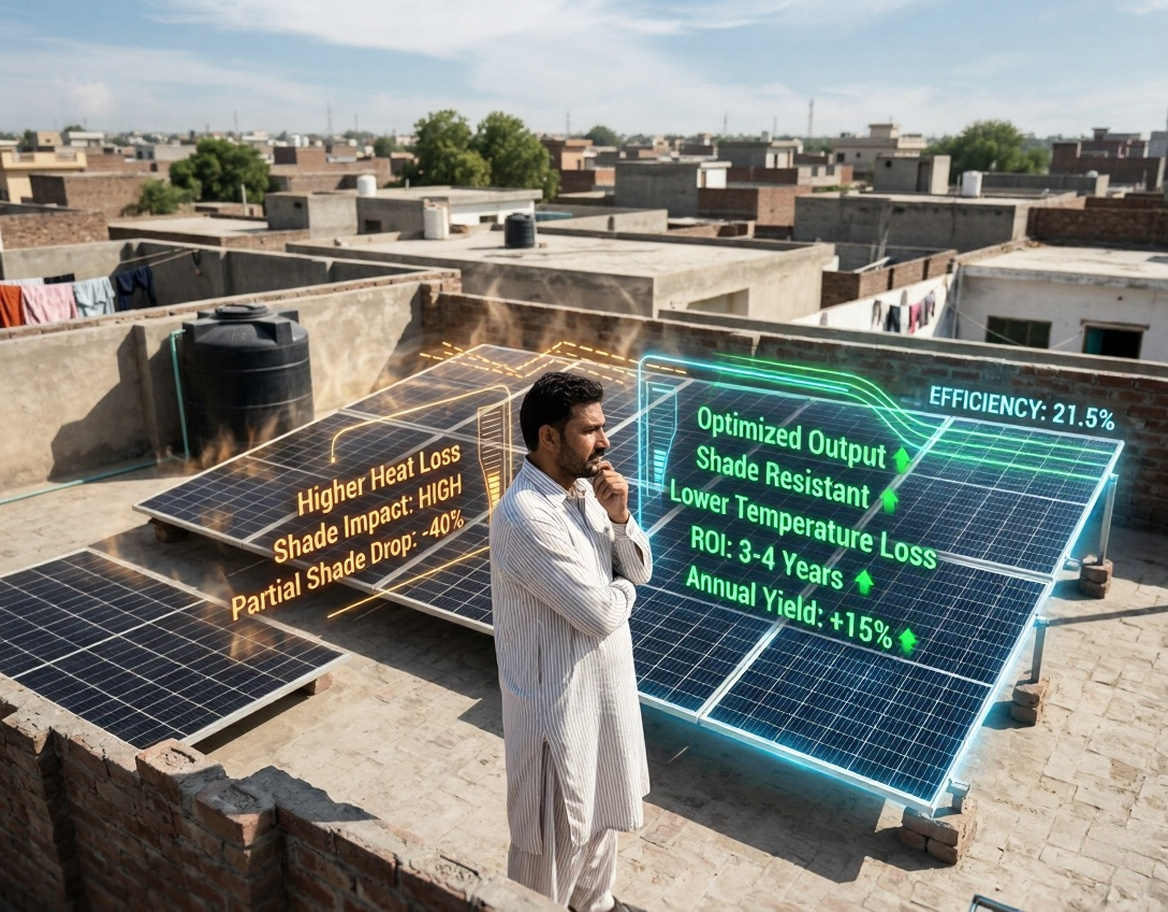
- Better shade tolerance: Half-cut panels divide their cell strings into two independent halves, top and bottom. If a parapet wall shades your lower panel section in the morning, only that half is affected. The upper half continues operating at full capacity. On a standard panel, the same shade scenario drags down the entire panel.
- Cooler operation: Less internal heat means slower long-term degradation. In cities where ambient temperature exceeds 40°C and rooftops add another 20°C to 30°C on top of that, any design feature that reduces internal heat has a real compounding effect over 25 years.
If you want to see how these numbers compare across panel types, our solar panel efficiency comparison guide puts them side by side.
Clearing Up the Terminology Confusion
Many Pakistani buyers leave installer meetings more confused than when they arrived. The reason is that terms like half cut, N-type TOPCon, and bifacial get used together without any explanation of how they relate.
The key point to understand is this: half cut is a cell design feature, not a panel type. It exists across different cell technologies. A PERC panel can be half-cut. A TOPCon panel can be half cut. A bifacial panel is almost always half-cut. These are not competing labels. They stack on top of each other.
When your installer says half-cut bifacial N-type TOPCon, they are describing one panel with three separate features layered together. Our guide on N-type solar panels in Pakistan explains how these technologies combine and which combinations perform best in Pakistani conditions.
Half Cut vs Standard Panels: A Practical Comparison
|
Feature |
Standard Mono Panel |
Half Cut Panel |
|
Efficiency |
17% to 19% |
20% to 22.5% |
|
Temperature coefficient |
-0.40% to -0.45%/°C |
-0.30% to -0.38%/°C |
|
Shade tolerance |
Low |
High |
|
Annual degradation |
0.5% to 0.7% |
0.4% to 0.55% |
|
Price per watt (2026) |
Rs. 32 to Rs. 38 |
Rs. 38 to Rs. 44 |
For a 5kW system, the price difference between standard and half-cut panels typically falls between Rs. 20,000 and Rs. 40,000 at current 2026 market rates. Most users recover this premium within 12 to 18 months through better annual energy yield. To calculate your own numbers, use our solar ROI calculator guide.
By year 20, a system running half-cut panels typically produces 3% to 5% more than an identical wattage standard system. Across a household’s consumption over that period, the difference runs into thousands of units of electricity.
Which Half Cut Panels Are Available in Pakistan Right Now
The most widely available half-cut panels in Pakistan in 2026 come from three tier-one sources:
- Longi Solar (Hi-MO 7 series): Rs. 40 to 40.50 per watt. Widely stocked, strong degradation warranty, and one of the most installed residential brands across Punjab and Sindh.
- Jinko Solar (Tiger Neo series): Rs. 42 to 42.50 per watt. Available in wattages up to 720W and well-suited for large residential and commercial systems. The Jinko 610W bifacial solar panel is a strong reference point for mid-to-large home systems.
- Canadian Solar (TOPCon bifacial): Rs. 42 to 42.50 per watt. Double-glass construction makes it a solid choice for coastal and humid environments. The Canadian Solar 615W N-type bifacial is among the more popular options in Pakistan’s distribution network right now.
Local assemblers also sell half-cut panels at lower price points. Cell quality and warranty enforcement vary significantly with these options. Always ask for the full datasheet before committing to any brand.
Three things to check on a panel spec sheet before trusting any claim:
- Temperature coefficient below -0.35%/°C
- Positive power tolerance, meaning the panel delivers at or above its rated wattage
- A linear power warranty guaranteeing above 80% output at year 25
Our PV module specification guide walks through exactly what each of these numbers means and what separates a credible warranty from a marketing promise.
One more thing worth knowing: “documented” panels, a term you will see repeated across Pakistani price lists, refer to panels imported with proper customs clearance and manufacturer traceability. Undocumented panels arrive cheaper but carry a real authenticity risk. Before finalising any purchase, read our guide on how to identify genuine solar panels and spot fakes.
Are Half-Cut Solar Panels Worth It for Your Setup
When the upgrade clearly makes sense:
- Your rooftop has partial shading from water tanks, parapet walls, boundary walls, or neighbouring buildings
- You are installing in a high-heat city such as Multan, Hyderabad, Rahim Yar Khan, or Karachi
- Your system is 5kW or above, where long-term yield matters more than upfront cost savings
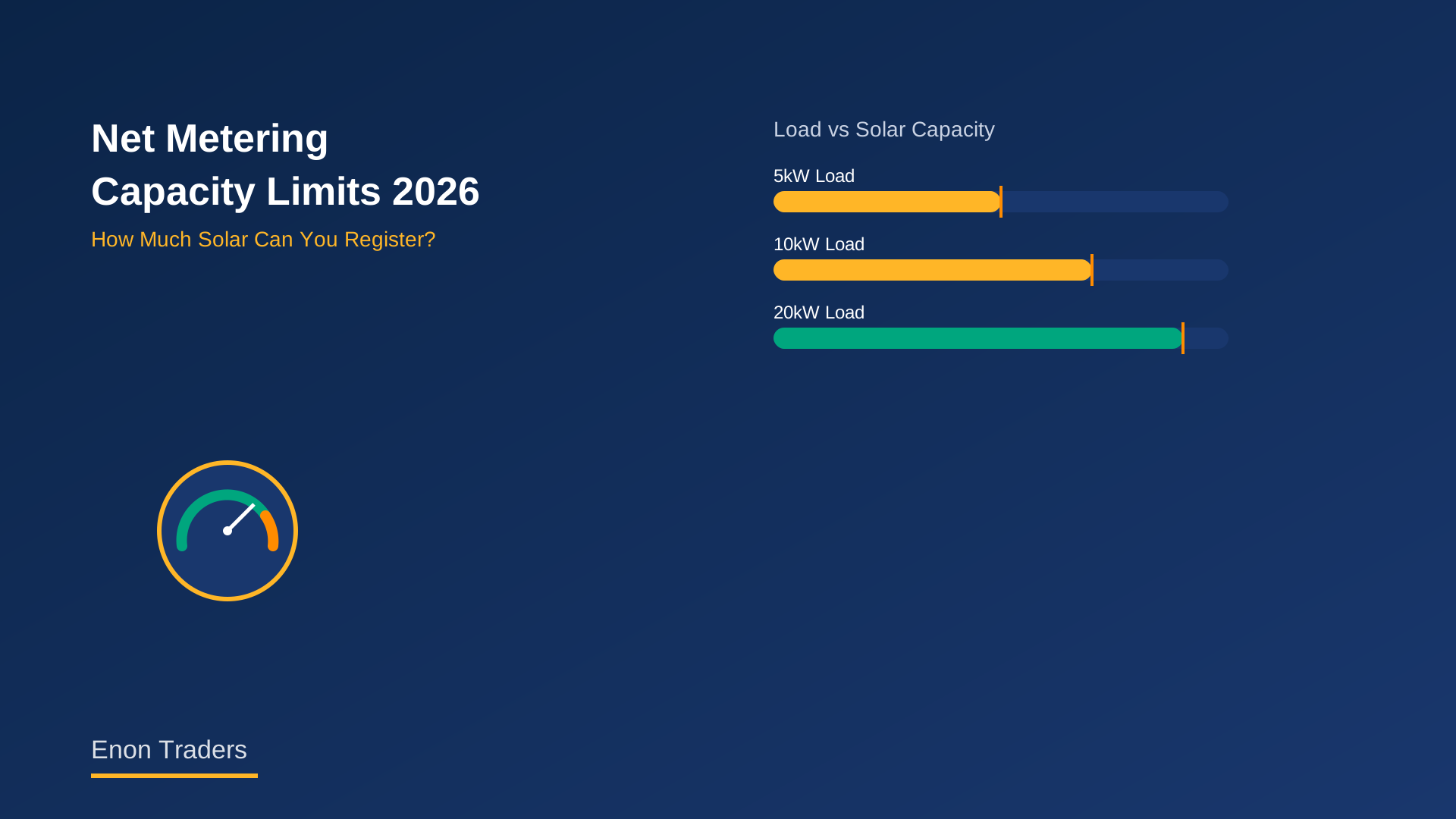
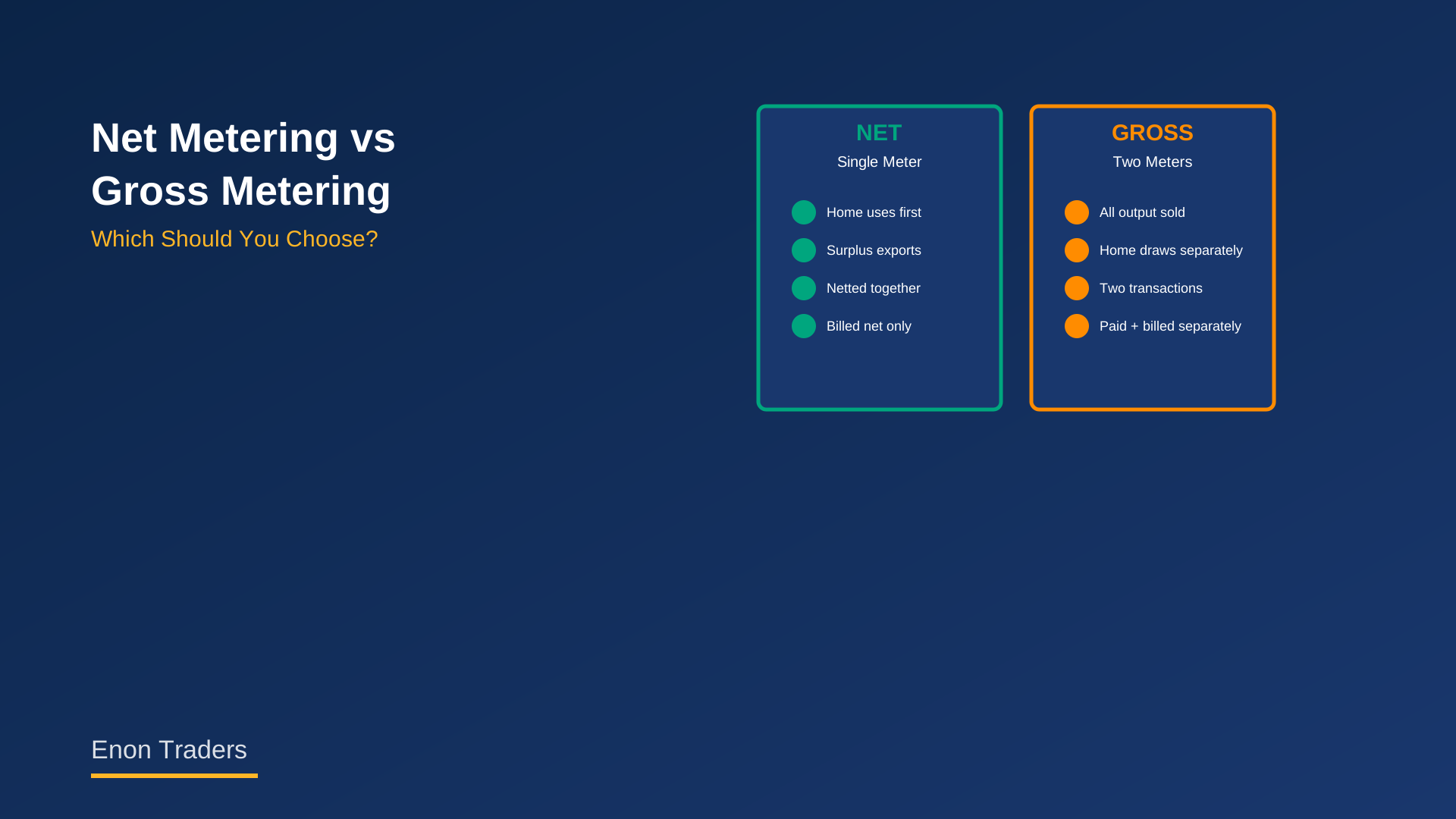
- You plan to use net metering, where every additional exported unit has direct financial value
When standard panels remain a reasonable choice:
- Your rooftop is fully unobstructed and south-facing with no shade risk throughout the day
- You are installing a smaller 3kW system on a genuinely tight budget
- Surrounding structures cast minimal shadow across your panels
One question to ask your installer before signing anything:
Ask for the annual yield estimate in kilowatt-hours, not just the system size in kilowatts. A reliable installer gives you a projected annual generation figure based on your location, roof orientation, and panel type. If they quote you two systems of the same kilowatt size at different prices without explaining the yield difference, that number is what should drive your decision. For more guidance on avoiding costly mistakes during the buying process, go through our checklist before buying a solar panel or inverter, before meeting any installer.
Conclusion
Half-cut panels are not a gimmick. In Pakistan’s climate, with rooftop heat regularly exceeding 60°C, partial shading from everyday urban structures, and systems expected to run for 25 years, this technology addresses real performance problems that standard panels handle less effectively.
The price premium has narrowed enough in 2026 that for most systems above 3kW, the case for half-cut panels is straightforward. What matters most is not which label appears on the panel, but whether you understand exactly what you are buying and why.
Independent Power: Connect with Enon Traders Today!
Start your off-grid journey with Pakistan’s most reliable solar partner.
| Connect With Us | Action Link |
| Chat Instantly on WhatsApp | Get an off-grid system quote: Click to Chat Now! |
| Visit Our Website | View our off-grid inverters: Official Website |
| Call Our Experts | Design your custom micro-grid: Contact Page |