Solar Panel Direction in Pakistan (2026): Ideal Azimuth Angle for Maximum Solar Output
March 30, 2026
MPPT Charge Controller in Pakistan (2026): How to Choose the Right Solar Regulator
April 1, 2026
Most people in Pakistan are of the opinion that any battery can be used with any inverter.
The system may work fine at the initial stages. It may light up the lights, run the fans, and charge the battery as desired. After some time, though, the system may begin to display problems.
Most batteries are not faulty; the only problem is that the battery is not matched.
The compatibility of the inverter with the battery is very important because the inverter and the battery have to operate within the same parameters.
The inverter regulates the charging and discharging of the battery, and the battery regulates the storing and releasing of the energy.
If the two are not matched, the system slowly becomes inefficient. The system may continue running, but incorrect matching gradually weakens battery performance over time.
Understanding inverter compatibility helps homeowners build more stable solar systems, protect expensive batteries, and avoid problems that usually appear months after installation.
What Inverter Compatibility with Batteries Actually Means
Inverter compatibility merely means that the inverter and the battery are safe to operate together in the same environment.
In order for this to occur, however, there are a few requirements that need to be met. First and foremost, the system voltage must be the same. Additionally, the charging parameters must also be compatible with the type of battery being used. Finally, with the advent of lithium batteries, compatibility between the inverter and the battery management system is also necessary.
Most individuals are unaware that compatibility between the inverter and the battery merely means that the same brand names are used. This is not necessarily the case. Brand names are not necessarily the key to compatibility.
For example, a 48V inverter must operate with a 48V battery system. A battery with a different system voltage cannot function correctly with that inverter. Even if the system appears to run temporarily, performance will usually remain unstable and inefficient.
Why Battery Matching Matters in Real Solar Systems
In battery matching problems, the situation may arise gradually. The system may be perfectly fine for the first few weeks of usage. However, problems may start developing gradually.
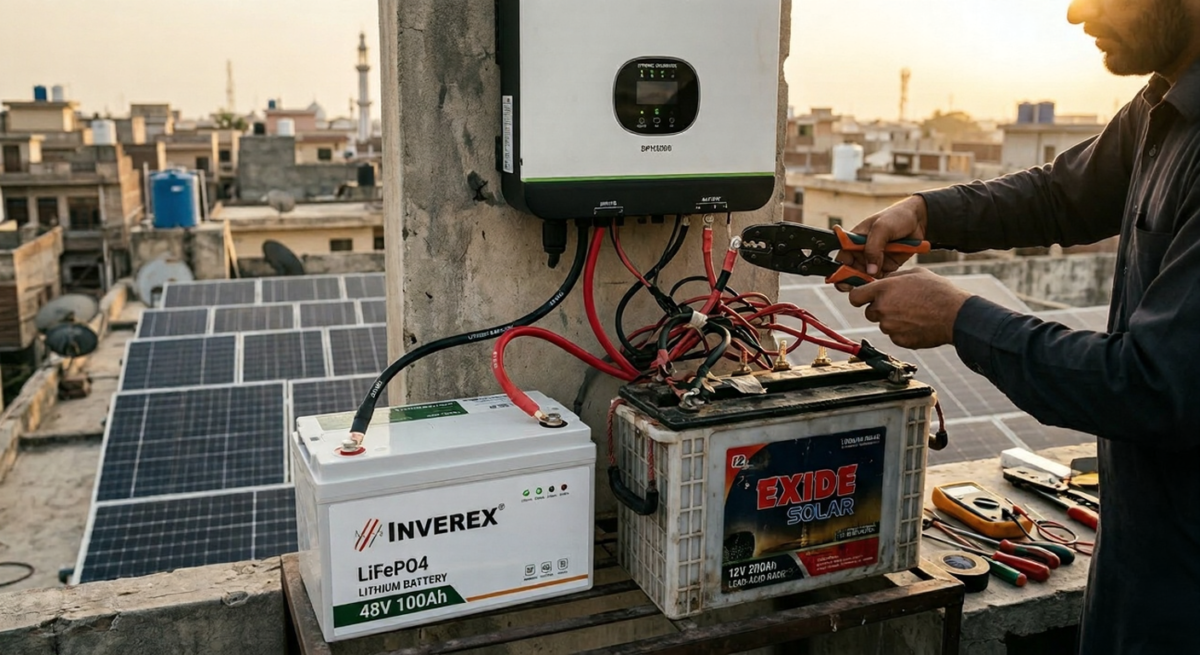
A common situation arises when using modern hybrid inverters with older tubular battery banks. The system may still be charging the battery. However, it does so slowly. The backup time also starts to reduce.
People often think that the battery brand is of poor quality. However, it is possible that the inverter settings simply do not support the battery type.
Another common situation arises when people upgrade from using lead-acid batteries to lithium batteries. However, they do not check their inverters’ compatibility. The inverter still charges the battery. However, it does so in generic mode. This does not allow for proper lithium battery charging.
If you are planning battery storage for your system, it helps to understand how to integrate battery backup with your solar system in Pakistan.
The Main Factors That Determine Inverter Battery Compatibility
Several technical factors determine whether an inverter and battery can work together safely.
1. System Voltage
Voltage is the most important compatibility requirement.
Most residential solar systems operate on:
- 12V battery systems
- 24V battery systems
- 48V battery systems
Modern hybrid solar systems in Pakistan usually operate on 48V battery banks or lithium battery modules.
If the inverter voltage and battery voltage do not match, the inverter cannot charge or discharge the battery correctly. This is one of the most basic rules in solar system design, yet it is often overlooked during installation.
2. Charging Current Limits
Every battery has an optimal charging current rate.
If the inverter supplies too much current, the battery may overheat, and its lifespan may be reduced by as much as 50%. On the other hand, if the charging current is too low, the battery may never be fully charged.
This problem tends to happen when an owner installs an inverter that has a high power rating but has a small battery bank. On paper, it may look okay, but in reality, the battery may be running under constant stress.
3. Battery Chemistry
Battery chemistry also plays a major role in compatibility.
Different batteries require different charging behavior.
Common solar battery types include:
- Lead-acid batteries
- Tubular batteries
- AGM batteries
- Gel batteries
- Lithium batteries
Each type uses a different charging profile and responds differently to deep discharge.
Anyone comparing battery technologies should first understand the lithium vs tubular battery in Pakistan.
4. Communication Support for Lithium Batteries
The latest Lithium Batteries are equipped with a battery management system called a BMS. Hybrid inverters are able to communicate with the battery using communication protocols such as CAN or RS485. The communication with the battery allows the inverter to monitor battery temperature, voltage, and charging limits.
When communication is supported, it is possible to optimize battery charging as well as ensure battery safety. The battery is still able to function without communication support, but it cannot be optimized.
To understand why lithium batteries are becoming popular in modern solar installations, read LiFePO4 battery advantages.
Compatibility Overview of Common Solar Batteries
The table below provides a simplified comparison of how different battery types behave with solar inverters.
|
Battery Type |
Charging Speed |
Depth of Discharge |
Typical Lifespan |
|
Lead Acid |
Slow |
50% |
3-5 years |
|
Tubular |
Slow |
60% |
4-6 years |
|
AGM / Gel |
Medium |
60-70% |
4-7 years |
|
Lithium |
Fast |
80-90% |
10-15 years |
This comparison highlights why lithium batteries require more precise inverter control compared with traditional battery technologies.
How Different Battery Types Behave with Inverters
Lead-acid batteries are old technology, but they are commonly used in backup systems. They are relatively tolerant and can work with many inverters as long as the voltage and charge rates are correct.
Tubular batteries are very popular in Pakistan because they are known and readily available. They work well for many residential backup systems, but they charge slowly and are not tolerant of repeated deep discharge.
Lithium batteries are different. They charge quickly, hold voltage well, and last much longer than lead-acid batteries. However, they require precise charge control from the inverter.
If the inverter settings are not correct, lithium batteries will not provide their expected lifespan or lifespan potential.
A lithium battery connected to an unsupported inverter, while it will run, does not provide the user with the safety, efficiency, or lifespan potential that the lithium battery is capable of.
Common Signs of Poor Inverter Battery Compatibility
Incorrect battery matching often reveals itself through small warning signs that develop over time.
Typical symptoms include:
- The battery becomes unusually warm during charging
- The inverter frequently changes charging modes
- Backup time becomes shorter than expected
- Battery voltage drops quickly under load
- The inverter displays warning messages or communication errors
For example, a homeowner may install a 6kW hybrid inverter and connect it to an aging battery bank. At first, the system appears to work normally. After some weeks, the inverter begins switching modes frequently, and backup performance slowly declines.
In such cases, the inverter is usually not faulty. The battery bank simply cannot support the inverter’s charging and discharge requirements.
Deep Discharge and Battery Lifespan
Many battery failures occur because of repeated deep discharge.
When batteries are regularly drained too deeply, their internal structure begins to degrade. This is particularly damaging for lead-acid and tubular batteries.
That is why homeowners need to understand the battery’s depth of discharge.
A battery may appear strong during the early months of use, but repeated deep discharge can weaken it quickly. Considering the high cost of solar batteries, avoiding deep discharge problems can save significant replacement expenses.
How to Check Inverter and Battery Compatibility Before Buying
The safest approach is to begin by reviewing the inverter datasheet.
Confirm the following specifications:
- Supported battery voltage
- Maximum charging current
- Supported battery chemistry
- Lithium battery communication protocols
Next, review the battery specifications and confirm its voltage rating, recommended charging current, and discharge limits.
Before purchasing any solar equipment, it is also helpful to follow a proper checklist before buying a solar panel inverter from the Pakistani market.
Many homeowners focus only on inverter power rating and ignore battery compatibility completely. This mistake often leads to expensive system problems later.
Practical Guidance for Safer Battery Matching
A practical way of doing this is by selecting the battery type first based on your energy requirements.
If your energy requirements demand a longer life and faster charging, then lithium is the way to go. If your energy requirements demand a battery on a tight budget and require moderate backup, then tubular is the way to go.
Once you have decided on the battery type, select an inverter that supports the battery type.
The last thing worth mentioning is that it is worth understanding that not all inverters are hybrid inverters, and not all inverters support all battery types.
Hybrid inverters are inverters that support multiple sources of energy, such as solar and grid, but that doesn’t mean that it supports all battery types.
If you are planning a dedicated backup system or remote installation, it is also useful to understand off-grid solar system design.
Once the system is installed, homeowners should monitor charging behavior, battery temperature, and backup hours regularly. Compatibility issues rarely appear immediately. They usually develop slowly over time.
Even when compatibility is correct, proper maintenance remains essential. Homeowners should also read about solar battery maintenance to keep battery performance stable.
Final Thoughts on Inverter Compatibility with Batteries
Inverter compatibility with batteries is not a trivial detail, as it has a direct bearing on the safety, efficiency, and lifespan of the solar energy system.
When the inverter is compatible with the batteries, the batteries get a stable charge, the backup works well, and the lifespan of the batteries is maximized. If the compatibility is not considered, however, things tend to go wrong, but the damage is done slowly.
The most important question that a homeowner should ask is not very complicated.
You should not just ask if the batteries can operate with the inverter.
You should ask if the batteries can operate safely, efficiently, and correctly with the inverter.
This is the most important question that a homeowner should ask, as it has the ability to save many solar energy system owners from many common problems with their solar energy systems, save expensive batteries, and ensure that the solar energy system works well for many years.
Independent Power: Connect with Enon Traders Today!
Start your off-grid journey with Pakistan’s most reliable solar partner.
| Connect With Us | Action Link |
| Chat Instantly on WhatsApp | Get an off-grid system quote: Click to Chat Now! |
| Visit Our Website | View our off-grid inverters: Official Website |
| Call Our Experts | Design your custom micro-grid: Contact Page |